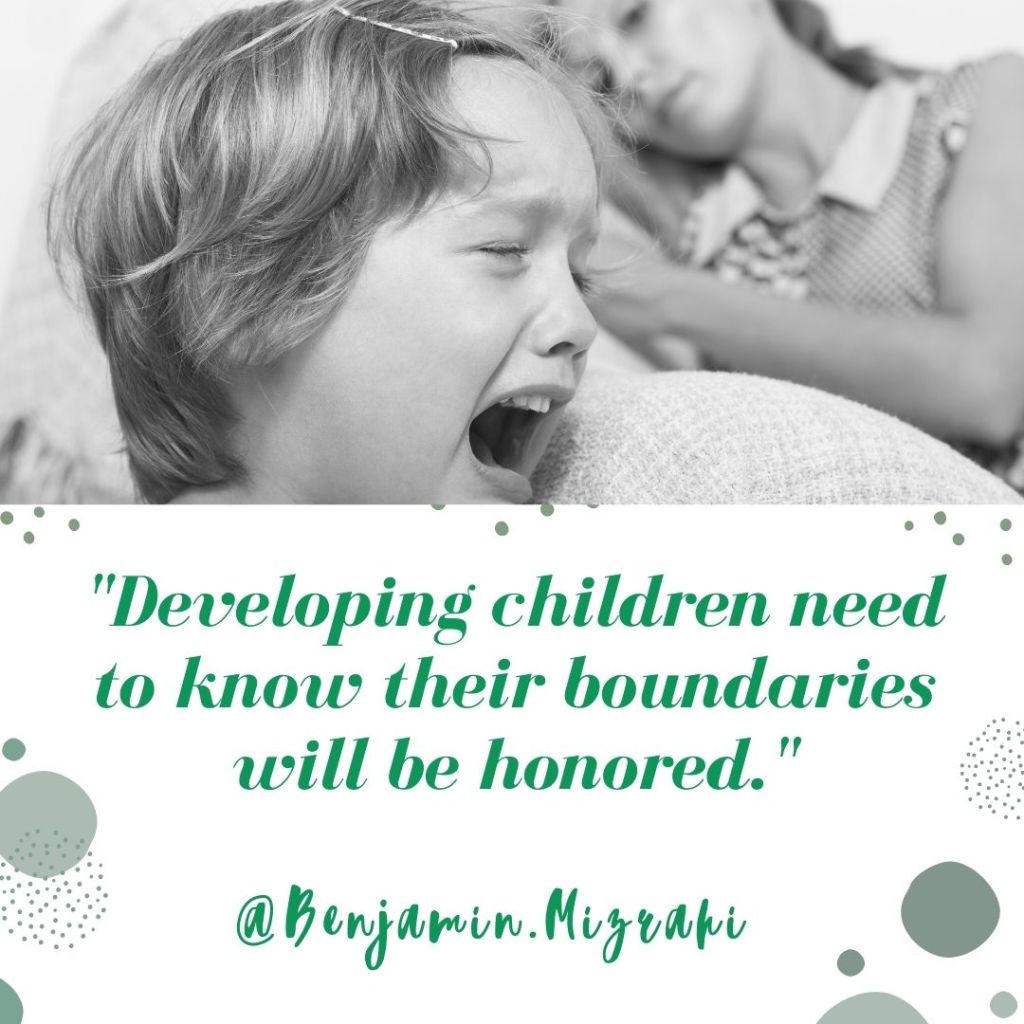
It’s critical that our children know that they can disagree. It’s imperative that they know they can experiment with boundaries without being cutoff. To be clear, when your child misbehaves, it’s okay to be upset; however, it’s not okay to emotionally disconnect. There’s a difference between disconnecting from your child and remaining connected and managing the behavior.
Emotional disconnection is withdrawing without explanation or avoiding your child whereas remaining connected will involve an explanation for what’s happening without becoming hostile, aggressive, or withdrawn. This pulling away and disconnection teaches our children some of their earliest lessons on boundaries. What they learn is that “I am only lovable when I behave.” This child will then learn to fall in line and keep the peace. They will avoid disagreeing to keep the relationship. They may fear that setting boundaries will lead to loss of relationships.
A better approach to this is speaking about the behavior you’re hoping to change or pointing out what you notice. Here are some examples: “I see you’re frustrated, but you still can’t go outside right now.” “When you scream like that it hurts my ears. Lower the volume and I’ll be able to hear you better.” They may persist. What should you do? 1. Hold your own boundary. 2. Tell them they are allowed to continue, but you’ll have to remove yourself (obviously if safe). 3. Show them what it looks like to do this appropriately without yelling or using forceful behavior.
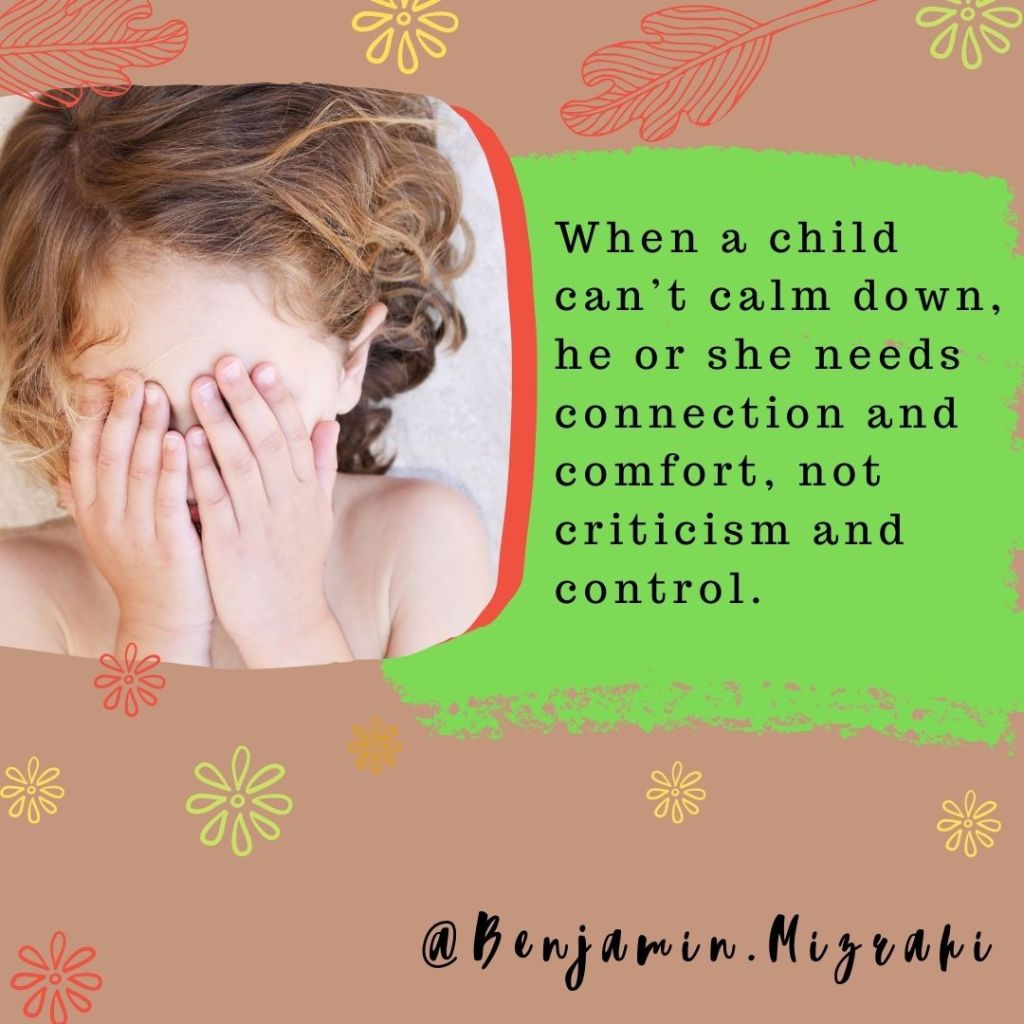
When we invalidate children’s feelings and experiences by minimizing, discrediting, accusing, or rushing them, we teach them to respond to their own feelings—and the feelings of others—the same way. We create in them an inner voice that will continue to discredit both themselves (“it’s not that bad, I shouldn’t feel so sad”) and others (it’s not that bad, YOU shouldn’t feel so sad). Instead of minimizing (“Stop crying, it wasn’t that big a deal”), try connecting (“it sounds like you’re feeling really sad. I’m here with you.”) Instead of discrediting (“I know you’re angry, but you have to stay calm”) try validating (“I hear that you’re too upset to be calm right now. Do you want space or would you like to talk about it?”) ️Instead of accusing (“Your teacher wouldn’t send you to the principal for no reason, you must have been goofing off.”), try empathizing (“To you, what happened at school felt really unfair. I’m listening.”) Instead of rushing (“I don’t want to hear it anymore.”) try empathizing (“Wow, it sounds like this is really hard for you. Would you like me to hold you?”)
When you have a child with ADHD, you may need a different approach to discipline. A few simple changes to your parenting strategies could give your child the tools they need to manage their behavior more effectively.
Kids with ADHD may have trouble sitting still, completing tasks, managing impulses, and following directions. These discipline strategies can be instrumental in helping a child with challenging behaviors to follow the rules.
Provide positive attention – Positive playtime reduces attention-seeking behavior. And it will make your consequences more effective. No matter how difficult their behavior has been, set aside one-on-one time with your child every day. Just 15 minutes of positive attention is one of the simplest, yet most effective, ways to reduce behavior problems.
Give effective instructions – Kids with short attention spans need extra help following directions. Quite often, they don’t hear the instructions in the first place. Ask your child to repeat back to you what they heard to make sure they fully understand.
Praise your child’s effort – Catch your child being good and point it out. Praise motivates children with ADHD to behave, and frequent feedback is important. Make your praise specific. Instead of saying, “Nice job,” say, “Great job putting your dish in the sink right when I asked you to.” Praise your child for following directions, playing quietly, and sitting still and you’ll encourage them to keep it up.
Use Time-Out when necessary – Time-out can be a good way to help kids with ADHD calm their bodies and their brains. Teach your child to go to a quiet spot to calm down when they are overstimulated or frustrated. Create a comfortable area and calmly guide them there, not as punishment, but as a way to soothe themselves. Eventually, your child will learn to go to this place on their own before they get into trouble.
Ignore Mild Misbehaviors – Ignoring mild misbehaviors teaches them that obnoxious behavior won’t get them desired results. Ignore whining, complaining, loud noises, and attempts to interrupt you. Eventually, your child will stop.
Allow for Natural Consequences – Sometimes, allowing for natural consequences makes more sense than trying to convince a child to make a better choice. For example, if your child refuses to take a break from playing to eat lunch, simply put the food away. The natural consequence is that they will likely be hungry later and will have to wait until dinner to eat. Tomorrow, they will be more motivated to eat lunch when it is served.
Establish a Reward System – Establish a few target token-earning behaviors, such as staying at the table during a meal, using gentle touches with a pet, or putting toys away after using them. Then, allow tokens to be exchanged for bigger rewards, like electronics time or a chance to play a favorite game together.
Work With Your Child’s Teacher – When parents work together with a child’s teacher, it increases the chances that a child will be successful in school. Some children need modifications to their schoolwork, such as being allowed extra time on tests, to be successful.
You’ll be doing this every time you acknowledge their strengths, the brave things they do, their effort when they do difficult things; and their tiny shuffles or big leaps towards braveness. ⠀⠀ This isn’t always easy. Their anxiety will trigger ours – when our children feel unsafe, often so will we. So, we have to hang on strong to the truth of it all – that we know they can do this. If you feel yourself believing in their anxiety more than their braveness, remind yourself that they will believe in themselves when you do. Then, breathe, find calm and let your courage lead theirs.
Whether you’re a stay at home or a working parent, not providing our children with “everything they need” can immediately put us in a state of guilt. We see images on social media of people taking big vacations, taking their kids to see the latest show, enrolling in three different lessons, or buying the best baby swing and we question whether or not our child is missing out by not having all of the extras. While vacations are wonderful and lessons are great, our children do not need much apart from a safe and nurturing relationship during those early years of life. They may remember going to Disneyworld and getting to meet Elsa or Mr. Incredible but when they grow up and someone asks them, what was it like growing up with your parents?
We hope that they’ll say,
I remember my mom sitting with me in the playroom building blocks, then after we used up all the blocks, we’d pretend we were bulldozers and knock down the tower. We’d roll on the floor laughing and hugging. I remember waking up each Sunday morning and making pancakes with my dad. He’d let me mix all the ingredients and then I’d sit on the counter and watch him flip the pancakes. Building a relationship with your children comes in the everyday ordinary moments. The moments when you make small gestures to connect with your children and let them know that they are special and loved.
Many children have difficulty regulating their emotions. Tantrums, outbursts, whining, defiance, fighting: these are all behaviors you see when kids experience powerful feelings they can’t control. Parents can start by helping children understand how their emotions work. Kids don’t go from calm to sobbing on the floor in an instant. That emotion builds over time, like a wave. Kids can learn control by noticing and labeling their feelings earlier, before the wave gets too big to handle.
Here are the 5 tips to help children calm down:
Validate their feelings. Validation is a powerful tool for helping kids calm down by communicating that you understand and accept what they’re feeling.
Paying positive attention. The most powerful tool parents have in influencing behavior is attention. When you’re shaping a new behavior, you want to praise it and give a lot of attention to it.
Clear expectations. Another key way to help prevent kids from getting dysregulated is to make your expectations clear and follow consistent routines.
Give options. When kids are asked to do things, they’re not likely to feel enthusiastic about it, giving them options may reduce outbursts and increase compliance. For instance: “You can either come with me food shopping or you can go with Dad to pick up your sister.” Or: “You can get ready for bed now and we can read a story together — or you can get ready for bed in 10 minutes and no story.”
Five special minutes a day. Even a small amount of time set aside reliably, every day, for mom or dad to do something chosen by a child can help that child manage stress at other points in the day. It’s a time for positive connection, without parental commands, ignoring any minor misbehavior, just attending to your child and letting her be in charge. It can help a child who’s having a tough time in school, for instance, to know she can look forward to that special time. “These five minutes of parental attention should not be contingent on good behavior,”. It’s a time, no matter what happened that day, to reinforce that ‘I love you no matter what.’
Every child is different. Children develop differently, have different personalities, possess different strengths and require different kinds of support to meet their individual needs. While their developmental pathways may differ, most pass a set of predictable milestones along the way. It is normal for children to experience developmental spurts and slow spots in different areas of their development over time. If your child is a little ahead or a little behind at a certain age – this is normal. Most of the time, given the right nurturing and stimulation, all children will catch up in the end.
All children have different strengths and vulnerabilities. Some are good at sport, others in music. Some are very academic and others are not. Some are highly anxious and others are more relaxed. Some children are good sleepers and others wake up through the night for years.
The task of parenting is a constantly changing one as the growing needs and abilities of our children change over time. There is no ‘one-size fits all’ way to parent. What works for one child may not work for another. What worked when children were two years old may not work when they are four.
Adaptability and flexibility are key ingredients to parenting.
One of the most encouraging things parents can do for their children is to spend regular, scheduled special time with them. You may already spend lots of time with your children. However, there is a difference between have to time, casual time, and scheduled special time.
There are several reasons why special time is so encouraging:
Children feel a sense of connection when they can count on a special time with you. They feel that they are important to you. This decreases their need to misbehave as a mistaken way to find belonging and significance.
Scheduled special time is a reminder to you about why you had children in the first place—to enjoy them.
When you are busy and your children want your attention, it is easier for them to accept that you don’t have time when you say, “Honey, I can’t right now, but I sure am looking forward to our special time at 4:30.”
Plan the special time with your children. Brainstorm a list of things you would like to do together during your special time. When first brainstorming your list, don’t evaluate or eliminate. Later you can look at your list together and categorize. If some things cost too much money, put them on a list of things to save money for. If the list contains things that take longer than the 10 to 30 minutes you have scheduled for the special time, put these items on a list that can be put on a calendar for longer family fun times.
NO ONE is born a parent; we all learn as we go. We are forever learning and adjusting. When we learn and know better, we do better.
Here are some commitments that will make you a better parent:
1. Commit to taking care of yourself and staying centered.
Commit to taking care of yourself and staying centered so you can be the happy, patient, encouraging parent your child deserves.
2. Commit to staying connected.
Separation happens. That’s why we have to repeatedly reconnect. Remember that quality time is about connection, not teaching, so it’s mostly unstructured. Hug your child first thing every morning and when you say goodbye. When you’re reunited later in the day, spend fifteen minutes solely focused on your child.
4. Commit to role modeling respect.
Want to raise kids who are considerate and respectful, right through the teen years? Take a deep breath, and speak to them respectfully. Not always easy when you’re angry, so remember the cardinal rules of managing your emotions with kids: You’re the role model, don’t take it personally, and this too shall pass!
5. Commit to looking for the needs behind your child’s behavior.
Your kid has a reason for whatever he’s doing that displeases you. It might not be what you consider a good reason, but it’s what’s motivating his behavior. If yelling at him about his behavior was going to change it, that would have worked already. Only by addressing the underlying need do we change a person’s behavior. Parents who address kids’ need pre-emptively by noticing problem areas (“Hmm…. looks like she wants to choose her own clothes, even if they don’t match!”) are rewarded with kids who cooperate.
6. Commit to guidance rather than punishment.
Kids only behave to please us. When we constantly criticize and discipline, they harden their hearts to us. Parents who lead by a loving example, address needs rather than focusing on misbehavior, redirect pre-emptively rather than punish.
7. Commit to remembering what’s important and an attitude of gratitude.
Stay positive and choose your battles. Every negative interaction with your child uses up valuable of the relationship capital. Focus on what matters.
How can you teach your kids to be respectful? Both respectful to you and to other kids and adults?
The answer is that YOU have to model the respect.
You can make a few simple tweaks to the way you interact with your children that will ENCOURAGE a mutually respectful relationship.
When you make an intentional effort to model a respectful attitude for your children, they are more likely to mimic it. The idea is that children deserve to be treated with respect and dignity.
Here are Effective Ways to Teach Kids Respect:
1. Stay calm and don’t overreact when you “think” your child is being disrespectful
To teach respect, first, we need to stay calm and stay in control. Identify if this is a real “disrespect” situation, a misunderstanding or simply because the child hasn’t learned the proper response in such situation.
2. Identify the cause for disrespect and focus on teaching problem-solving alternatives
When genuinely being disrespected, we should pay attention to the circumstance instead of going off on the child, “You are being disrespectful!”
Ask your child why he or she is acting that way.
3. Model how to be respectful by respecting your kids first
What better way to teach a behavior than modeling the behavior you want to teach? Show them how to respect by respecting them. Just treat your child as a person in the same way you treat other grownups.
When children’s differences are accepted, they feel heard and respected. They see first-hand how to treat others who have different opinions. They learn that they should respect people despite their differences. This understanding and tolerance for differences will become especially important when the teenage years come.
4. Use kind and firm discipline to teach, not to punish
Discipline means to teach or to train, not to punish. It doesn’t have to be punitive. In fact, studies have shown that positive discipline is a lot more effective and longer-lasting than punitive strategies.
If we discipline using a menacing or stern tone when our kids have done something wrong, we are showing them how to be cruel and harsh to those who make mistakes.
5. Give respect to earn respect
Parenting is one of the hardest jobs in the world. Parents spend so much effort, time and money to care for their little ones. Their entire lives changed and started to revolve around their children the moment they were born. It is only natural that we expect kids to respect their parents.
But little children don’t understand all this. And to be fair, they didn’t ask us to do all this! We ourselves decided to take on these responsibilities.
Staying calm means when our kids don’t listen, we walk away before we start yelling. It means we take a breath and count to ten before responding.
It means we choose not to fight fire with fire. Keeping calm cools our heads while allowing us to parent intentionally and strategically. Instead of driving ourselves nuts reminding and nagging our kids to get their work done, we can use THESE Parenting strategies
1. Change the way you view your child’s behavior.
The way you view your child’s behavior will influence the effect it has on you. Understanding child development can help you to see your child’s behavior in a less negative light.
Parents often say “he’s winding me up” or “she knows how to press my buttons”. If you believe your child is deliberately seeking to upset you, then their behavior is bound to infuriate you!
Let go of the idea that your infant or toddler is scheming about how to drive you crazy; this kind of manipulation is developmentally impossible as it requires a child to be able to understand that other people have beliefs and intentions different from his or her own – in developmental psychology this is called “theory of mind”.
This relatively advanced type of thought process does not develop until around age three or four years.
Try to view your toddler for what he is; a little person enjoying his new found ability to move around and explore, with huge curiosity, the fascinating world around him. Remember that the little person causing such havoc simply can’t understand that his actions affect other people, has not developed the ability for self-control so will act on impulse. He also has no sense of time, so will just not be able to wait.
If you have an older child whom you feel is deliberately winding you up, try to look at why he or she may be behaving like this. Perhaps that child has learnt that pushing you to the edge is the only way to get what he or she wants? Make sure your child gets attention for all the positive behaviors you want to see more of.
2. Reduce stressful moments
If you can reduce the chances of melt-downs, tension and conflict in the first place there will be fewer chances of you reaching explosion point. Be aware that children will readily absorb the emotional climate around them; if you’re wound up they will be too.
Use clear, brief, simple commands and keep your tone polite, calm but firm. Children will pick up on any hints of stress, wavering or anger in your voice and this may make them more agitated or more persistent.
Avoid sarcasm (“Great, I just love clearing up your mess!”), threats (“If you don’t hurry up, I’ll go without you”), labelling (“you’re so selfish”) or criticism (“you’re taking forever, you’re always lazy”) when speaking to your child. In the short term these kinds of comments will upset and provoke your child and in the long term they may cause a damaging erosion of his or her self-esteem.
Parents are often aware of the importance of praising good behavior, but feel resentful about dishing out compliments to the little terror who’s causing so much grief. Set yourself small goals e.g. initially aim to praise just four good things a day, then gradually increase this. The more you praise, the more good behavior you’ll see so this should be fairly easy!
Agree on a set of house rules and consequences – write these down and post them somewhere obvious. If you have a pre-agreed plan, your children know where they stand, and you’re less likely to react hastily in the heat of the moment.
Set aside weekly relaxation time – this is not a luxury for you but a necessity. This may be a massage, a nice walk, listening to music or just a relaxing bath. Set up a babysitting circle with a group of friends if you are struggling with childcare.
3. How to cope if close to snapping
Reacting in anger often leads to rash decisions and sometimes aggressive responses such as shouting, smacking or hastily imposing extreme discipline. The result is that you’re left feeling guilty and your child is left feeling upset and anxious. It’s fine to feel angry but it’s important to not let it control you.
Tune into your body and learn to recognize early warning signs that you’re getting annoyed such as heart racing, feeling shaky or getting sweaty.
Whenever you notice your body’s angry warning signs kicking in, stop what you are doing and try to look objectively at what has wound you up. This will help you to feel more in control.
State your feelings, without attacking. Use ‘when…then’: “When you call me names, I get upset”.
Now is not a good time to get into a debate. Show willingness to resolve things but just not now – “We can talk about this tomorrow over breakfast, but right now I’m feeling too wound up”.
If your child is safe, take time out, saying “I need some time to cool down”. Remove yourself from the situation.
Take deep breaths; in through your nose and out through your mouth, trying to slow your breath as much as possible.
Try clenching your hands tightly as you breathe in then releasing them as you breathe out. This will turn down your body’s fight-flight response and will make you feel calmer.
If it’s hard to leave your child, use distraction techniques (counting, reciting song lyrics or a poem in your head) to stop yourself from reacting rashly. Use positive self-talk – say to yourself “I’m doing the best I can” or “Keep calm!”
Displace your anger by whatever means works for you – vacuuming, singing along to a favorite song, doing exercise.
Some parents find it useful to keep a journal to jot down how they feel after angry outbursts. This is a useful way to vent your emotion and also may be helpful in revealing any recurrent patterns in you and your child’s behaviors.
If you find you are regularly losing control of your anger and it feels like nothing is helping, you may benefit from seeking some professional support and advice.
From the moment that our children come into our lives, we know that it’s our responsibility to guide and teach them. As newly formed little humans, they have a lot to discover and learn. And as their parents, we are the tour guides who help them figure out this world.
But, as their parents, we are so busy rearing, educating, and helping them to navigate the world that we often don’t realize that they are teaching us. So, what do they teach us?
10 Important Life Lessons Children Teach Us:
To Be Curious: Children ask questions, peek into cupboards, and push buttons. It’s important as adults to remember that being inquisitive is how we learn. And there is always more to learn.
To Find Joy in the Simple Pleasures: A perfectly timed burp. Sliding down a water slide. Children appreciate the simple pleasures because they don’t have unrealistic expectations. They understand that joy can be found anywhere. As adults, we must remember to keep seeking the simple pleasures.
To Accept: Children don’t judge. They don’t see color, faults or flaws; they see the potential for a new friend. Tolerance is a lesson none of us should forget.
To Express Our Emotions: Children scream when they’re mad. Squeal when they’re happy. Wail when they’re sad. As adults, it’s good to remember that it’s much better for our soul to let it out than to keep it bottled in.
To Live in the Moment: Children never stop playing cars because they must meet their self-imposed deadline to color. Instead little ones stay present when they feel joy. So, sip your coffee—the laundry can wait an hour. Live in the now, it makes life more enjoyable.
To Be Passionate: A craft, a car, or a dollhouse can keep a child entertained, enthralled and busy for hours or even days. When a child discovers a new activity, he or she embraces it with love and excitement. Children put their whole selves into the endeavor. As adults, we need to remember to not temper our passion but rather embrace it—it’s how greatness is achieved.
To Savor the Sweet Moments: Playing in the bath, tumbling across the floor or nestling in our arms are just a few of the sweet moments children never rush. They don’t stop or pull away to sweep, or take a call. Their pure delight living in the moment teaches us that now are the good old days.
To Not Limit Ourselves: A firefighter, the president, a space cowboy. Children believe they can be anything because they don’t limit themselves. It’s not their perceived flaws and shortcomings that dictate their dreams but rather their interests and passions. So, the next time you think you can’t, remember that you can.
To Be Fearless: Children jump, climb, and tumble. They taste, try, and run headlong into new experiences. It’s a good reminder to adults that being bold and daring makes for the best memories and a much more interesting life.
To Indulge, Savor and Enjoy: Children don’t scarf down their food. They don’t turn away dessert. They welcome and enjoy the things and moments that bring them joy. Adults should always bear in mind that indulging in and savoring the sweet things in life is what makes life sweet.











 EXECUTIVE FUNCTIONS COACHING