Teach Kids Important Life Values 

Values are very important in parenting since they deeply influence all behaviors and attitudes and effect our decisions and relationships. Understanding the concept of values and the importance of teaching them gives parents a powerful way to influence their children and to shield them from the adverse forces they may encounter in the outside world. 

Teach your kids about the following universal values: 
 
1. Kindness and compassion 

Be sure to show your child that you notice when someone does something nice. Likewise, if your own child treats someone nicely, be sure to acknowledge and praise her effort.   

 
2. Honesty and trustworthiness 

If you wish to teach your children not to lie, you need to make sure they know the consequences of their actions and punish the undesirable behavior. Also emphasize that we want to earn the trust of others, which comes through acting genuinely and in ways that do not let others down. 
 
3. Respect 

It’s true that respect is earned, but you should also teach children to maintain a basic respect for living things in general, a type of courtesy we extend towards others under any circumstance.  

 
4. Integrity 

Integrity means I can be counted on to fulfill a commitment I made to the best of my ability. It also means I can admit when I’ve overcommitted and can make amends for how it affects other people. Repeatedly following through with your own commitments to your kids shows them first-hand. 

5. Love 

Let your child see you demonstrate your love and affection for the people in your life. The more you say “I love you” to your child, the more your child will say “I love you” back.  

Coach Benjamin Mizrahi. Educator. Learning Specialist. Family Coach. Father. Husband.   

More articles on www.MrMizrahi.blog 
Dealing With Power Struggles

Power struggles are inevitable. They spring from what looks like competing interests of loving people at very different ages and stages. The fact that you and your child get into power struggles means that you and your child are each doing the most appropriate thing you can think of. Your job is to be the parent, keeping life safe and somewhat ordered. Your child’s job is to keep from feeling helpless in the face of so many decisions that are out of her hands. 

Take a moment to consider your relationship with your kids. Remember that you can influence your child positively, but mostly only when they feel the connection with you. Here are some tips when dealing with power struggles:  

  • Don’t take it personally. Remember that your child’s efforts to try and control situations stems from a healthy impulse to want to meet his/her needs.  
  • Identify areas where you can appropriately empower your child. 
  • Give them age-appropriate responsibilities, this conveys your confidence in their capabilities, which will empower your child. 
  • Respect their opinions. Listen. Often the very experience of being heard can calm a child and make them feel supported. Even if what your child is suggesting isn’t appropriate at the time, having the freedom to share is validating. 

Coach Benjamin Mizrahi. Educator. Learning Specialist. Family Coach. Father. Husband.   

More articles on www.MrMizrahi.blog 
Healthy Parenting Tips

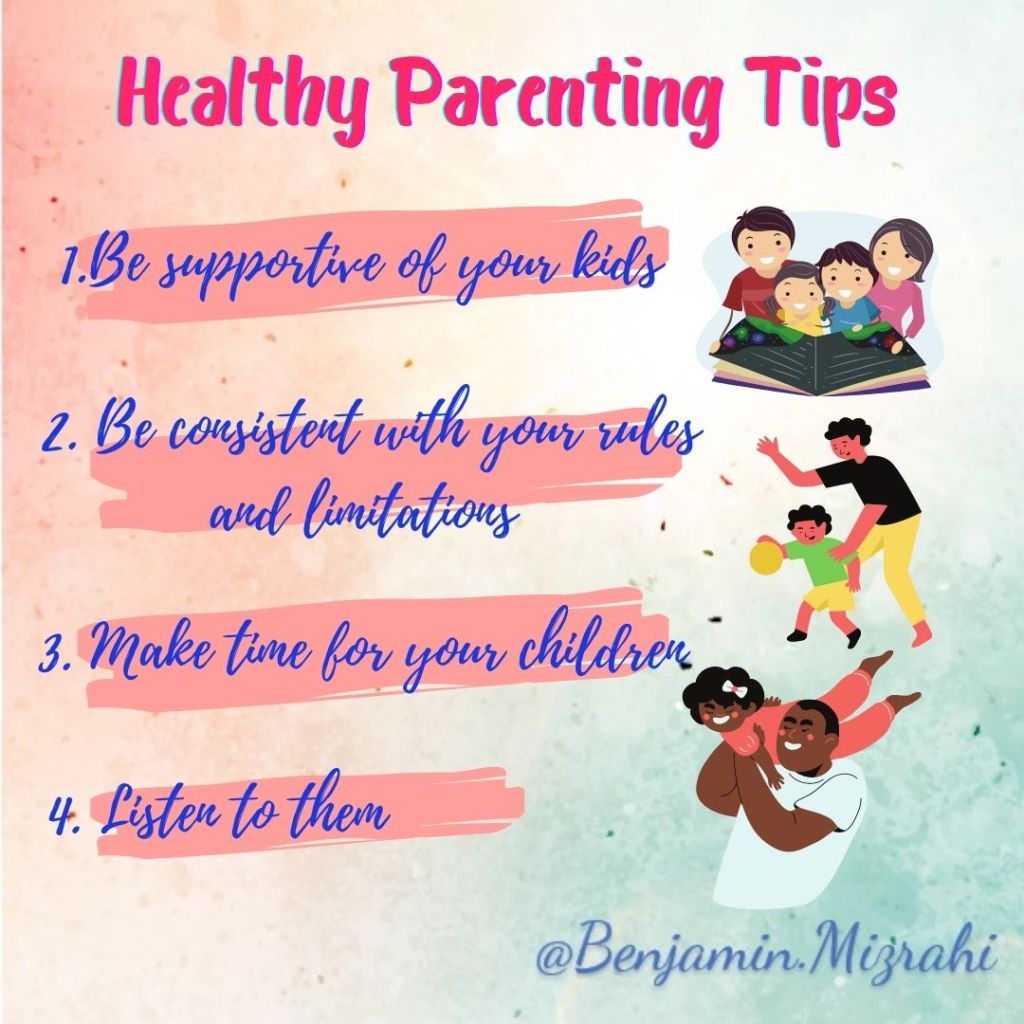
  1. Be supportive of your kids 

It is important for a child to find their sense of self at their age. Their childhood is a crucial point in their life in which they discover their wants, aspirations, ambitions, their identity. Allow them to explore their interests and hobbies, give them praise for their achievements no matter how small, raise them to become strong and independent yet compassionate. Do not be controlling of every single aspect of their lives for it will only make them feel as if they have no control of it or grow to become heavily dependent. Parents should be the guiding wind, instead of a governing river. 

  1. Be consistent with your rules and limitations 

Kids can… get tough at times, even more so if they perceive the house rules as “open to interpretation”.  Discipline is an important aspect of child-rearing, and so with consistent rules and their corresponding consequences, they may learn to be held accountable for their actions.  

  1. Make time for your children 

As parents, you will most likely desire a wealthy life for your children to grow up comfortably, and truly that is the goal of which parents shed blood, sweat and tears for. However, do not brush off the most valuable possession of yours that cannot be bought by any currency, that is a fraction of your time. Not only will this help your child to grow up with the attention and affirmation they need, but you’ll also be able to see where your child needs most support. 

  1. Listen to them 

Oftentimes talking to parents can be like conversing with a wall, stubborn and unmoving.  Don’t always resort to authority when your child questions the rationale behind your judgement. Be reasonable and allow them to give their insights regarding certain issues and beliefs. This will help your child to be articulate, and by doing so they tend to rebel less because they will see you as a guiding figure, and not an authoritative one. 

Coach Benjamin Mizrahi. Educator. Learning Specialist. Family Coach. Father. Husband.   

More articles on www.MrMizrahi.blog  

6 Ways to Show Faith in Your Child

Understanding Dyslexia

Dyslexia is a learning disorder that makes reading and decoding letters and words difficult for those affected by it. It is important to understand that dyslexia is not a disorder of the eyes, but rather on how the mind interprets what the eyes see. Dyslexics have different variations in their perception of words and letters, but some may: 
 

  • See letters backwards or upside down 
  • See text jumping around the page 
  • Have difficulty differentiating letters that have similar shapes such as o, e, c 
  • Have difficulty differentiating letters of different orientations such as b,q,p, and d 
  • Feel dizzy after trying to read  
  • Be able to read but unable to sound them out  

Some dyslexics might have these perception disorders, but some may have none and yet still be dyslexic. It all comes down to how the brain interprets these codes wherein the essence of dyslexia is anchored upon. Either way, it is important to recognize the symptoms early on, so that dyslexic children may be given the help they need. Symptoms become more prominent as the child gets older, such as: 

Before School 

  • Talking late 
  • Learning new words slowly 
  • Difficulty in forming new words; jumbling the sounds of a word or reversing its pronunciation 
  • Difficulty learning nursery rhymes 
     

School Age 

  • Reading ability is well below what is expected of their age 
  • Difficulty processing what they see or hear 
  • Difficulty formulating answers or right words to questions 
  • Unable to differentiate similar letters  
  • Difficulty in spelling 
  • Deliberate avoidance of tasks that involve words and letters 

Teens and Adults 

  • Difficulty reading  
  • Slow and tedious reading and writing 
  • Trouble in spelling  
  • Avoidance of activities that involve reading and writing 
  • Mispronouncing names or words 
  • Trouble understanding jokes or expressions that have allude to a different meaning such as idioms or metaphors 

It is never too late to seek help when one is suffering from dyslexia. We must remove the stigma that surrounds “slow” individuals and instead help them develop at their own pace, and to give help when they need it the most. However, let us not forget that the goal of helping or seeking medical help is for them to become independent. Babysitting such individuals will only make them reliant on others for a disorder that will last their lifetime. 


Coach Benjamin Mizrahi. Educator. Learning Specialist. Family Coach. Father. Husband.   

More articles on www.MrMizrahi.blog  
6 Ways to Show Faith in Your Child

Importance of Praise and Encouragement

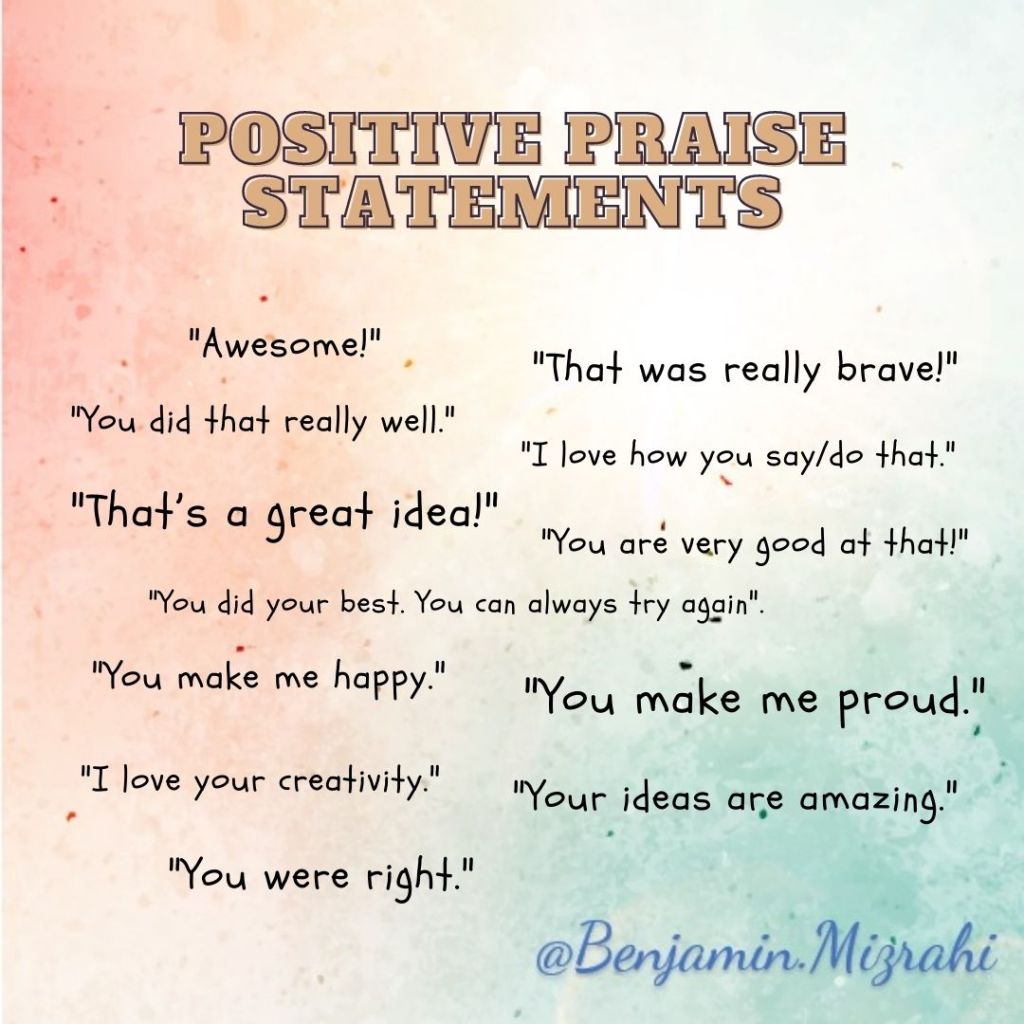
Praise and encouragement help parents to be more positive, it reduces conflict, promotes cooperation and reduces the likelihood that young people will engage in risky behavior. A compliment, a gesture, a facial expression, a simple hug, or a high-five can generate self-worth and pride in children.  

As children grow older, gaining approval from a parent or guardian becomes very important in their lives. Here are the benefits for children if they receive praise and encouragement: 

• Children learn who they are and the things that they do are pleasing to their parents and caregivers. 

• Children develop a personal sense of self-worth and self-esteem. 

• Children who believe they have self-worth go on to treat themselves and others positively. 

• Children with positive self-worth tend to get better grades in school, do not get discouraged easily, and have more productive lives overall.  

• Giving compliments strengthen your bond with them and enhance your relationship. 

Make your own positive phrases by saying what you feel in your heart each time your child makes you proud. You can adapt your praises depending upon the age of your child and their own level of understanding. 

Even if your child does something badly, always try to look for the positives in any situation. There is nearly always a bright side to focus on, and children and parents alike will all benefit from taking the positives, rather than the negatives, from any situation. 

Coach Benjamin Mizrahi. Educator. Learning Specialist. Family Coach. Father. Husband.   

More articles on www.MrMizrahi.blog 
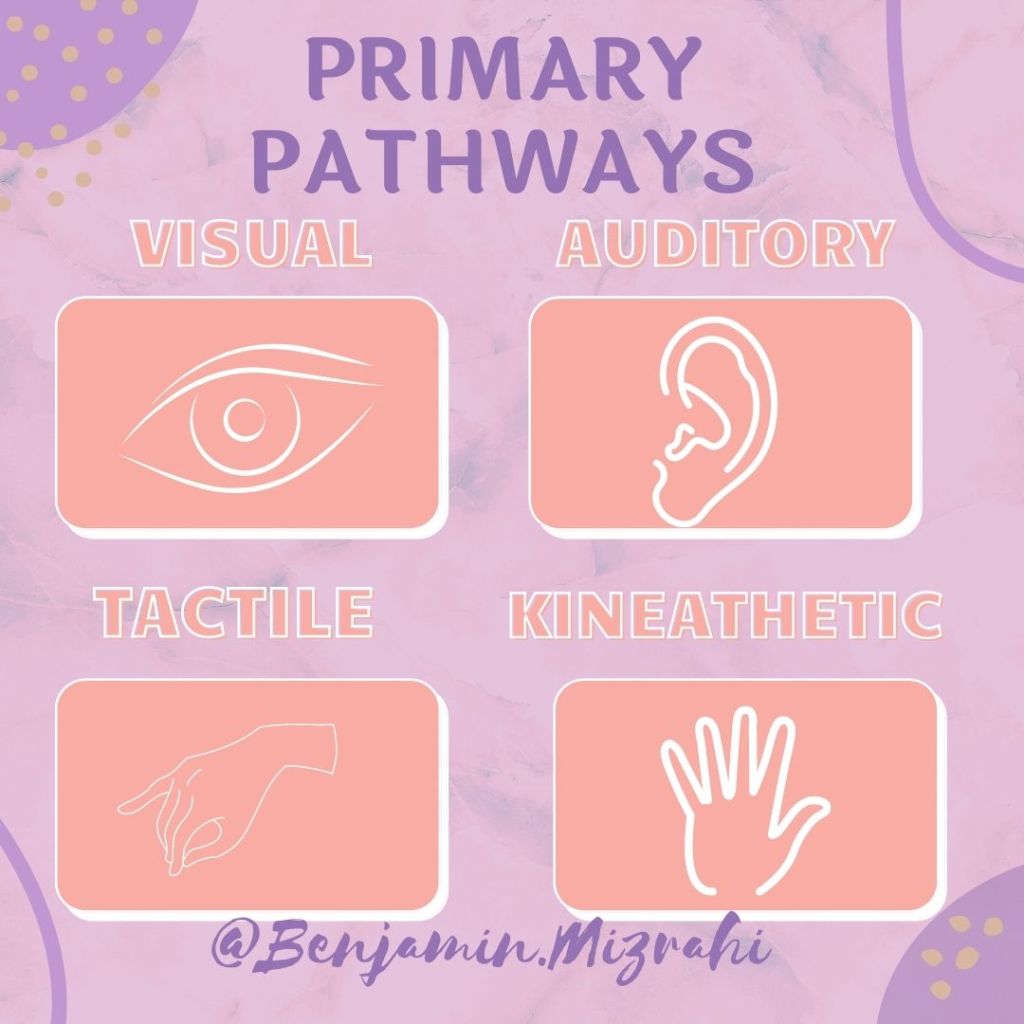
Primary Pathways

Each child has their own strengths and weaknesses in learning. Thus, it is important to be diverse in our method of teaching and understand how they learn best. 

Here are the four primary pathways of information gathered by the senses: 

Auditory – Learning through hearing, or more accurately, listening. Auditory learners not only learn through listening but can better understand if they are able to read the material aloud themselves.  

Visual – Gathering information through the sense of sight. Visual learners tend to visualize concepts or equations in their minds because it is how they understand best. Charts, graphs, and other visual aids are beneficial to visual learners because they can pick up patterns and images better. 

Tactile – The use of hands or sense of touch in general for learning. Tactile learners find meaning through the manipulation of objects which represent certain concepts, such as the use of counting chips in math. 

Kinesthetic – Learning through movement. Kinesthetic learners often project what they are thinking such as counting numbers using several different limbs or methods, perhaps mimicking the teacher to better understand what is being taught.  

 Coach Benjamin Mizrahi. Educator. Learning Specialist. Family Coach. Father. Husband.   

More articles on www.MrMizrahi.blog  
Dealing With Sibling Rivalry

How many times have you had to play referee between your kids? If you can’t stand to stay out of your children’s fights and decide to become involved, the most effective way is to put your children in the same boat. This method makes sure there is no accidental favoritism that can erode the sibling relationship.  It honors the fact that in any conflict, both parties can influence the outcome. 

 
Since fighting requires both children to keep the situation hostile and unresolved, both should experience the same discipline for their disruptive antics, regardless of who started it, who had it first, or who owns it.  None of those matters!  If fighting erupts and doesn’t resolve itself, and you feel you must step in, try these several approaches that can help resolve conflicts: 

️☑️ Instead of intervening in every argument, talk your children through how they can stand up for themselves and try to resolve the issue before reporting to you. 

☑️ Insist that everyone take a break to calm down when arguments get heated. 

️☑️ Set hard rules against name calling, profanity, and bringing up the past. 
 
☑️Instead of using individual names, say: “You two.” 

️☑️ Minimize comparisons. Whether comparisons are positive or negative, they have the same unintended effect on your children. 
 
☑️Give a choice: “Would you two like to go to the Peace Table, use the Wheel of Choice, or take some Positive Time Out?” 
 
☑️Show faith: “Let me know when you two have brainstormed ideas and have a solution you both feel good about trying.” 

Coach Benjamin Mizrahi. Educator. Learning Specialist. Family Coach. Father. Husband.   

More articles on www.MrMizrahi.blog  
Tips to Cope with Dyslexia

We should give our kids the confidence to be able to think that nothing is unattainable if they learn the skills that they need in order to succeed. 

Here are some tips to cope with dyslexia: 

1.“Read, read, and read some more!” –  Through good reading practice many kids overcome the immediate challenges of dyslexia. Good reading practices must go together with remediation (e.g. Swords & Stationery’s specialist tuition program), for best results. 

2.Be positive and encouraging towards your child – Dyslexic learners need plenty of positivity and encouragement from friends and family members. Let them know that the people around them are not giving up on them—this is an important factor in keeping them motivated to learn. 

3.Finding the right people and resources to help – It’s important to get in touch with people who can help your child. Finding the right people to help is crucial to your child’s success. There are many specialists in who can help your child depending on his/her needs, whether he/she has dyslexia, ADHD, or Autism Spectrum Disorders. These are learning challenges that can be circumvented and/or conditioned by experts and experienced professionals in the field. 

Coach Benjamin Mizrahi. Educator. Learning Specialist. Family Coach. Father. Husband.   

More articles on www.MrMizrahi.blog  

Ten Ways to Help Children & Teens Learn from Mistakes

  1. Acknowledge that you don’t expect them to be perfect. 
  1. Let them know your love is unconditional regardless of their mistakes or lapses in judgment. 
  1. Don’t rescue kids from their mistakes. Instead, focus on the solutions. 
  1. Provide examples of your own mistakes, the consequences, and how you learned from them.  
  1. Encourage children to take responsibility for their mistakes and not blame others. 
  1. Avoid pointing out your child’s past mistakes. Instead, focus on the one at hand. 
  1. Praise children for their ability to admit their mistakes. 
  1. Praise children for their effort and courage to overcome setbacks . 
  1. Mentor your child on how to apologize when their mistakes have hurt others. 
  1. Help kids look at the good side of getting things wrong! 

Attention Seeking Behavior is Connection Seeking Behavior

Dealing with attention seeking can be challenging. Most children gain attention in school or at home in normal, positive ways. However, some children feel that misbehaving is their best way to get your attention – as any attention is better than being ignored.  

When a child appears to be attention seeking what they are doing is seeking a connection and validation. When viewed as behaviors that express a child’s need to belong, parents are better equipped to deal with these behaviors positively. 

Connection seeking stems from a child’s need to remind you that they exist. In their world they feel they need and deserve more attention than they have been receiving. Renaming from attention seeking to connection seeking allows us to analyze the behavior in a more positive perspective. Provides the opportunity for us to reflect on the reason behind the child’s feeling of need to seek out the connection, love or validation. 

Schedule special time with your child like you would with any other commitment. Connection seeking behaviors, wanted and unwanted, are part of parenting. Let’s manage it in a peaceful and positive way, without punishment. 

Coach Benjamin Mizrahi. Educator. Learning Specialist. Family Coach. Father. Husband.   

More articles on www.MrMizrahi.blog  

The Importance of Reading

Early reading ignites creativity, sparks curiosity, and stimulates the imagination in young children. Often, this leads to role-play as children grow, which helps to develop other skills such as empathy, problem-solving, and morality. 
 
Think about reading. Even an elementary age child with a relatively simple book must keep in mind a group of characters, the setting, and past actions. Reading helps to strengthen memory retention skills. That’s a powerful tool for young students – and older adults, as well. 
 
Reading books aloud to children stimulates their imagination and expands their understanding of the world. It helps them develop language and listening skills and prepares them to understand the written word. Even after children learn to read by themselves, it’s still important for you to read aloud together. 
 
Research shows that regular reading: 
✅improves brain connectivity. 
✅increases vocabulary. 
✅reduces stress. 
✅lowers blood pressure and heart rate. 
✅prevents cognitive decline. 

Coach Benjamin Mizrahi. Educator. Learning Specialist. Family Coach. Father. Husband.   

More articles on EXECUTIVE FUNCTIONS COACHING (mrmizrahi.com)

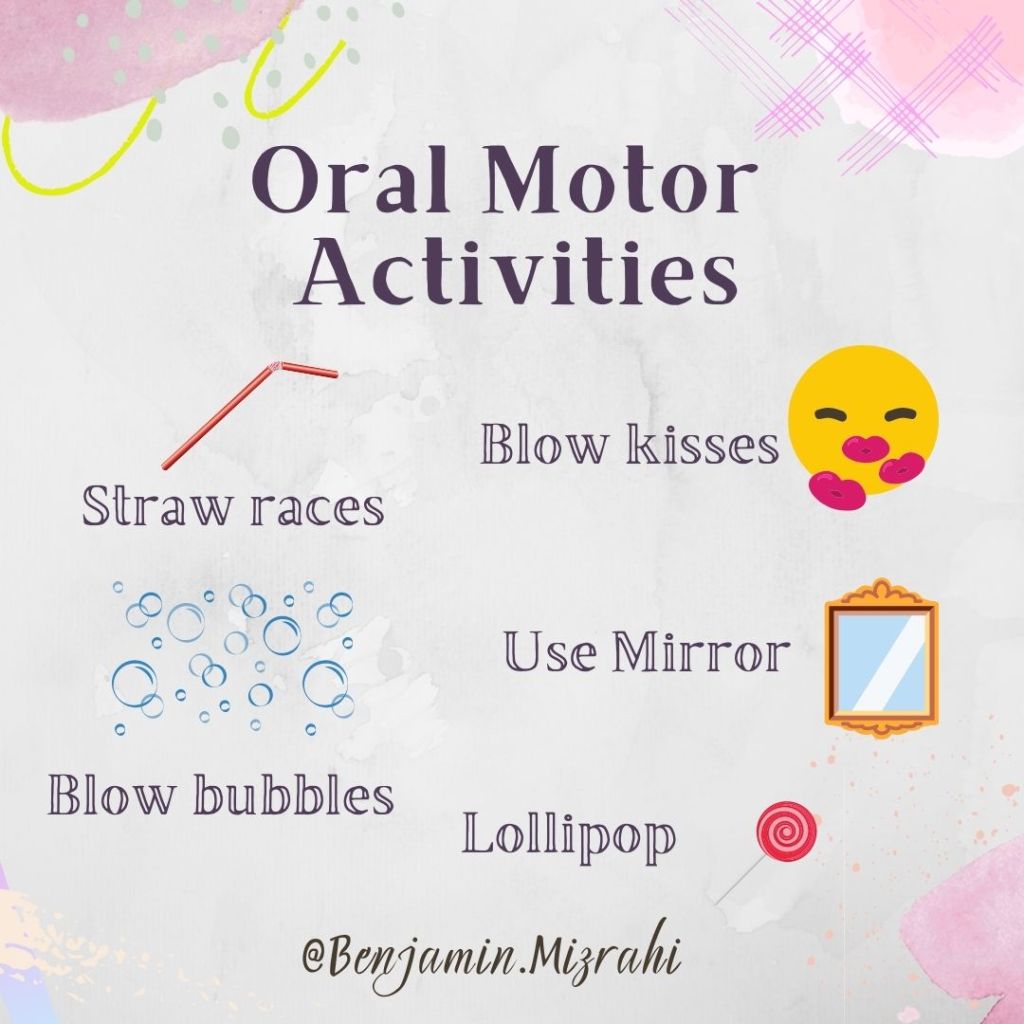
ORAL MOTOR ACTIVITIES

STRAW RACES – have your child pick out a Pom Pom color then have their partner, or you pick out a different Pom Pom color. Next pick out a straw color each. Last place a dot or a finish line for your Pom Pom race. Whoever blows their Pom Pom to the finish line first is the winner! 
 
BLOW KISSES – have your child purse their lips to make a kiss face and blow kisses. This will increase their lip awareness, endurance, and strength. 
 
BLOW BUBBLES – this will increase your child’s lip and tongue awareness, strength, and endurance. This activity will also help your child work on their breath and breathing. 
 
USE A MIRROR – look in the mirror and have your child copy your facial expressions. Make it a fun game of “Simon Says.” Mirrors are great for visual feedback. 
 
LOLLIPOP – have your child suck on a lollipop to increase their tongue and cheek awareness. 

Coach Benjamin Mizrahi. Educator. Learning Specialist. Family Coach. Father. Husband.   

More articles on www.MrMizrahi.blog  
6 Ways to Show Faith in Your Child