How to Calm an Angry Child


Managing your own anger when things get heated will make it easier to teach kids to do the same. To help tame a temper, try to be your child’s ally. 


While your own patience may be frayed by your child’s negative emotions, it’s during these episodes that you need your patience most. Reacting to kids’ meltdowns with yelling and outbursts of your own will only teach them to do the same. But keeping your cool and calmly working through a frustrating situation lets you show and teach appropriate ways to handle anger and frustration. 


Teaching by example is your most powerful tool. Speak calmly, clearly, and firmly — not with anger, blame, harsh criticisms, threats, or putdowns. Of course, that’s easier said than done.  


Remember that you’re trying to teach your kids how to handle anger. If you yell or threaten, you’ll model and ingrain the exact kinds of behavior you want to discourage. Your kids will see that you’re so angry and unable to control your own temper that you can’t help but scream — and that won’t help them learn not to scream. 


Be clear about what is and what is not acceptable without using threats, accusations, or putdowns. Your kids will get the message if you make clear, simple statements about what’s off limits and explain what you do want them to do. 


Coach Benjamin Mizrahi. Educator. Learning Specialist. Family Coach. Father. Husband.   

More articles on www.MrMizrahi.blog  


Why Phonemic Awareness so Important?


The stronger the Phonemic awareness, the stronger the mapping. Just a few repetitions are needed for permanent mapping. Once a word is mapped, the recollection never fades, and students will have the capacity to decode any word containing the same graphemes. 
 

Phonemic awareness is important well beyond the primary grades. In middle school, phonemic manipulation gaps are COMMON! This deficit comes to light in students’ decoding and encoding of multisyllabic words. It indicates that phoneme-grapheme relationships have not been mapped/anchored for permanent retrieval. 


Knowledge of phonemes is critical to learn a language, but language learning is an unconscious process that only requires immersion in an active linguistic environment; explicit instruction is not necessary. In accomplishing this remarkable feat, the child’s language learning system responds to information at the phonemic level without the need for conscious awareness of that level. Learning to read that language, if it is represented alphabetically, does require explicit knowledge of the phoneme since, unlike learning language, learning to read is a process that requires more 


Coach Benjamin Mizrahi. Educator. Learning Specialist. Family Coach. Father. Husband.   

More articles on EXECUTIVE FUNCTIONS COACHING (mrmizrahi.com)


Helpful ADHD Relationship Tips

Relationships thrive when you act lovingly towards one another, willing to make an effort to grow, and committed to working on themselves. 

Follow these ways to live peacefully with ADHD: 

SLOW DOWN 

Life with ADHD is often frantic. Leaving the house, finishing projects, and showing up for appointments on time can be stressful for the person with ADHD. Each day whizzes by. Sometimes you can’t even remember where you went, what you did, and who you were with. ADHD is fast-moving, in the body and in the mind. Take time to slow down your body. Intentionally, move slower. Your mind will follow. 

ACCEPT IMPERFECTIONS 

People with ADHD have a few more challenges than most. However, everyone is imperfect. Even you. Once you accept your own flaws, you will think differently about your partner’s imperfections. We are human; all of us are struggling through life individually, yet together. Judgmental, critical thoughts distance you from peace and love. 

LOOK FOR THE GOOD 

Every trait has a positive and a negative side to it. The trait that drives you crazy is probably the same trait that brings a benefit to your life. Start by giving compliments. Say something nice. Sometimes you have to look hard to find it, but if you value your relationship, it’s worth the effort.    

BE ON THE SAME TEAM 

One of the most important things you can do is join forces. Be on the same team. Bickering, competing, and criticizing are unhealthy habits. When you’re amid negativity, be it an argument or just the voice in your head, remember to regroup, readjust, and realign your thoughts so that you feel united. 

PRACTICE COMPASSION 

This is indispensable within any relationship. A person with ADHD often feels disappointed, overwhelmed, and frustrated. When a person with ADHD appears to be acting selfishly, it may be that he or she is feeling overwhelmed with their own thoughts. ADHD takes up a lot of mental and emotional bandwidth. It’s exhausting and often the ADHDer is struggling to get through the next task. Slow down, be compassionate, and refrain from judgment. Your ADHD loved one will respond lovingly to your kindness. 

Coach Benjamin Mizrahi. Educator. Learning Specialist. Family Coach. Father. Husband.   

More articles on www.MrMizrahi.blog  

6 Ways to Show Faith in Your Child

How Can We Best Support a Child With Dyscalculia? 

How can we best support a child with dyscalculia? 

1. Don’t call attention to their struggle. 

Just be kind, patient, understanding and encouraging with them. 

2. Address math anxiety. 

Students with dyscalculia aren’t the only ones to have math anxiety. Talking openly about this, is a good way to normalize it for every child. If you see a child becoming overwhelmed or flustered, take a quick break to do some stretches or take some deep breaths together as a class.  

3. Use visuals. 

Use manipulatives to represent numbers. You don’t need anything fancy – you can even use paper clips or poker chips. Mix it up occasionally with small treats. 

4. Incorporate number lines. 

The number line is a great visual tool to help all children see relations between and among numbers. Graph paper helps students keep their number lines straight, neat and organized.  

5. Practice in short sessions. 

Practicing in short bursts with the child throughout the day. Even thirty seconds or a minute of quick one-on-one practice a few times a day helps students become more comfortable exploring math concepts.  

6. Allow helpful tools. 

Have items available that make math less intimidating, such as graph paper, pencils, erasers, and calculators. Provide the student with a quiet place to work or allow noise-canceling headphones.  

7. Make it playful. 

Give students time to play board games with dice, dominos and play with coins together. Playing games allows students to practice math skills without realizing it, taking away a lot of anxiety. 

8. Focus on logic and language. 

It is difficult for students with dyscalculia to memorize multiplication tables and recognize numerals. Focus on areas they might be stronger in, such as logic or vocabulary to explain math topics instead of expecting memorization to suddenly just click. Demonstrate real-world applications whenever possible. 

9. Use technology. 

Allow the student to record lectures to watch or listen to again. Email copies of your notes. Encourage students to play math apps and games. 

10. Offer extra support. 

Allowing extra time for tests, use of a calculator or other tools, or shortened homework assignments. 

Coach Benjamin Mizrahi. Educator. Learning Specialist. Family Coach. Father. Husband.   

More articles on EXECUTIVE FUNCTIONS COACHING (mrmizrahi.com)

Why Play Matters

Play is one of the main ways in which children learn and develop. It helps to build self-worth by giving a child a sense of his or her own abilities and to feel good about themselves. Because it’s fun, children often become very absorbed in what they are doing.  

Play is very important to a child’s development; it is an integral part of a child’s early years foundation stage and supports their learning journey too. Young children can develop many skills through the power of play. They may develop their language skills, emotions, creativity and social skills. Play helps to nurture imagination and give the child a sense of adventure. Through this, they can learn essential skills such as problem solving, working with others, sharing and much more. 

Coach Benjamin Mizrahi. Educator. Learning Specialist. Family Coach. Father. Husband.   

More articles on www.MrMizrahi.blog  

6 Ways to Show Faith in Your Child

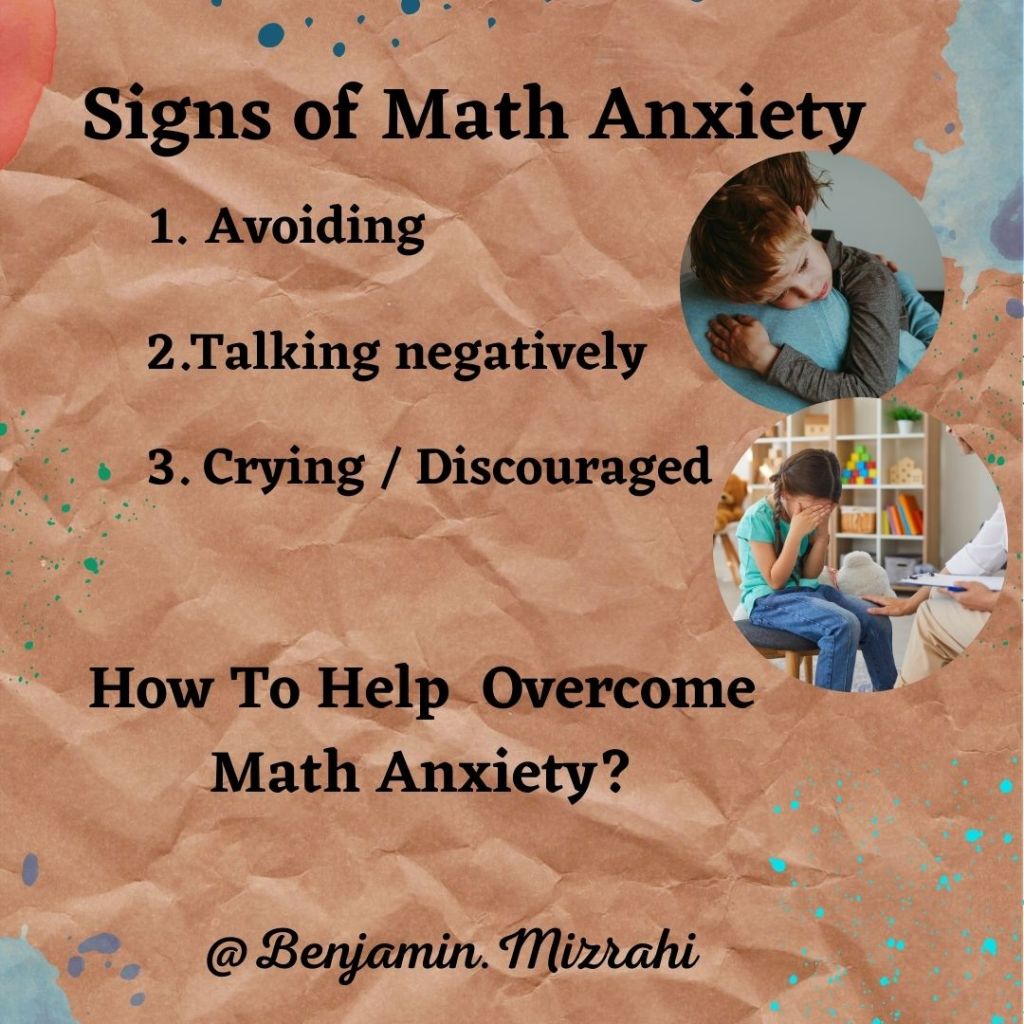
How to Help Overcome Math Anxiety?

Math anxiety can range from general discomfort and mental disorganization to feelings of panic and physical nervousness. For many students, math anxiety turns into a cycle of failure because the more worried they become, the less they learn. 

  1. Surround the child with positive reinforcement. 
  1. Supplement teaching with a qualified tutor. 
  1. Have the child write down his or he worries about math before doing It so they can realize the unfounded fears. 
  1. Try to create positive emotions by making math fun. 

Coach Benjamin Mizrahi. Educator. Learning Specialist. Family Coach. Father. Husband.   

More articles on www.MrMizrahi.blog  

Improving Kids Social Skills

Feeling alone and disconnected from peers is a distressing thing for a child to experience. And it’s not only the children who suffer. As parents, we also feel frustrated and hopeless about not knowing how to help your children make the friends they so strongly desire. Developing social skills and interacting with the world around them will be a critical part of their success and happiness, even more important than their academic results. 

Kids with ADHD often struggle to stay tuned in to their environments; they frequently misread social signals.  Misinterpretations may lead to overreacting to ambiguous social situations or can also lead to under-reacting. The kids who don’t see these signals may be insensitive to the feedback cues others are giving them, leading to anger from peers who feel that their ‘social hints’ are being ignored. 

  • Talk to your child about the need for social skills. Discuss the importance of making friends and getting along with others. 
  • Set a social goal with your child. 
  • Carefully arrange a supervised, time-limited play date for your child to spend with other children to practice newly learned social skills.  
  • Choose play activities that are simple and enticing. 
  • Record your child at home. Review these videos with your child to increase self-observation and awareness. 
  • Help your child understand the motivations and feelings of others by observing out loud what others’ faces and bodies are telling us.  

You already help your child to develop social skills by modeling good social skills yourself and by creating situations in which your child can practice. 

Coach Benjamin Mizrahi. Educator. Learning Specialist. Family Coach. Father. Husband.   

More articles on www.MrMizrahi.blog  
Acknowledging Childs Feelings

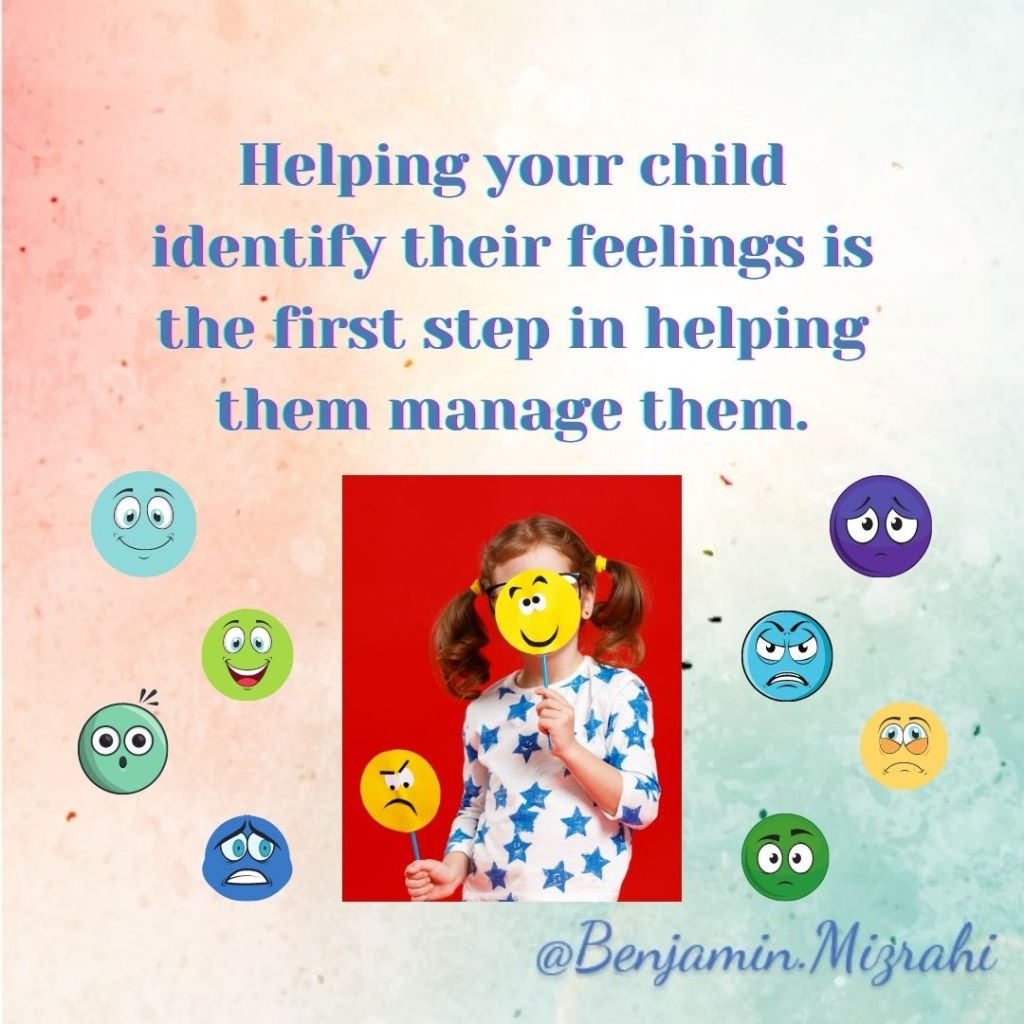
Kids experience complex feelings. Just like adults they get frustrated, excited, nervous, sad, jealous, frightened, worried, angry and embarrassed. 

Our kids don’t have the vocabulary to talk about how they are feeling. Instead, they express their feelings through facial expressions, through their body, their behavior and play. Sometimes they may act out their feelings in physical, inappropriate or problematic ways. They need guidance on how to manage their feelings in positive and constructive ways. 

Verbalizing acceptance of your child’s emotions is a key to helping him feel loved and understood. Acknowledging out loud his disappointment makes him feel heard and respected, which calms him down and reduces his need to protest physically. 

Acknowledging their feelings will assist him toward a better self-understanding. Children often experience a swirl of emotions inside and do not know what is happening. When you can label his emotions and attach it to a situation the child will feel calmer. 

As the child grows, he will internalize this way of working with emotions and handle life situations in a more effective way. 

Coach Benjamin Mizrahi. Educator. Learning Specialist. Family Coach. Father. Husband.   

More articles on EXECUTIVE FUNCTIONS COACHING (mrmizrahi.com)

Discipline Your Child with Love Not Fear

Discipline is an important and effective tool but use it in a way that keeps your child’s dignity intact. They need to understand the ways their actions affect other people, and which behaviors others will and won’t tolerate. 

Effective discipline requires guiding and redirecting your child with love, not fear. Here are some tips to help you discipline with love:  

  • Make corrections about learning rather than getting in trouble. Don’t just tell your child not to run around with food in his mouth. Explain why this rule is important. Tell your child that it isn’t safe because they could choke, and that your job is to help keep them from getting hurt. Make explanations short. Kids tune out of long-winded speeches. 
  • Yell less. Try to stay calm. Loving discipline requires us to keep a clear head so that we can talk to our children and reach their hearts as well as their ears. 
  • Teach your child healthy behavior habits. Be pro-active by working with your child to create a daily schedule and a list of responsibilities (including a chore chart). This gives them much-needed structure, and a chance to practice self-discipline by completing necessary tasks. 
  • Model good behavior. The more we model how to respond to disappointment, sadness, boredom, and not getting what we want, the more our children learn emotional discipline.
  • Acknowledge your child’s feelings. Your child may be angry and uncooperative because a playdate just ended. You can say, “I see you are feeling upset because Jack left, but you still need to pick up your train set.” 
  • Never hit, spank, shake, or slap your child. Fear-based discipline simply doesn’t work if you want to raise a healthy, well-adjusted child. 
  • Be logical about consequences. Issue consequences that make sense and are appropriate for the situation. And make sure they’re something you’re willing and able to follow through on. 
  • Hug often. Physical affection outside of discipline time is a crucial element of disciplining with love. And if you’ve established a bond of touch in your relationship with your child, it will be more natural to conclude your time of discipline with a reassuring and reconnecting hug. 

We want to inspire our children to gain our approval and that inspiration doesn’t come from fear. Rather, it comes from discipline that is positive and based on a respectful, healthy relationship between parent and child. 

How do you discipline your children with love? 

Coach Benjamin Mizrahi. Educator. Learning Specialist. Family Coach. Father. Husband.   

More articles on EXECUTIVE FUNCTIONS COACHING (mrmizrahi.com)

Encourage Your Child to Identify and Communicate their Needs

Learning to identify and express feelings in a positive way helps kids develop the skills they need to manage them effectively. 

Being a parent means you’ve got a really important role to play in helping kids understand their feelings and behaviors. Kids need to be shown how to manage their feelings in positive and constructive ways. 

When kids learn to manage their emotions in childhood, it leads to positive attitudes and behaviors later in life. 

But as your child begins to grow and mature, how can you CONTINUE to encourage them to identify and communicate their needs?  
  
It can sound something like this: 
  

“I’m thinking you want some attention right now. Do you know what type of attention you want? Maybe to talk a little…? Or to sit next to me?”   
  
“I can tell this is hard… and frustrating, I get that. Do you know how you can help yourself start to feel a little better? If you need my help, I’m right here. You can let me know what type of help you need from me when you’re ready.”  
  
And yes, once you start this you will probably hear a lot of… “I don’t know.”   
That’s ok… keep at it… 
 

You can say: “That’s ok, sometimes it takes time to know what to do.” or “Hmm… let’s think together. I’ll tell you my ideas and you can tell me yours.”  
  
You’re planting the seed that it’s up to your child to advocate for what they want.  


Coach Benjamin Mizrahi. Educator. Learning Specialist. Family Coach. Father. Husband.   

More articles on EXECUTIVE FUNCTIONS COACHING (mrmizrahi.com)

Ways to Teach and Encourage Respect

Figuring out how to explain respect to a child is no easy task. To truly teach children empathy and respect, you will have to start with yourself. Every time you talk to your child, they are learning about respect or disrespect in relationships. Your job as a parent is to be aware of your actions and be a role model of respectful behavior and good manners for your children when reacting to them.  

The following are some ways to teach and encourage respect: 

  1. Model Respect. By modeling respectful behavior for your child, you are not only teaching respect for others but also teaching your child to respect themselves. 
  1. Discuss Respect. Talk about the way we treat others. Focus on the words we use and the attitudes we portray.  Explain the expectation of respect for others demonstrated in both attitude and behavior. 
  1. Teach Turn-Taking. Helping children to patiently wait for a turn to speak encourages respectful listening.  Encouraging children to wait develops an attitude of patience and respect. 
  1. Teach Polite Responses. As children begin vocalizing, adding phrases to their vocabulary like, “excuse me,” “no, thank you,” and “yes, ma’am/sir” continues to encourage an attitude of respect. 
  1. Praise Respectful Behavior. When children demonstrate good manners and respect to others, give specific praise for the positive choices they are making. 

Time and consistency together with our intentional teaching efforts will teach children this valuable character trait. 

Coach Benjamin Mizrahi. Educator. Learning Specialist. Family Coach. Father. Husband.   

More articles on EXECUTIVE FUNCTIONS COACHING (mrmizrahi.com)

Losing Your Temper with your Kids

Losing our temper with our kids sometimes doesn’t make us bad parents; it’s just part of life with little ones. But when our explosions become habitual, when we’re losing it on a regular basis, then it’s a problem. It’s a problem because it increases the stress levels in our home, weakens our relationships with our children, and to top it all off, it rarely solves any issues. 

We don’t have to be perfect parents. We just have to seize those opportunities to realize when we’re off-course and find ways to start moving in the right direction. They need a parent who models how to take responsibility and make repairs. A parent who apologizes and reconnects when things go wrong — as they inevitably do sometimes in human relationships. 

Remember: If you manage to stay levelheaded instead of losing your temper, your child will eventually learn that she can keep calm too. Here are some “stay cool” strategies to try the next time your kid’s behavior gets your temperature rising:  

1. Commit to NOT TAKING ACTION while angry. 

When you notice that you’re getting upset, that’s your red flag reminder to Stop, Drop (your agenda, just temporarily), and Breathe. 

2. Remind yourself to see the situation from your child’s point of view. 

3. Restore calm and safety. 

Take a few deep breaths. Switch gears emotionally by finding a more positive thought. Then, if you’re calm enough, reconnect with your child and try a “Do Over.” If you can acknowledge your child’s feelings, it opens the door to reconnecting. Empathize with why they’re upset. Set whatever limit you need to. Modulate your tone and keep breathing. Remember, anger doesn’t dissipate until it feels heard. So, listen and try to understand. 

4. Always apologize after you lose it

Remember that you are role-modeling, both when you yell and when you apologize. Resist the natural impulse to blame it on your child by saying that if they would just act right, you wouldn’t yell. It’s always your responsibility if you yell, and no child (or adult) ever deserves to get yelled at.  

5. Avoid a Repeat. 

Ask yourself, “What’s one thing I can do so I don’t lose it next time?” 

Coach Benjamin Mizrahi. Educator. Learning Specialist. Family Coach. Father. Husband.   

More articles on www.MrMizrahi.blog