When they are at that line, deciding whether to retreat to safety or move forward into bravery, there will be a part of them that will know they have what it takes to be brave. It might be pale, or quiet, or a little tumbled by the noise from anxiety, but it will be there. And it will be magical. As parent your job as their flight crew is to clear the way for this magical part of them to rise.
To do this, you first need to let them know you are with them, that you will see their world the way they see it. Let this be with so much love and warmth – the relational connection is everything.
Whenever you can, speak to that bravery part of them and usher it to into the light. You’ll be doing this every time you acknowledge their strengths, the brave things they do, their effort when they do hard things; and their tiny shuffles or big leaps towards brave.
This isn’t always easy. Their anxiety will trigger yours – when your children feel unsafe, often so will you. So you have to hang on hard to the truth of it all – that you know they can do this. If you feel yourself believing in their anxiety more than their bravery, remind yourself that they will believe in themselves when you do. Then, breathe, find calm, remember the truth of it all, and let your courage lead theirs.
Being a parent is a major responsibility. You are in charge of raising an individual to the point of adulthood with the goal of turning him or her into a valuable member of the community. This undertaking requires care, love, understanding and the ability to keep the children on the right path. If done right, it is one of the hardest things you will do, but it also will be one of the most rewarding.
By maintaining your duty of care as a parent, your child is more likely to put their trust in you and realize the love, care and affection you have towards them hence creating a stronger relationship with you.
Setting limits
It is your responsibility as a parent to set limits and guidelines for your child to follow. Using guidance is much more useful than severely punishing your child as that only distances them further. By setting limits, you’re allowing your child to know what’s expected from them, learn about fairness and respect others.
Children grow up and are mostly around their parents and so teaching them correct behaviors and setting out expectations in regards to how they should behave both around the family and in public is essential.
Discipline
This is not always about punishing your child after they’ve done something wrong. Instead, discipline should be about guiding your child’s behavior. Establishing clear rules that are understood by your child is an easy way to discipline your child. As mentioned earlier, your child will often tend to do the same thing you do and so by being a good role model, you are showing your child the correct way to behave. However, in order for your child to learn to the right thing, there should be consequences for poor behavior.
Correct discipline can lead to building a positive relationship with your child as they may understand that you’re only doing what’s best for them and have their best interest at heart.
Every parent wishes there was a “Parenting Handbook” at some point in their parenting duties. From knowing what to say in the right situation to knowing how to correctly discipline, it is true that parenting is not for the weak hearted. Since children are each so vastly unique in how they view the world having a simple design to parent kids would make parenting so much easier.
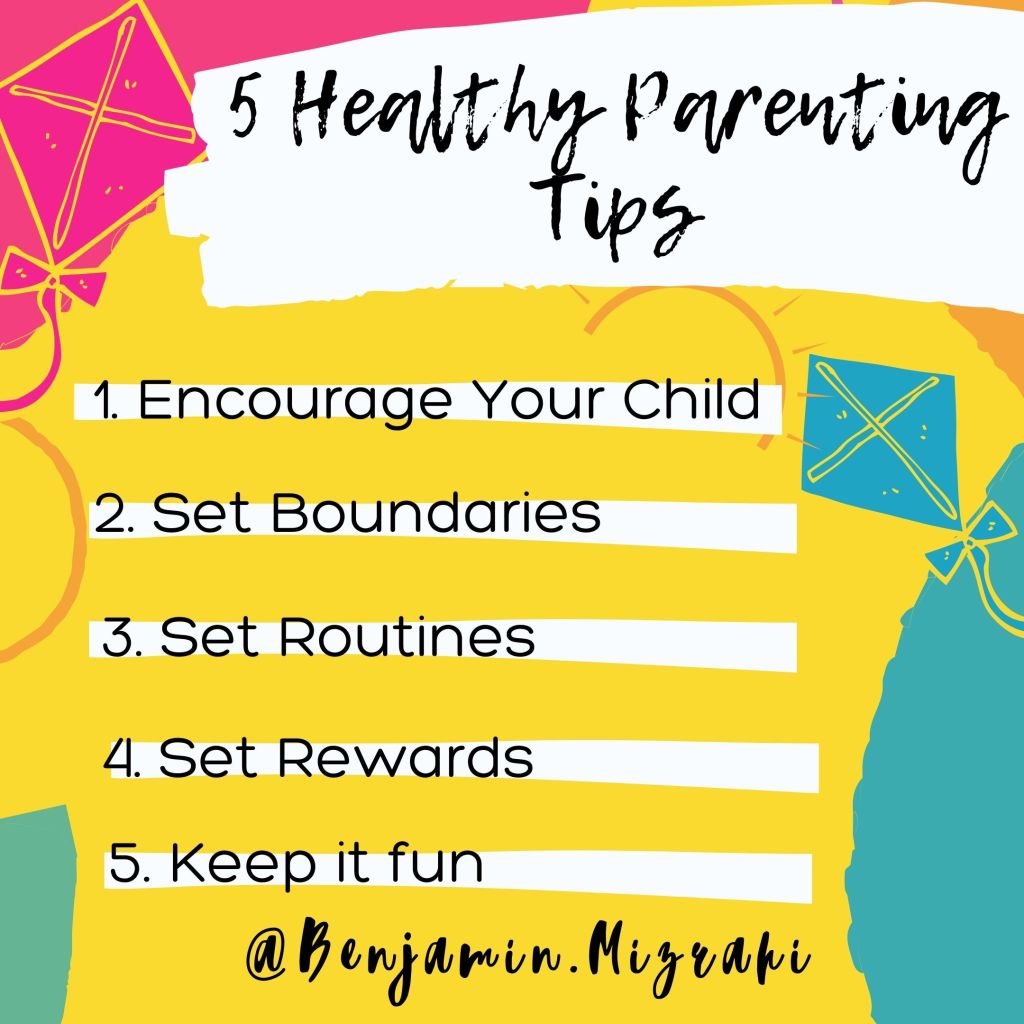
Here are 5 healthy parenting tips to help you with your positive parenting goals. While parenting is more multifarious than just applying these tips, if you’re consistently incorporating these tips into your family you can provide a healthy, encouraging, and safe environment for your children.
Encourage Your Child
This is one of the most important principles you can apply to your parenting strategy. By encouraging and nurturing your children, they are fostering a sense of self, their importance in the world, and a sense of belonging. This is where self-worth and self-esteem are developed. Essentially, spend quality time with your children by learning who they are, how they think, and show them that you value them through love and affection.
Set Boundaries
Boundaries are the rules and limitation within the household. Teach them to speak kindly to one another, encourage sharing, and inspire them to always tell the truth. These are values you want your children to learn. If you teach and encourage your child to be respectful to others then they will be respectful. Most kids don’t just wake up one day and understand the concept of respect. That’s our jobs as parents to teach them. So if you believe being respectful means speaking kindly to one another then that is the boundary you incorporate in the home. Whenever you observe your child share his toys or speaking kindly, say to them “Wow Jimmy, good job at speaking kindly to your little sister! You are being very respectful. Great job!”
Set Routines
Each day of our lives we live by a set of routines. Routines are a great way to encourage kids to perform certain tasks that need to be completed at certain times of the day. Daily routines like eating breakfast, getting dressed, brushing their teeth, and packing their school bag are great age appropriate tasks. As kids get older, add tasks and chores that are age appropriate to their daily routines. Make sure what you are expecting your child to do matches their age and skill level if not you might find some routines and tasks difficult to maintain. Here is a list of age appropriate chores to get you started.
Set Rewards and Consequences
Use rewards well by reassuring any aged child how proud you are of his or her decisions and choices. Likewise, express concern and consequences for poor choices. For younger children, use a rewards charts for kids to see their accomplishments. Consider the option of earning an allowance for completing chores and for positive choices.
Keep it Fun
Finally, the most important element in all positive parenting is keeping it fun. Spend family time together, play board games, go to the park, have a picnic, or laugh together. Parenting is a full-time job and often we get so busy with daily life that we forget that it is about having fun TOGETHER. So plan fun activities with your children, ask them what their idea of fun would be, and try not to be overly focused on expectations of you, and begin concentrating on what you can do today to make you and your children
Coach Benjamin Mizrahi. Educator. Learning Specialist. Family Coach. Father. Husband.
We give our children wings when we believe in them. When we trust in their dreams and what they’ll be able to do, they can fly. That’s why we must play the role of mentors, dream-makers. Parents must understand that one day their child will follow their example and not their advice.
What can we do to support a child’s self-esteem?
Speak nicely to them: speaking nicely to our little ones means speaking to them with affection, patience and positivity. If we do, we’ll be showing them a good example and helping them balance their emotions.
Tell them stories that make them better at introspection. Children should understand that it is of the utmost importance not to forget about what we think, feel and do. Through communication we get knowledge about people (ourselves and others) and things.
Praise and do not ridicule: We’re talking about highlighting, reinforcing and recognizing their positive behaviors. Here’s a golden rule: praise in public, criticism in private.
Help them handle frustration and teach them to be proud of their achievements.
Make them feel like an important part of the family.
Avoid overprotecting them and encourage good socialization with their peers.
Educate by example: Parents should be a good model of self-esteem.
Take 10 minutes to play something REALLY special with your little one today, and tomorrow, and the next day. Yes, you read that right, just 10 minutes per day.
Make it really special, give time for your child. No phones, no siblings. All 10 minutes. Your toddler chooses anything they want in the world to play.
Because when they’ve had a hard day, they can’t say “I’m sad” or “I need you.” Instead, they just need you to connect, and play. This one’s a game changer.
Children usually sense when you mean what you say and when you don’t. It’s usually best not to say anything unless you mean it and can say it respectfully, and can then follow through with dignity and respect.
The key to effective limits and boundaries is to say what you mean and mean what you say. This means you need to think before you speak, which generally means you should take time to be calm and consider things rationally.
Don’t set a consequence that you know you won’t be able to follow through on– and don’t follow through when you know you’re being unreasonable or simply acting out of anger and frustration.
Remember, discipline is meant to teach. Set consequences in advance, preferably with your child’s input, then follow through with dignity and mutual respect.
Screentime is addictive and interferes with relationships. There is research that demonstrates how the brain develops differently with excessive screen time, so it is true that screen time does affect a child’s development.
But my guess is that you don’t need research to know that your children are on their screens too much each day; you know this from your own wisdom and intuition. The key lies in finding a balance. Yes, kids are keeping up with technology and learning new skills that will help them if their lives. And yes, too much media use does prevent them from becoming proficient in person-to-person communication skills.
Try these ways to help manage your family’s screen time so it doesn’t manage you:
Have a Family Meeting. Get the whole family involved in a plan for reducing screen time. Part of the solutions should include things to do in place of screen time. It is more difficult to give something up when you don’t have plans for what else to do.
Create a “parking lot” for electronics—have a basket or charging station in a central location in the house at which family members “park” their electronics during certain times of day.
Establish new routines. Start with one time of day to be screen free (such as dinner) and periodically add on other times of day.
Stay close with your child with Special Time. Children will listen to your limits about screen time when they feel understood and that you “get” them.
Spend regular one-on-one time together to keep your relationship strong.
Hold limits with Kindness and Firmness. Changing a screen time habit is hard; be ready for disappointment, anger, and sad feelings. Hold your limits by empathizing with a child’s feelings and sticking with the limit you’ve set.
Kids experience complex feelings just like adults. They get frustrated, excited, nervous, sad, jealous, frightened, worried, angry and embarrassed.
However young kids usually don’t have the vocabulary to talk about how they are feeling. Instead they communicate their feelings in other ways.
Kids can express their feelings through facial expressions, through their body, their behaviour and play. Sometimes they may act out their feelings in physical, inappropriate or problematic ways.
From the moment kids are born, they start learning the emotional skills they need to identify, express and manage their feelings. They learn how to do this through their social interactions and relationships with important people in their lives such as parents, grandparents and caregivers.
When we understand the critical role emotions play in our children’s development, we need not squash them when those feelings challenge us. Instead, we can help train them at various ages and stages to listen to their heart and respond in ways that will be healthy for them and others.
Life with a child or teen with attention deficit hyperactivity disorder (ADHD or ADD) can be frustrating, even overwhelming. But as a parent you can help your child overcome daily challenges, channel their energy into positive arenas, and bring greater calm to your family. And the earlier and more consistently you address your child’s problems, the greater chance they have for success in life.
Children with ADHD generally have deficits in executive function: the ability to think and plan ahead, organize, control impulses, and complete tasks. That means you need to take over as the executive, providing extra guidance while your child gradually acquires executive skills of their own.
Although the symptoms of ADHD can be nothing short of exasperating, it’s important to remember that the child who is ignoring, annoying, or embarrassing you is not acting willfully. Kids with ADHD want to sit quietly; they want to make their rooms tidy and organized; they want to do everything their parent says to do—but they don’t know how to make these things happen.
If you keep in mind that having ADHD is just as frustrating for your child, it will be a lot easier to respond in positive, supportive ways. With patience, compassion, and plenty of support, you can manage childhood ADHD while enjoying a stable, happy home.
We teach our children by example. Most of what they learn and pick up is based on things we do and not on things we say. When our children see us giving grace to others, forgiving them and seeing them as human they are able to forgive themselves and see their own selves as human. They allow themselves room to make mistakes and forgive themselves for their errors. Conversely if we hold grudges, don’t forgive people or don’t see them in their humanity, our children learn that there is no room for human error or simple imperfections. They learn to be hard on themselves and may have difficulty moving past their own missteps. So, forgiving others is not just helpful for living happier healthier lives, it’s important because it can impact our children’s self-esteem and the way they feel about themselves.
It is important for parents to spend quality time with children. In this fast-paced world, we have to make space for our kids, and assure them that we care about them and will always be there as pillars of support. They need our love, kindness, and strength, so that they feel secure and confident with themselves.
Importance of Spending Quality Time with Children
Unbreakable Bonds – It takes time to create and maintain relationships. Similarly, as parents, we need to take time out for our kids. Everyday is important and every free minute counts. Making an effort to utilize every moment possible, will allow you to spend more a good amount of time with your kids. You may not see much coming off it now, but this practice will yield its positive results in the future, when the kids are in high school and college etc. It is important for parents to be aware of the events happening in their child’s life, and must participate in discussion, so as to guide them to the right path. Growing up can be confusing and adolescence difficult. Parents can share their own experiences and failures with their children, so that the child is made aware of the consequences of their thoughts and actions.
Instilling Everlasting Values – Children observe, process, and assimilate values from their parents as well as their immediate surrounding. Everything they learn is through years and years of ingraining of morals and principles, which the family upholds. Children learn to be respectful towards elders and protective towards younger siblings and cousins. They learn the difference between right and wrong, safe and unsafe. They grow up to understand the value of education, hard work, honesty, kindness, and forgiveness. Children gradually become more receptive to the challenges their parents face and all the hardships they have undergone in their own personal lives.
Acceptance and Strength of Character – A family offers the perfect environment for the child to develop a healthy and balanced personality. Good parents accept their children for who they are and never compare them or judge them. Children must be given the freedom to express their feelings, and creativity without a worry in the world. Parents must be aware of their children’s talents and accordingly provide them with further training and encouragement, so that the children feel more confident about themselves. Confidence can take people far and help them contribute positively to the society. Similarly, your child too can grow up to become a confident individual, only and only if you give him or her your support.
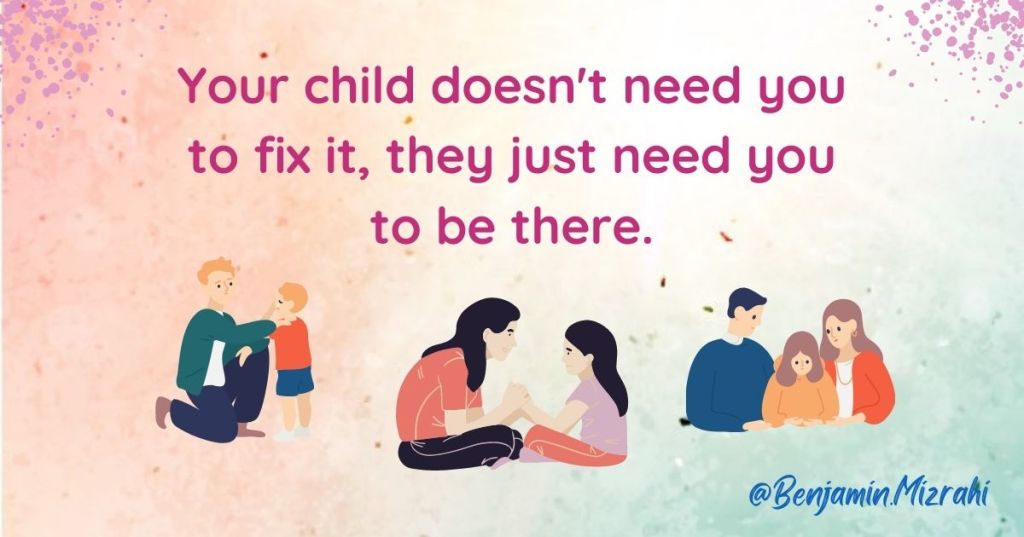
Many children struggle to be in touch with and express their feelings. Too often children are not allowed their feelings because adults try to fix, squelch or even deny feelings.
Instead, it is much more helpful to just validate feelings. You can do this by asking a simple question or reflecting back with empathy.
Here are the ways that can help you be in touch with your child’s feelings :
Validate their emotion
Allow their big feeling
Sit with them
Ask them what they need
Children learn resilience when they have the experience of working through their feelings and learning that they pass—eventually.
Many times they can work through their feelings on their own. Other times you can involve them in problem-solving—after everyone has calmed down.
We help children understand their feelings and deal with them effectively by taking them seriously and then helping them work it out or trusting them to work things out after they feel validated and have a little time.
And, it is amazing how often children do work out solutions to their problems when they are simply allowed to do so in a friendly atmosphere of support and validation.
Coach Benjamin Mizrahi. Educator. Learning Specialist. Family Coach. Father. Husband.










 EXECUTIVE FUNCTIONS COACHING