Processing Skills
Cognitive Processing Speed
Cognitive Processing Speed reflects how quickly and efficiently a student is able to perform mental tasks. For many students, the intellectual portion of schoolwork isn’t the challenge – it’s how quickly they can process and express the information that they know. This set of skills becomes particularly important in time-limited scenarios (including standardized tests) and in managing tasks that require multiple steps, such as higher-level math and critical reading activities. Processing speed challenges are also linked to delays in other processing skills and improvements in Cognitive Processing Speed generally result in improvements across a number of other processing skills.
Working Memory
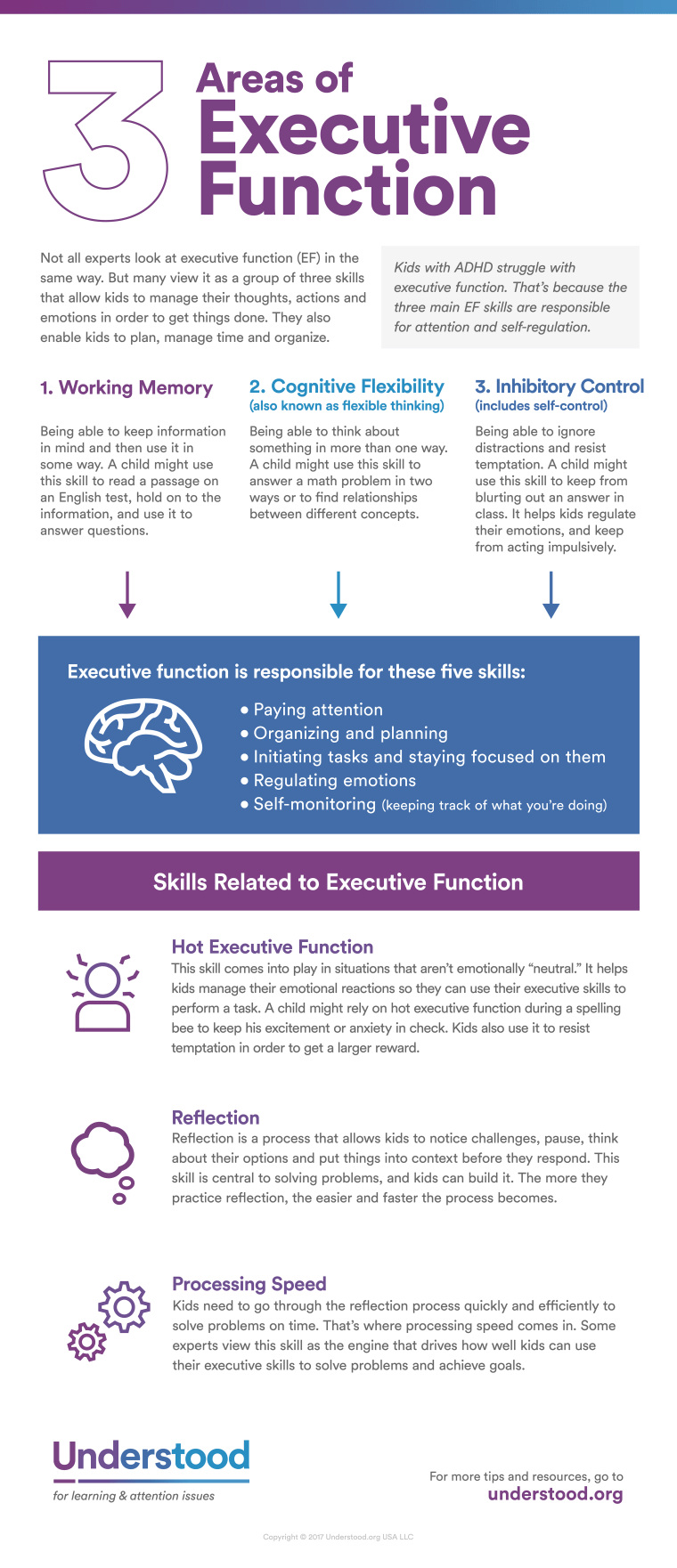
Working Memory determines how well new concepts and information can be integrated and used in simple tasks building up to more complex tasks. Critical to academic success, working memory is often implicated in mathematics as it affects how well a student can hold multiple pieces of information in his or her mind while solving a problem or conducting a complex analysis. Similarly, in reading comprehension, simultaneously keeping multiple ideas or pieces of information in mind is critical to a student’s understanding and success. Working Memory skills are crucial in any course of study that values more complex analytical, scientific, mathematical or financial analysis.
Visual Processing
Visual Processing correlates with a student’s ability to process and manipulate visual stimuli efficiently to perform various tasks. Challenges in Visual Processing can make upper level math and sciences more challenging as many of these classes use diagrams to demonstrate concepts. For university students, science, engineering and higher-level financial modeling, in particular, are heavily visual subjects that require strong visual processing skills. Students who struggle with Visual Processing may find that they rely more heavily on other forms of input – such as language – to compensate for visual challenges. Visual Processing challenges may be linked to underlying physical challenges, such as visual tracking or convergence challenges.
Language Processing – Reading, Written and Oral
Language Processing requires a foundation of being able to decode words effectively, associating strings of symbols (letters) with the appropriate sounds. As students go through school, they are constantly being asked to learn vocabulary and use it in context. Challenges in Language Processing make acquiring new vocabulary difficult, which then means that applying new words they encounter to other higher-order critical reading and thinking activities will be more difficult. Auditory Analysis determines how well information presented in oral formats will be received and processed – particularly when listening to lectures in an academic setting. Auditory processing skills prove important for skills as simple as following directions (particularly multi-step directions) all the way up to retaining content presented in lectures, the predominant instructional format in high schools and universities. Many students with Auditory Analysis challenges become quite adept at APPEARING as though they understand what is being said even if they don’t completely understand. As a result of the extraordinary effort these students must apply to processing auditory input, school can be physically draining and emotionally stressful. For many students, alleviating the effort and energy diverted to accurately processing and comprehending auditory input can result in increased attention across the board.
Logic and Reasoning
Logic and Reasoning is the core skill used in problem solving and strategizing. Logic and Reasoning skills impact a student’s ability to plan and prioritize a strategy for multistep problems, especially as teachers assume a base level of conceptual understanding and assign problems that require a higher degree of inference. For any discipline that involves mathematics or written work which requires logically organized, persuasive arguments, logic and reasoning skills are crucially important and can be strengthened with the proper support.
Selective Attention
Selective Attention describes a student’s sensitivity to distractions and the ability to sustain attention despite other competing stimuli. Selective Attention is also strongly correlated with a student’s ability to prioritize information and tasks, manage time and stay organized. Selective attention is what allows students to sift through the overwhelming amount of auditory and visual input in their daily environment and interactions and prioritize this input effectively. For example, a lecture may be challenging to attend to due to the sounds of a classmate tapping his pen or the construction site next door. Similarly, a page full of dense text may be challenging to sift through for important information. Ultimately, Selective Attention links strongly with a student’s Executive Functioning skills, which we also address in our program (see below). In the absence of strong Selective Attention skills, a student’s ability to take in and organize information can be seriously constrained. This often means that he or she will have to work extra hard as they attempt to attend to everything instead of just what is most important.
Academic Skill-Building and Executive Functioning
Learning Efficiency’s programs cover a number of key academic skills and executive functioning processes, including:
- Time Management
- Task Analysis and Prioritization
- Organization and Note-Taking Skills
Read on for an in-depth description of what each of these skills includes:
Time management
Time management is a bedrock skill needed for academic performance—particularly as students reach middle school, high school and university, when demands on their time rise sharply. Students who struggle with time management often procrastinate and complete their schoolwork very close to the due date, usually the night or morning before. Part of this dynamic is that their workload leaves them little room to get ahead. With more efficient planning, however, they can regain lost time and feel more in control of their work and lives. Mr Mizrahi coaches students in developing a variety of habits and techniques to strengthen behaviors that will help them manage time more effectively. With targeted guidance and coaching, time management can become a more natural part of their lives.
Task Analysis and Prioritization
Difficulty breaking down large tasks, such as term-long science projects and research papers, is a problem experienced by many students across a wide range of ages. Larger tasks, especially those with fewer explicit instructions, can give even the most organized students difficulty. Students who struggle with task analysis and prioritization often show tremendous work ethic but have difficulty tackling large tasks or prioritizing a number of competing obligations. When given step-by-step directions, these students possess the technical skills to complete each task, but identifying those steps without direction proves harder. Practicing this skill, just like others, involves pursuing a variety of new and multi-stage projects. Mr Mizrahi provides an excellent opportunity to work on these skills through projects that build on a student’s existing interests. As we work on their chosen projects, we focus more on the process and less on the specific content to reduce the number of stressors inherent in building these skills.
Organization and Note-Taking Skills
A student’s ability to be successful in school is not purely academic. For most students, in fact, a far greater component of their academic success is whether or not they can maintain the level of organization required to keep track of the many things they need to do and the information they need to do it. Students with challenges in organization often find themselves spending more time than necessary to complete their work. Mr Mizrahi works with students to build an organizational system they can use to structure their tasks and environment, improving efficiency while offering the comfort that comes with having a predictable structure. For older students (middle school, high school and university), Mr Mizrahi also includes exercises related to note-taking, including HOW to take notes and tools for prioritizing information. Students with enhanced organization and note-taking skills will be able to complete more work in less time – reducing stress while improving academic performance.
Left/Right Brain and Brain/Body Integration
Like the building blocks in our physical development (e.g. crawling before walking) neurodevelopmental systems are the building blocks for academic, social and behavioral learning. For a variety of reasons, some of these systems develop less well in some of us than in others—this simply means some of our kids must work harder to support these underlying systems.
When students experience challenges with neurodevelopmental systems, they may appear anxious, distracted or fatigued in class. It takes a great deal of effort to support suboptimal systems that are working hard to keep the body still and upright while also staying focused on the teacher. The extra pressure can overtax a child’s system and leaves little room for attending and learning. For some students, this sense of feeling overtaxed can lend itself to impulsive or even explosive behavior when stress levels rise.
An overview of the most crucial systems includes:
Interhemispheric Integration
The strength of the integration between our left and right brains depends on the efficient functioning of all the other neurodevelopmental systems. Interhemispheric communication makes it possible to reason and strategize, process and retain information, express our thoughts as written words, mentally and physically organize, respond when simultaneously doing another task, manage academics, and play sports. Organized rhythmic activity helps to organize the brain. For students whose integration is inefficient, their processing is often not supported by efficient differentiation and lower level sensory-motor systems. These inefficiencies then leave less energy in reserve for integrating information between the left and right sides of the brain. For many students, interhemispheric integration is linked to challenges in working with word problems and higher order reading comprehension questions. As the demands increase over the years, this challenge may manifest in ways such as essays/reports/homework not being representative of what a student knows or is able to articulate. You may also find that a student avoids expanding beyond his comfort zone of strengths so as not to overload his system.
Vestibular Functions
Our vestibular system, located in the inner ear, forms a foundation for almost all of our other neurodevelopmental systems. The inner ear supports hearing, vision, muscle tone, proprioception, kinesthesia, awareness of gravity and barometric pressure, balance, knowledge of starting, stopping, accelerating, decelerating, motor planning and movement. It is the vestibular system that allows us to do more than one thing at a time. When a student’s vestibular system is working inefficiently, the disorganization can contribute to difficulty in attending to and retaining auditory information when no visual or kinesthetic support is provided. In social situations that are dynamic and unpredictable, many individuals with vestibular challenges may likely seem more reserved or they may prefer to do things on their own rather than be in a more chaotic group setting. Students with vestibular inefficiencies often fidget or need to shift in their chair, feeling a need to get up and move around a room. Rather than asking a student to “sit still,” our program focuses on helping them learn how to monitor their own need for increased vestibular stimulation in order to be able to focus. We give them strategies for coping and perform more successfully in school.
Visual Tracking
Beyond visual acuity (e.g. 20/20 vision), our eyes also need to work TOGETHER to focus on a single point (convergence) and move smoothly over information (visual tracking). Strengthening this system allows for improved reading, spelling, attention and eye contact. Ocular motility (visual tracking) is interdependent on the vestibular system and muscle tone. Auditory processing is directly linked with vision through the workings of the colliculus, which means that when one system is stressed so is the other. Roughly speaking our ears follow our eyes in the sense that our auditory attention is guided by what we are looking at. If it is hard for our eyes to maintain focus for an extended period, then we are more prone to auditory distractions as well as auditory miscues. For some students, visual tracking challenges may manifest as skipping occasional words as they read, sometimes missing written details or instructions or miscomprehending what they have read. Irregularities with visual tracking sometimes have an impact on reading fluency due to disruptions in the thread of ideas as sentences have to be re-read or are not fully understood. This may make it so that students struggle to get the big picture when reading more complex literature, affecting skills such as inferring and judging validity.
Proprioception
Proprioception is our own sense of our body in space as well as our sense of self in relationship to our surroundings. Our proprioceptive system is interrelated to our vestibular system, tactility, muscle tone, kinesthesia, vision, smell and hearing. Proprioception has an impact on vital activities such as sleep, attention, and social interactions. Proprioception also supports the development of visual functions, in particular visual-spatial awareness. Students with proprioceptive inefficiencies will sometimes report not feeling rested, even after having slept. The academic and social implications range from difficulty taking notes or copying off the board, challenges with summarizing readings, remembering and following multi-step directions, understanding social cues and social boundaries, and feeling comfortable learning a new game or sport. For students with proprioceptive issues, we build in targeted exercises to strengthen their underlying systems while also providing families with interventions they can do at home to continue supporting proprioceptive optimization and efficiency.
Growth Mindset Enhancement
Students with learning challenges receive a great deal of feedback from the school system about how they are NOT doing well. In addition to the fact that most unique learners would actually do quite well with a little bit of targeted support, the metrics that the system chooses to use are often not fair representations of a unique learner’s true ability. Over time, the feedback from school can result in challenges with self-esteem and damaged self-confidence. Our program for unique learners helps address these challenges by incorporating “Growth Mindset” exercises. These exercises allow each student to rebuild and strengthen their self-esteem and confidence by placing their personal challenges in context and transforming current challenges into future opportunities for learning, growth and joy. Students who move from the traditional “fixed” mindset to a Growth mindset will report less stress, improved self-esteem and a greater willingness to try and explore new activities and social settings.






 EXECUTIVE FUNCTIONS COACHING