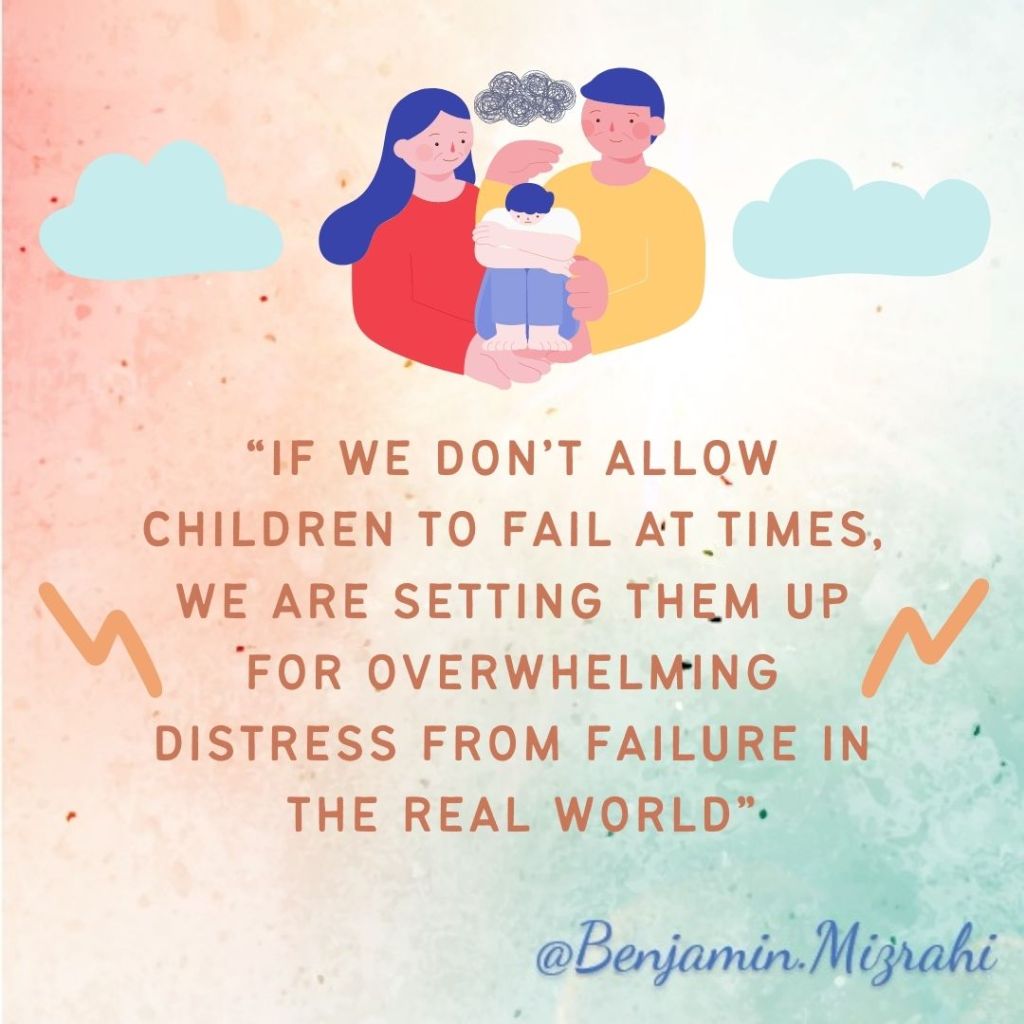
Help Children Learn to Tolerate the Risk of Making Mistakes

It is said that “If we don’t allow children to fail at times, we are setting them up for overwhelming distress from failure in the real world”. When you encourage thinking beyond single approaches and allow your children opportunities to make decisions, choices, and confront the mistakes that come with these transitions from the unknown, you give them the gift of flexible and creative thinking. 

How does one decrease the fear of making mistakes? 

🌟 Share motivating memories 

🌟 Provide examples of people they admire who described their struggles with mistakes 

🌟 Acknowledge your own mistakes.  

When you make a mistake, acknowledge it to your children. Tell them about times when you were their age and felt very embarrassed or angry about your mistakes. Perhaps at times, your first instinct was to blame someone else or to try to hide your mistakes. Let them know if it was a struggle for you to acknowledge your mistakes and frustrating to spend more time to really understand something that was hard. 

🌟 Encourage them to tell you about mistakes they have made in the past and how they felt and reacted. Ask them what they would do differently now when confronting similar issues. 

Just as learning how to walk, speak, and read does not emerge fully proficient, the development of tolerance to setbacks is not a smooth pathway to perfection. When you increase their comfort by making mistakes, you’ll build their willingness to think out of the box and interpret information with wider perspectives. Help your children recognize that they’ll build confidence, problem-solving perseverance, and creativity by understanding that mistakes can be brain boosters. 

Coach Benjamin Mizrahi. Educator. Learning Specialist. Family Coach. Father. Husband.   

More articles on www.MrMizrahi.blog  
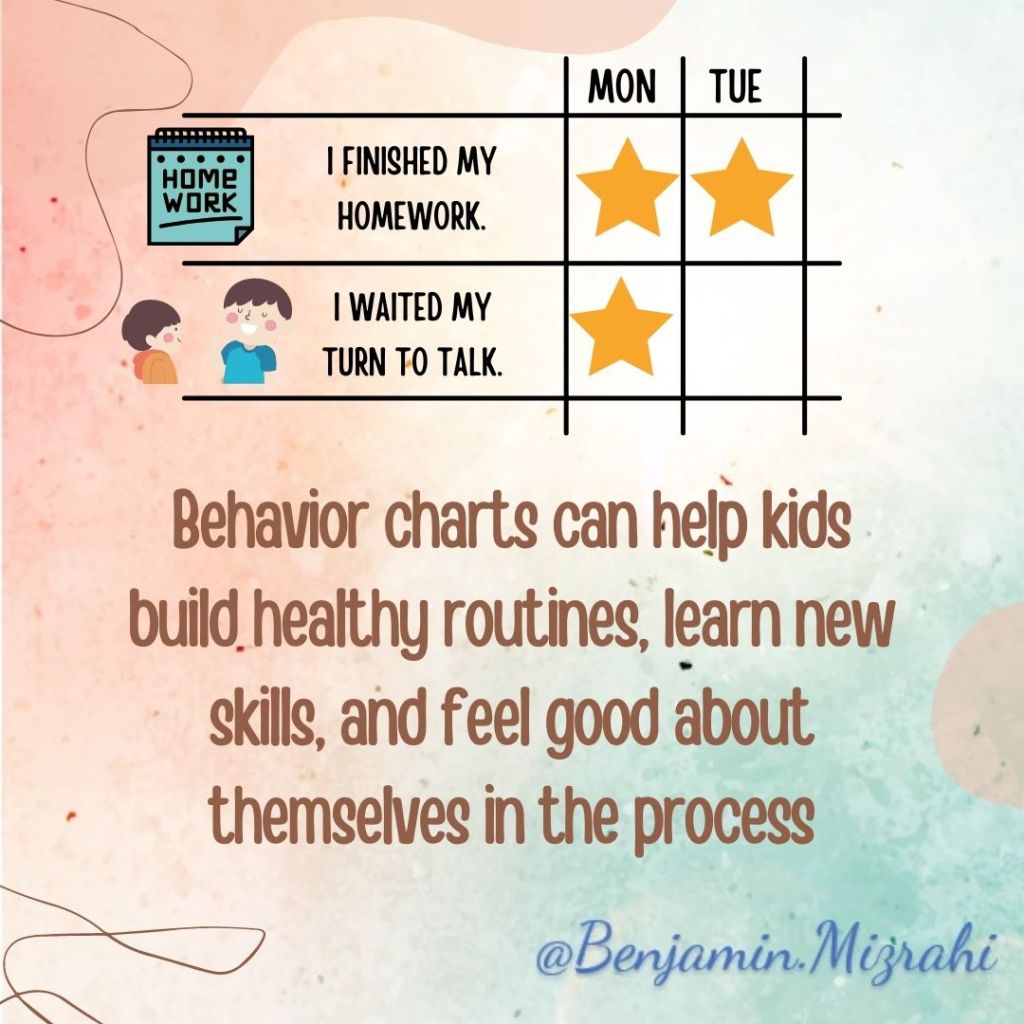
Behavior Charts for Children with ADHD

Whether the child is a preschooler or a high schooler, ADHD can present some significant behavioral challenges at home and at school. Recent research shows that behavior charts offer a great resource for kids, parents, and teachers managing the symptoms of ADHD. 

Charts can be a great way to encourage proper home and classroom behavior, but it’s important not to overwhelm young children with too many goals. 

  1. Print out the chart in color. Pictures will help the child stay focused. 
  1. Clearly label the child’s reward. It may also help to include a picture of the reward. Be sure to set a goal for the number of stickers required to receive the reward. 
  1. For each day of the week, give the child a sticker if he or she has demonstrated the desired behavior. Provide verbal praise too. 
  1. At the end of the week, check whether the child has received the appropriate number of stickers. If the child has received enough stickers, present the goal. 

When using behavior charts with kids who have ADHD, keep the following tips in mind: 

  • Keep it simple. A chart that is too wordy may be difficult for your child to follow. 
  • Decide on a reward. Choose a reward that is motivating. 
  • Keep it positive. For the greatest success, the goals on the behavior chart need to be phrased in a positive manner. Stay away from words like “doesn’t” or “not.” 
  • Be consistent. Consistency is the key to success of using behavior charts. If you expect the child to follow through, you need to follow through as well. 
  • Expect some push-back. Keep in mind that your child may really test you when you first begin using behavior charts. However, the positive nature of these charts will soon win. 
  • Keep it age appropriate. Make sure your expectations are reasonable and that you’re using a chart that’s appropriate for the child’s developmental level. 

Coach Benjamin Mizrahi. Educator. Learning Specialist. Family Coach. Father. Husband.   

More articles on www.MrMizrahi.blog  

When Kids Won’t Cooperate: Give Choices

Controlled choices allow children to feel a sense of control. We, as adults know, if we have a sense of control and make an active choice, we are more likely to follow through with the task. This is the same with children. Controlled choices can increase motivation to complete the task, reduce task refusal and increase task engagement and completion. 

Providing young children opportunities to use their voices, make decisions, develop ownership, and solve problems are great ways to bond with them too. 

Giving kids a say also: 

  • Builds respect and confidence. 
  • Develops problem-solving skills. 
  • Invites cooperation. 
  • Decreases problem behavior. 
  • Gives children a sense of worth and accomplishment. 

With controlled choices, children are given a limited set of options, any of which you are ok with them choosing. It allows the child to feel control over the activity and can increase motivation in completing the task. Giving children choices helps them feel like they have some control over their lives. 

Coach Benjamin Mizrahi. Educator. Learning Specialist. Family Coach. Father. Husband.   

More articles on www.MrMizrahi.blog  

How to Handle Disrespectful Children

Disrespectful behavior such as cursing, yelling, arguing, ignoring you, refusing requests, name-calling—is a kind of wakeup call to parents. As parents, we need to teach our children how to treat others with kindness, and how to communicate big feelings without being disrespectful so they can develop healthy relationships with peers, authority figures, and family members.  

It’s hard to deal with this shift in attitude, but it’s important that you know how to respond and what to do when your child is disrespectful. Here are some tips that will help you handle disrespect: 

  • Stay calm: Meeting them with disrespect sends the wrong message. Instead, model good self-care by taking a deep breath, counting to 20 or repeating a mantra before you respond to your child. 
  • Decode the Behavior: Look at things from your child’s perspective. Their response reflects what they are feeling inside. Unfortunately, at this point, they can’t put it into more appropriate words. 
  • Empathize: Help your child understand their own feelings by offering an empathetic response. You do not have to agree with the feeling, it simply means that you are willing to relate to their experience. 
  • Check the Time: Some kids are affected by low blood sugar, hunger or thirst. Others are very sensitive to environmental stimulation or not getting enough sleep. 
  • Slow It Down: It’s easy to get pulled away with the “runaway train” of angry, frustrated words and emotions. Instead of jumping on board and responding to every criticism or complaint your child throws at you, try to put on the brakes. 

Coach Benjamin Mizrahi. Educator. Learning Specialist. Family Coach. Father. Husband.   

More articles on www.MrMizrahi.blog  
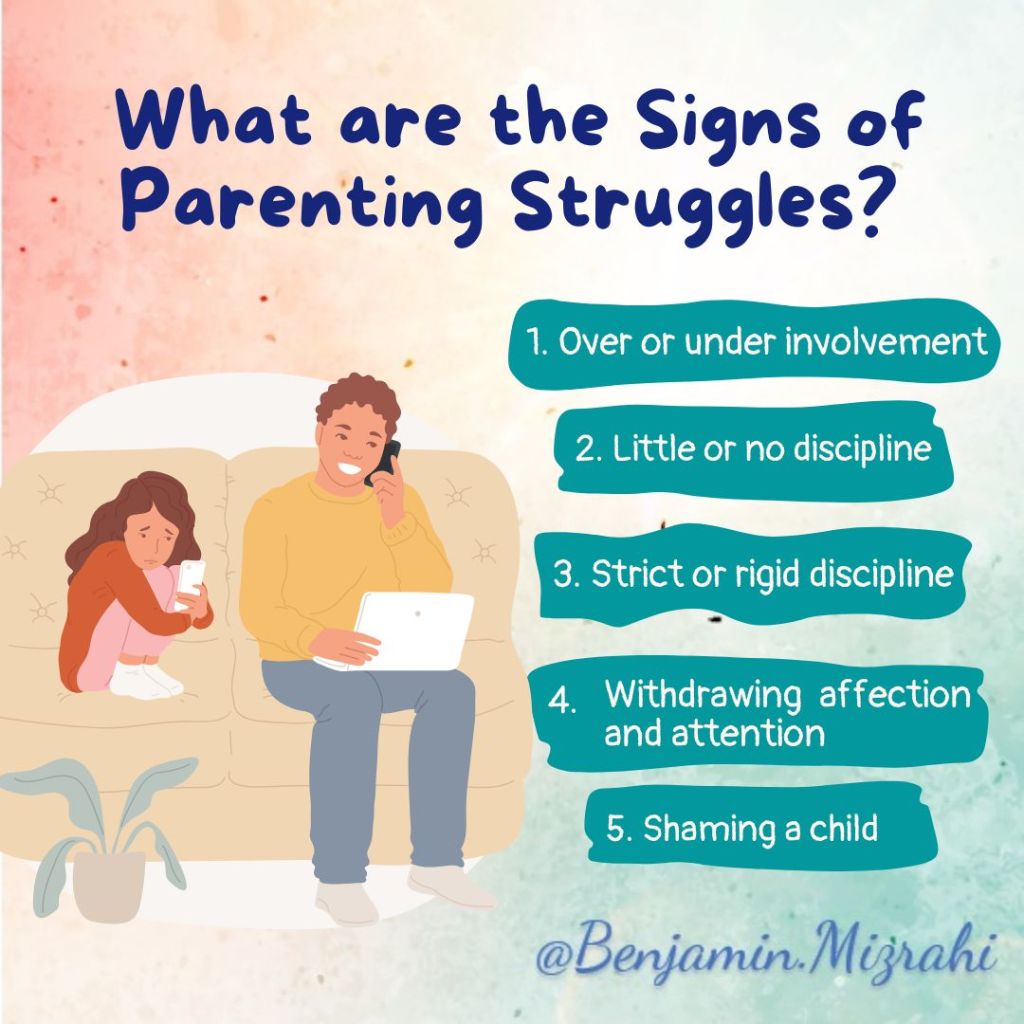
What are the Signs of Parenting Struggles?

There is no universal by-the-book manual that will tell you the rights and wrongs or dos and don’ts for parenting. Often, it is a process of learning and adjusting for the parent. It involves experiences and guidance for one to develop their ability to raise a child; who will prepare them for the world. However, there are some telltale signs that are indicative of a parent’s negligence or authoritarianism in certain aspects. Some of which are: 

Over or under involvement 

Over – can be very limiting as to the child’s sense of agency, which can result in their overdependence and lack of independence. It can also lead them to rebel due to being very repressed. 

Under – Very dangerous as the child is not provided with the most basic needs such as food, shelter, and clothing, or lacking in the sense of love, which can drive them to a dark path due to the lack of a guiding hand. 

Little or no discipline 

Defining boundaries and regulating their behavior is one of the most important principles a parent can teach their child. If the child grows up not knowing the consequences, it can lead to their own undoing. 

Strict or rigid discipline 

The exact opposite of the former, rigid discipline can render the child fearful of every decision they make and its outcomes. It can also lead them to be rebellious. 

Withdrawing affection and attention 

This type of parenting is emotionally destructive to the child as it will teach them that love is conditional and will believe that they must please a person for them to reciprocate the feeling of love, which can yield to abusive relationships and codependency. 

Shaming 

Shaming a child will encourage them to fear imperfection and failure, thus makes them anxious of every aspect of themself, and in severe cases, depression. 

Coach Benjamin Mizrahi. Educator. Learning Specialist. Family Coach. Father. Husband.   

More articles on www.MrMizrahi.blog  

6 Ways to Show Faith in Your Child

SIGNS OF DEPRESSION IN CHILDREN

Depression is a serious issue that exists among all ages and should be taken seriously no matter the context. Depression in children is easily brushed off as a phase of development or seen as superficial. However, if left to fester, this may lead to severe consequences in the development and wellbeing not only of the child, but also the immediate family. Observe for these signs of depression that may manifest: 

 
Persistent sadness  

Feelings are often short, and if the child seems to exhibit sadness that persists through long periods of time without warning, it may be a symptom of depression. 

More irritable than usual 

This is characterized by irritability towards people who try to interact with them, as they have a negative outlook towards people due to the nature of their illness. 

Loss of interest in usually fun activities 

People suffering from depression often lose motivation to live. This is like taking the light away from life, making everything dark and gloomy. This is perhaps one reason why they see no point in taking part in these activities, they see no motivation in it. 

Constantly feeling tired or disinterested 

When they are not motivated by anything, it will always feel like there is no point in everything they do, and thus the feeling of tiredness or fatigue. 

Trouble sleeping through the night 

Sleeping problems are common in people with depression.  Overthinking and negative feelings may be contributors to this symptom. 

Loss or change in appetite 

Depression makes a person lose interest in daily activities, or life in general. This also includes the need for sustaining oneself. 

If your child is manifesting several of these signs, it is time to seek professional help for their evaluation. You must be there for your children in times that they need you the most. They should not feel outcast from their own family, for the people who are the most difficult to love are those that need it the most. 

Coach Benjamin Mizrahi. Educator. Learning Specialist. Family Coach. Father. Husband.   

More articles on www.MrMizrahi.blog  
6 Ways to Show Faith in Your Child

How to Be a ‘Gentler’ Parent 

Gentle parenting is a parenting style that promotes a relationship with your children based on willingness and choices, rather than demands and rules made by a parent. It teaches children to do what is good by using positivity and patience, rather than fear or punishment. 

Gentle parenting starts with the parent. Are you in control of your emotions? Do you have a healthy relationship and communication with your partner? Are you ready to raise a child using gentle parenting methods? Make sure to reevaluate your own behavior before you correct your child’s. 

Parents should try to follow these four key principles of gentle parenting: 

Empathy 

Parent, while always being aware of your child’s feelings and needs. Difficult parenting situations typically occur when a child is misunderstood. Rather than dismissing a child as ‘manipulative’ or ‘naughty’, a parent should instead try to understand the cause of the child’s misbehavior. 

Respect 

Respecting your child as an adult is another key characteristic of gentle parenting. It requires respect to be earned through parents respecting their child’s feelings and personalities, and over time a child will learn to respect their parent. 

Understanding 

The gentle parenting technique of understanding that children have not fully developed and therefore do not have the same control over their behavior. This understanding also requires a parent to understand their own behavior. Modifying our own behavior is key to being a role model for children to follow. 

Boundaries 

Boundaries play a crucial role. Boundaries are not about endless lists of rules or regulations – boundaries are about teaching children a better way of doing things. 

Parenting requires both physical and emotional support. Proper care for yourself as a parent is equally crucial for your wellbeing. Nurturing yourself nourishes the body and mind making you more understanding, patient, empathetic and sensitive to your children’s needs. This benefits both you and your children! Don’t be hard on yourself if you have a hard day parenting – we’ve all been there. You’re doing great! 

Coach Benjamin Mizrahi. Educator. Learning Specialist. Family Coach. Father. Husband.   

More articles on www.MrMizrahi.blog  

How To Help Your Child to Do Chores

One of the most important lessons a parent needs to impart upon their children is the importance of housework. Yes, it can be difficult, even more so if you are raising a child who has been diagnosed with ADHD.  

ADHD kids often have trouble following directions and are easily distracted. But that doesn’t mean you should give up; you need to adjust your parenting skills somewhat. Getting kids to do their chores is never easy. Here are a few tips to help your child with ADHD learn their chores and other household duties. 

🔹 Break down each chore into components. Simply telling them to “clean your room” can overwhelm them with all the tasks that need to be done. Instead, provide them with a checklist detailing each task that you want them to do like so: 

  1. Pick up your toys and put them back where they belong 
  1. Put dirty clothes into the hamper 
  1. Fix your bed 
  1. Arrange your shelves 

🔹 Set a deadline. Having a set deadline can help them focus on the task at hand. Make these deadlines reasonably long and make sure to remind them of their deadlines at regular intervals to keep them focused on the task. Using a timer might also be a good idea to help keep track of time. 

🔹 Make a chore chart.  Provide them with a reference of what they need to do. Your child will be more receptive to visual learning so creating a task board and updating it as your child finishes tasks is a good way to remind them visually of all the tasks they need to do as well as how much they’ve already done.  

🔹 Provide positive incentives. These rewards can be simple, like providing a bit of spending money, or you could reward them with something more substantial like a day out with them or letting them visit their friends to play. Keep your promise of the reward as much as possible. 

🔹 Be Ready to Assist Your Child When They Need It. Sometimes a child with ADHD will feel overwhelmed by the sheer number of tasks that go into a chore like cleaning their room. At times like these, you should come in and help your child out by assisting them in their work. You can make a game out of the task to keep their attention focused on cleaning.  

🔹 Know your child. Observe their behavior. Take note of what they find exciting, what frustrates them, and what sorts of strategies they are receptive to. A parent needs to remember that not every negative action their child does is out of defiance. Sometimes it’s because they are feeling overwhelmed, or frustrated.   

Coach Benjamin Mizrahi. Educator. Learning Specialist. Family Coach. Father. Husband.   

More articles on www.MrMizrahi.blog  

Benefits of Nature for Kids

A new study into the impact of outdoor activity on children’s wellbeing suggests that being outside can also make youngsters feel more confident and capable of trying new things. 

Studies show that children are more creative when exposed to nature; they can use all their senses rather than just sight and sound; they can use their imagination. Children in nature-based playgrounds engaged in more creative play than children in traditional asphalt/structure-based playgrounds. The benefits of getting kids in nature can be seen on many levels. 

Body 

  • Outdoor play increases fitness levels and builds active, healthy bodies, an important strategy in helping the one in three American kids who are obese get fit. 
  • Spending time outside raises levels of vitamin D, helping protect children from future bone problems, heart disease, diabetes, and other health issues. 
  • Being outside improves distance vision and lowers the chance of nearsightedness. 

Mind 

  • Exposure to natural settings may be widely effective in reducing ADHD symptoms. 
  • Schools with environmental education programs score higher on standardized tests in math, reading, writing, and listening. 
  • Exposure to environment-based education significantly increases student performance on tests of their critical thinking skills. 

Spirit 

  • Children’s stress levels fall within minutes of seeing green spaces. 
  • Play protects children’s emotional development, whereas loss of free time and a hurried lifestyle can contribute to anxiety and depression. 
  • Nature makes children nicer, enhancing social interactions, value for community, and close relationships. 

In order to raise adults who are passionate about protecting the environment and preserving our planet, they must first develop a deep love for it. The only way to enable children to grow comfortable in nature is to open the door and let them out to explore the wonder and awe of the natural world. 

Coach Benjamin Mizrahi. Educator. Learning Specialist. Family Coach. Father. Husband.   

More articles on www.MrMizrahi.blog  

TIPS FOR MINDFUL PARENTING

Parents carry the burden of raising their children well and setting a good example for them. A budding life that has stemmed from you, whose character and future are dependent on how well they are raised, might at times weigh heavily on your conscience. But, at the end of the day we are still human. So, when you are on the verge of a collapse, keep these tips in mind: 

  1. Be mindful of your own triggers 
  1. Mindful, relaxing breathing for instant calm 
  1. Model the behavior you want 

(If you can’t do it, your kids can’t either) 

  1. Apologize if you made a mistake, no one is perfect, nor should one believe to be 
  1. Show that being human is a good thing 
  1. Recognize when you are reaching your limits, and prioritize your wellness and self-care (You can’t take care of your children if you are unwell yourself) 
  1. Make everyday a learning experience for both of you 

Keep in mind, parenting is not the destination, but the journey. 

Coach Benjamin Mizrahi. Educator. Learning Specialist. Family Coach. Father. Husband.   

More articles on www.MrMizrahi.blog  

How Parents Affect Their Child’s Mental Health 

When parents are stressed out or dealing with emotional issues such as anxiety, anger or depression, they must be extra careful about what they say and how they act at home, so as not to affect their kids. 

Children pick up on their parents’ moods more easily than you might think. When kids see that their parents are stressed, tired, angry, upset or irritated, they can’t help but experience that negative energy as well. 

If it happens often enough, this negativity may affect the children’s emotional and cognitive development. In time, parents may find that their kids can’t relate to them or no longer want to spend time with them. They may stop sharing their problems with them or find it hard to express themselves verbally at home. 

It may also impact physical aspects of your child’s life. Struggling to find enough energy to leave the house or being habitually late when dropping off your child for school or appointments could jeopardize their standing in school. In turn, academic struggles may lead to negative feelings often associated with mental health disorders. 

These situations are often stressful for both parent and child and can deteriorate a relationship, leading to abandonment issues or problems with trust. Be upfront with your children and talk to them about mental health. Explain what it is and that treatments exist. Use your words carefully and avoid labels. 

You should also be open and honest with how you both verbally and nonverbally communicate. Children are smarter than we give them credit for and can pick up on cues. Don’t feel selfish if you need to prioritize getting help over caring for your family. Without you at full strength, your family will struggle to get by even if you’re physically present. 

Coach Benjamin Mizrahi. Educator. Learning Specialist. Family Coach. Father. Husband.   

More articles on www.MrMizrahi.blog  
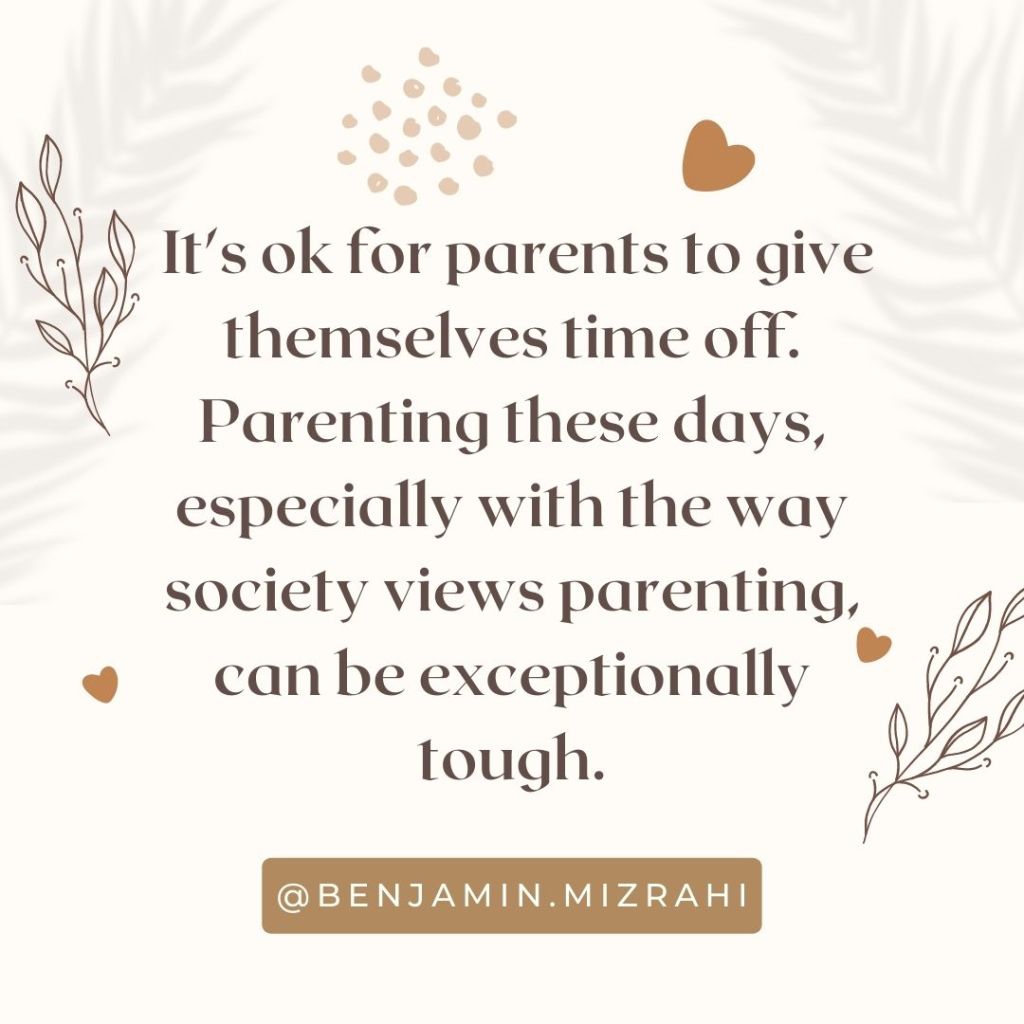
Self-Regulation Techniques for Parents

Being a parent is one of the most challenging and most important jobs you will have in your lifetime. When’s the last time you checked in with your own self-regulation techniques? Without proper attention paid to our own needs and feelings, the stress can become overwhelming, and we might not always respond to that stress in healthy ways. 

But knowing which self-regulation techniques work best for you in stressful situations can help you work through those moments. Being able to identify what triggers an emotional response in you is a great first step in self-regulation. You could even make a list of these triggers and assign a healthy way to respond in each situation. 

  • Practice deep belly breathing exercise. 
  • Listen to upbeat music when you are feeling down or calming music when you are feeling tense. 
  • When unhelpful or negative thoughts enter your mind, acknowledge them, then move on. 
  • Think before acting. This involves taking a pause between your feelings and an action. Feel your feelings and name them. Once you can name the feeling, you can take it. 
  • See if you can find the humor in the situation. 
  • Spend some time thinking about what happens in your body when you start to feel upset. What helps you notice those feelings and remain calm? 

Learning to regulate emotions is a lifelong journey. Start by noticing your own moods and feelings. When you get upset, resist acting until you’re calm. Just breathe, and hold yourself with compassion, so you can calm down before you act. 

Keep in mind that our children learn self-regulation techniques through the way we parent and how we manage our feelings. You will see your child act like you do and say what they hear you say. Let’s strive to be the best role models we can be! 

Coach Benjamin Mizrahi. Educator. Learning Specialist. Family Coach. Father. Husband.   

More articles on www.MrMizrahi.blog