How to Support Healthy Risk-Taking

A better approach is to let kids figure out their capabilities by taking some risks. Instead of always freaking out, just watch. If you see determination on his face even if it’s mixed with fear – let him, be. Remain close by, if it makes you more comfortable, but resist the urge to reach out. 

Rather than immediately stop your child’s “crazy plans,” watch and observe. Ask what he’s doing. If you see something potentially unsafe, speak up. Express your concern, but then let your child solve the problem. Some kids will immediately adjust their plans. Others will resist. It’s OK to step in and stop things if needed. 

Let kids try some risky things under the supervision of an adult who models and discusses safety protocols. Allow your child to gradually assume more responsibility. In doing so they will feel that powerful emotion of pride through accomplishment. 

Above all, encourage and praise your child’s ambition and determination. His desire to tackle challenges and take risks will serve him well in the years to come. 

Coach Benjamin Mizrahi. Educator. Learning Specialist. Family Coach. Father. Husband.   

More articles on www.MrMizrahi.blog  

AUTISM: WHAT YOU NEED TO KNOW

Autism Spectrum Disorder (ASD) or more commonly known only as Autism, is a developmental disorder that affects communication and behavior. Symptoms generally appear within 2 years of life. 

The cause of ASD is not entirely clear, however, there is research which suggests that the factors which can cause autism are genetic with the influence of environmental factors and non-genetic factors. Therefore, it is important to be vigilant for early signs so that the child may get the help they need to develop. 

Early Signs  

  1. Difficulty with communication and interaction with other people 
  1. Restricted interests and repetitive behavior 
  1. Behavior that impairs the child’s ability to function properly in society 

 
Specifics 

  1. Not responding to their name 
  1. Avoidance of eye-contact 
  1. Flat facial expression 
  1. Avoids physical contact 
  1. Echolalia, repetition of words or phrases 
  1. Overall peculiar behavior accompanied by lack of response to other people or parents 

 
By being able to recognize concrete symptoms and evidence of autism, the child can undergo therapy or interventions so that they can receive the proper attention they need.  

Coach Benjamin Mizrahi. Educator. Learning Specialist. Family Coach. Father. Husband.   

utism Spectrum Disorder (ASD) or more commonly known only as Autism, is a developmental disorder that affects communication and behavior. Symptoms generally appear within 2 years of life. 

The cause of ASD is not entirely clear, however, there is research which suggests that the factors which can cause autism are genetic with the influence of environmental factors and non-genetic factors. Therefore, it is important to be vigilant for early signs so that the child may get the help they need to develop. 

Early Signs  

  1. Difficulty with communication and interaction with other people 
  1. Restricted interests and repetitive behavior 
  1. Behavior that impairs the child’s ability to function properly in society 

 
Specifics 

  1. Not responding to their name 
  1. Avoidance of eye-contact 
  1. Flat facial expression 
  1. Avoids physical contact 
  1. Echolalia, repetition of words or phrases 
  1. Overall peculiar behavior accompanied by lack of response to other people or parents 

 
By being able to recognize concrete symptoms and evidence of autism, the child can undergo therapy or interventions so that they can receive the proper attention they need.  

Coach Benjamin Mizrahi. Educator. Learning Specialist. Family Coach. Father. Husband.   

More articles on EXECUTIVE FUNCTIONS COACHING (mrmizrahi.com)

THE 4 INTELLIGENCES

Apart from the Intelligence Quotient (IQ), there are 3 other measures of intelligence that comprise the person, and these are: 

  • Intelligence Quotient (IQ) 

The measure of your ability to comprehend concepts, solve mathematics, memorization and recall. IQ is well known to be the measure of intelligence with standardized tests. This is a reflection of your intelligence. 

  • Emotional Quotient (EQ) 

Measure of one’s ability to control and understand their emotions to positively express them and properly communicate and empathize with others. A high EQ tends to reflect a more positive outlook in life and ability is able to maintain more wholesome relationships. This represents your character. 

  • Social Quotient (SQ) 

The SQ is the measure of your ability to build relationships with friends and maintain it for a long period of time. It is a reflection of your charisma and social prowess. 

  • Adversity Quotient (AQ) 

The measure of your ability to overcome hardships in life. The AQ highlights the person’s internal strength and will to push through adversity. By far, this is the most practical form of intelligence. 

 
You can perceive these intelligences in two ways: 

  1. These quotients are fixed for every person. Meaning, where they are proficient, that is their strength and cannot build up other intelligences.  

or 

  1. These quotients are skills that one can improve over time through effort. 

Thus, it is important to fortify one’s intelligences at a young age, that they may grow up to be well-rounded individuals. 

Coach Benjamin Mizrahi. Educator. Learning Specialist. Family Coach. Father. Husband.   

More articles on EXECUTIVE FUNCTIONS COACHING (mrmizrahi.com)

Activities to Help Your Child Develop Confidence

Self-confidence is something that we all build upon as we go through life. With the support and encouragement of their parents, family and circle of friends, every child can begin to build their confidence and empower themselves. 

These activities are simple, but effective for building confidence, which is vital to happiness and health: 

Make a list. Sit down with your child and together, brainstorm their strengths. Focusing on the positive can go a long way towards empowerment.  

Use positive affirmations. These words of encouragement can become rituals in your family that lead to positive self-talk over time. Simple phrases such as “you are loved” or “you are safe” can become second nature.  

Make time for play. Playtime is one of the best investments you can make in your child. The hours you spend playing with your children shows them that they are valuable and worth your time.  

Goal plan. Set some attainable personal goals with your child and then help them set out to achieve them. Celebrate their progress. 

Do an act of kindness. Acts of kindness such as helping a friend at school, or volunteering at a food bank, are incredibly important for kids. We feel good about ourselves when doing good for others. 

Provide them with small jobs. Children need opportunities to display their skills and feel that their contribution is valued. At home, this means asking them to help with household chores. 

Collaborate on some artwork for the home. Displaying a child’s artwork on the wall or refrigerator is a major confidence-booster for kids. Grab a canvas from the craft store and work on a piece of art for the home together! 

Coach Benjamin Mizrahi. Educator. Learning Specialist. Family Coach. Father. Husband.   

More articles on www.MrMizrahi.blog  

Common Mental Disorders in Children

Attention Deficit Hyperactivity Disorder (ADHD) 

This disorder is characterized by an inability to focus on one task, and their focus is easily swayed by other things. If left undiagnosed, this can be brought into adulthood. It is important to recognize the early symptoms so that the child is given the necessary help. 

 
Autism Spectrum Disorder 

 
A developmental disorder that affects the child’s social ability which is characterized by strange social behavior and difficult communication with them. ASD is an umbrella term that encompasses many forms and conditions that affect communication and development. 

Depression 

This is a medical condition that is characterized by deep, severe sadness that goes beyond normal sadness or grief. It is difficult to clinically diagnose this without seeking professional help, thus it is important to be vigilant for signs of depression. 

 
Anxiety 

This is a category of psychiatric diagnoses that cover several disorders such as specific phobias, separation anxiety, social anxiety disorder, panic disorder, etc. Anxiety attacks are commonly characterized by physical, emotional, behavioral, or cognitive symptoms. Often, these are similar to the fight or flight response. 

 
Vigilance and observation are key in monitoring your child’s development. Though every child is unique, look out for definitive, significant symptoms that mark the presence of certain disorders so that the child may be given professional help. 

Coach Benjamin Mizrahi. Educator. Learning Specialist. Family Coach. Father. Husband.   

More articles on www.MrMizrahi.blog  
6 Ways to Show Faith in Your Child

PARENTING TIPS FOR CHILDREN’S MENTAL HEALTH

Mental health is an aspect of our wellbeing that is just as important as our physical health, and on a personal scale, we should always strive for its preservation. However, there is a stigma that exists against the youth who experience mental illnesses, especially those who live relatively comfortable lives (who, if I may observe, are more prone to mental illness).  

Parents have the duty to ensure that their children are healthy in every sense of the word, and so they must also account for their mental and emotional wellbeing. Here are some tips for helping your child through difficult times: 

  • Pay attention to your child’s feelings 
  • Praise their accomplishments 
  • Don’t punish them for their shortcomings constantly 
  • Be their companion in tough times 
  • Empathize with them, put yourself in their shoes 
  • Be flexible with your expectations in times of stress 
  • Try to maintain a calm demeanor, as your child will experience stress too if they sense from you that all is not well 

Parents can’t always be a Superman/Wonder Woman that can shoulder the burden of the world, which is why the most essential tip is to be human. At the end of the day, perhaps all we need is someone to be our friend in difficult times, someone we can relate with, laugh with, and most importantly, find strength in each other. 

Coach Benjamin Mizrahi. Educator. Learning Specialist. Family Coach. Father. Husband.   

More articles on www.MrMizrahi.blog  

Tips for Preventing a Victim Mentality

When children take on a victim mentality, it becomes a form of defiance, used to avoid taking appropriate responsibility and being held accountable. If left unchanged, the victim mentality can eventually impact your child’s ability to have healthy relationships and to adequately function as an adult. 

It is vital that your child learns new skills in order to manage responsibility in the real world. Here are seven steps you can take to empower your child: 

🟡 Create Gratitude Rituals 

Spend time talking about what you’re grateful for every day. Even when you encounter difficult circumstances, role model a grateful attitude. 

🟡 Silence Negative Thinking 

Help your child silence their negative thinking by looking for exceptions to the rule. If they say, “No one ever likes me,” point out people who do. 

🟡 Face Uncomfortable Emotions 

Let them know that emotions are OK but that it’s important to handle those emotions in a socially appropriate manner. Teach them healthy ways to express their feelings and prevent them from hosting their own pity party every time they get upset. 

🟡 Teach Problem-Solving Skills 

Teach your child how to problem-solve. A child who takes action when they face hardship is much less likely to see themself as a helpless victim. Kids with good problem-solving skills can prevent small stumbling blocks from turning into major obstacles. 

🟡 Help Other People 

Helping other people can show your child that no matter how young they are, or no matter what problems they’ve experienced, they have the ability to help someone else. 

🟡 Teach Assertiveness Skills 

Kids with assertiveness skills can speak up and say, “Don’t do that,” or “I don’t like it when you do that.” Empower your child to use their words and you’ll reduce the likelihood that they’ll become a victim. 

🟡 Role Play Tough Situations 

Help your child learn to avoid a victim mentality by showing them how to proactively deal with tough situations. When they realize their choices in responding to tough situations, they’ll be more likely to take positive action.  

Coach Benjamin Mizrahi. Educator. Learning Specialist. Family Coach. Father. Husband.   

More articles on www.MrMizrahi.blog 

Teaching Kids About Boundaries

Implementing boundaries can be tricky. The real world is filled with rules and limitations. When rules and expectations are enforced without love, grace, and respect, the family atmosphere turns legalistic, without much room for grace and forgiveness. 

Kids who understand healthy boundaries learn what it means to grow up and be more like an adult, listen and respond to authority. They develop a stronger sense of safety and security and can focus on fun and enjoyment rather than trying to figure out what rules are going to get them in trouble. 

Using different activities to teach your children what their boundaries are, will help motivate them to follow the rules.  

👉 Teach your children what the boundaries are, including inappropriate and acceptable physical touch.  

👉 Demonstrate to your children how to work their problems out on their own.  Solving your children’s problems every time they experience something unpleasant will send the message that there are no boundaries for taking personal responsibility.  

👉 Spend regularly scheduled time alone with each of your children. It lets them know that you are a safe place to go when they are having trouble in their lives.   

👉 Give children a chance to express their successes, failures, questions, and concerns. Children who feel as if they have a voice are more likely to follow your rules and adhere to your boundaries. 

👉 Sometimes the best way to define or set a limit is with a good old fashion “no.” However, when “no” is overused on every nitpicky little irritation, it loses its value and creates a negative atmosphere. 

Coach Benjamin Mizrahi. Educator. Learning Specialist. Family Coach. Father. Husband.   

More articles on www.MrMizrahi.blog 

Teach Kids Important Life Values 

Values are very important in parenting since they deeply influence all behaviors and attitudes and effect our decisions and relationships. Understanding the concept of values and the importance of teaching them gives parents a powerful way to influence their children and to shield them from the adverse forces they may encounter in the outside world. 

Teach your kids about the following universal values: 
 
1. Kindness and compassion 

Be sure to show your child that you notice when someone does something nice. Likewise, if your own child treats someone nicely, be sure to acknowledge and praise her effort.   

 
2. Honesty and trustworthiness 

If you wish to teach your children not to lie, you need to make sure they know the consequences of their actions and punish the undesirable behavior. Also emphasize that we want to earn the trust of others, which comes through acting genuinely and in ways that do not let others down. 
 
3. Respect 

It’s true that respect is earned, but you should also teach children to maintain a basic respect for living things in general, a type of courtesy we extend towards others under any circumstance.  

 
4. Integrity 

Integrity means I can be counted on to fulfill a commitment I made to the best of my ability. It also means I can admit when I’ve overcommitted and can make amends for how it affects other people. Repeatedly following through with your own commitments to your kids shows them first-hand. 

5. Love 

Let your child see you demonstrate your love and affection for the people in your life. The more you say “I love you” to your child, the more your child will say “I love you” back.  

Coach Benjamin Mizrahi. Educator. Learning Specialist. Family Coach. Father. Husband.   

More articles on www.MrMizrahi.blog 

Dealing With Power Struggles

Power struggles are inevitable. They spring from what looks like competing interests of loving people at very different ages and stages. The fact that you and your child get into power struggles means that you and your child are each doing the most appropriate thing you can think of. Your job is to be the parent, keeping life safe and somewhat ordered. Your child’s job is to keep from feeling helpless in the face of so many decisions that are out of her hands. 

Take a moment to consider your relationship with your kids. Remember that you can influence your child positively, but mostly only when they feel the connection with you. Here are some tips when dealing with power struggles:  

  • Don’t take it personally. Remember that your child’s efforts to try and control situations stems from a healthy impulse to want to meet his/her needs.  
  • Identify areas where you can appropriately empower your child. 
  • Give them age-appropriate responsibilities, this conveys your confidence in their capabilities, which will empower your child. 
  • Respect their opinions. Listen. Often the very experience of being heard can calm a child and make them feel supported. Even if what your child is suggesting isn’t appropriate at the time, having the freedom to share is validating. 

Coach Benjamin Mizrahi. Educator. Learning Specialist. Family Coach. Father. Husband.   

More articles on www.MrMizrahi.blog 

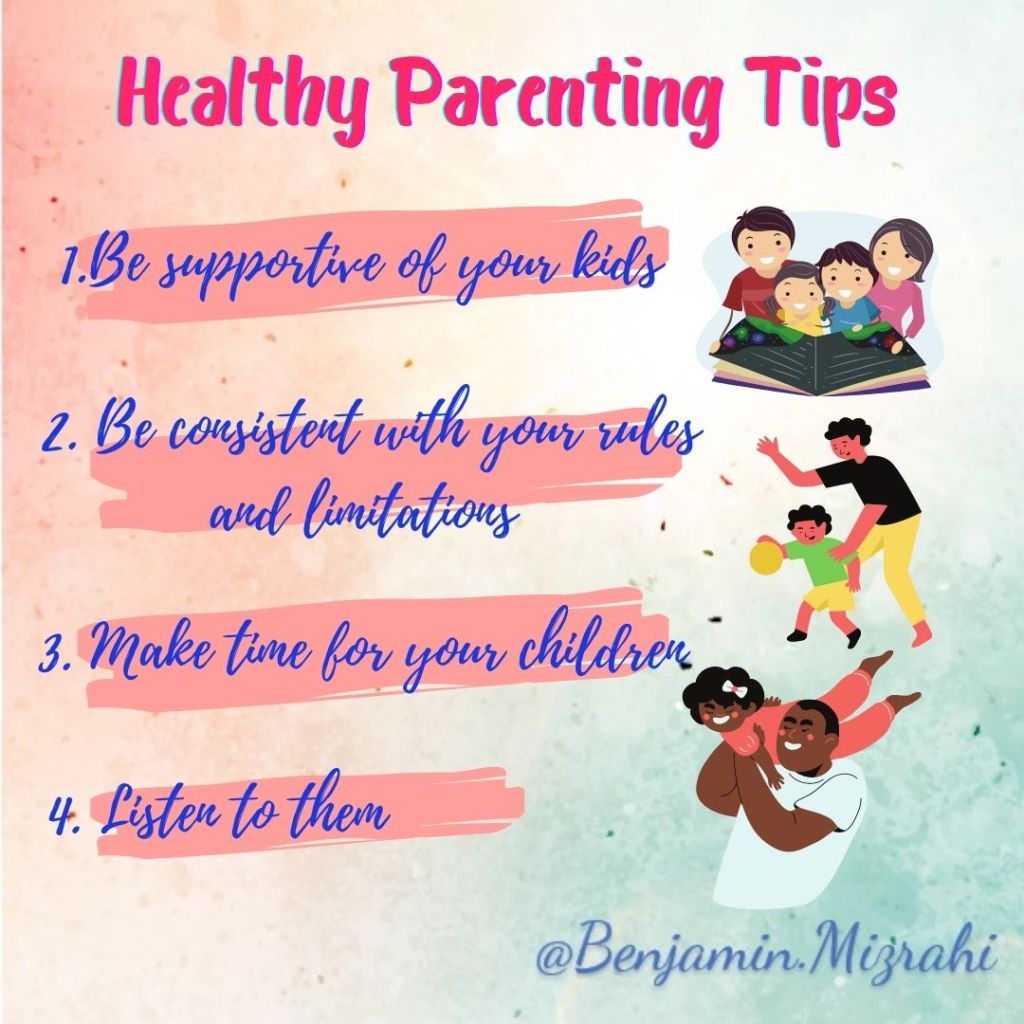
Healthy Parenting Tips

  1. Be supportive of your kids 

It is important for a child to find their sense of self at their age. Their childhood is a crucial point in their life in which they discover their wants, aspirations, ambitions, their identity. Allow them to explore their interests and hobbies, give them praise for their achievements no matter how small, raise them to become strong and independent yet compassionate. Do not be controlling of every single aspect of their lives for it will only make them feel as if they have no control of it or grow to become heavily dependent. Parents should be the guiding wind, instead of a governing river. 

  1. Be consistent with your rules and limitations 

Kids can… get tough at times, even more so if they perceive the house rules as “open to interpretation”.  Discipline is an important aspect of child-rearing, and so with consistent rules and their corresponding consequences, they may learn to be held accountable for their actions.  

  1. Make time for your children 

As parents, you will most likely desire a wealthy life for your children to grow up comfortably, and truly that is the goal of which parents shed blood, sweat and tears for. However, do not brush off the most valuable possession of yours that cannot be bought by any currency, that is a fraction of your time. Not only will this help your child to grow up with the attention and affirmation they need, but you’ll also be able to see where your child needs most support. 

  1. Listen to them 

Oftentimes talking to parents can be like conversing with a wall, stubborn and unmoving.  Don’t always resort to authority when your child questions the rationale behind your judgement. Be reasonable and allow them to give their insights regarding certain issues and beliefs. This will help your child to be articulate, and by doing so they tend to rebel less because they will see you as a guiding figure, and not an authoritative one. 

Coach Benjamin Mizrahi. Educator. Learning Specialist. Family Coach. Father. Husband.   

More articles on www.MrMizrahi.blog  
6 Ways to Show Faith in Your Child

Understanding Dyslexia

Dyslexia is a learning disorder that makes reading and decoding letters and words difficult for those affected by it. It is important to understand that dyslexia is not a disorder of the eyes, but rather on how the mind interprets what the eyes see. Dyslexics have different variations in their perception of words and letters, but some may: 
 

  • See letters backwards or upside down 
  • See text jumping around the page 
  • Have difficulty differentiating letters that have similar shapes such as o, e, c 
  • Have difficulty differentiating letters of different orientations such as b,q,p, and d 
  • Feel dizzy after trying to read  
  • Be able to read but unable to sound them out  

Some dyslexics might have these perception disorders, but some may have none and yet still be dyslexic. It all comes down to how the brain interprets these codes wherein the essence of dyslexia is anchored upon. Either way, it is important to recognize the symptoms early on, so that dyslexic children may be given the help they need. Symptoms become more prominent as the child gets older, such as: 

Before School 

  • Talking late 
  • Learning new words slowly 
  • Difficulty in forming new words; jumbling the sounds of a word or reversing its pronunciation 
  • Difficulty learning nursery rhymes 
     

School Age 

  • Reading ability is well below what is expected of their age 
  • Difficulty processing what they see or hear 
  • Difficulty formulating answers or right words to questions 
  • Unable to differentiate similar letters  
  • Difficulty in spelling 
  • Deliberate avoidance of tasks that involve words and letters 

Teens and Adults 

  • Difficulty reading  
  • Slow and tedious reading and writing 
  • Trouble in spelling  
  • Avoidance of activities that involve reading and writing 
  • Mispronouncing names or words 
  • Trouble understanding jokes or expressions that have allude to a different meaning such as idioms or metaphors 

It is never too late to seek help when one is suffering from dyslexia. We must remove the stigma that surrounds “slow” individuals and instead help them develop at their own pace, and to give help when they need it the most. However, let us not forget that the goal of helping or seeking medical help is for them to become independent. Babysitting such individuals will only make them reliant on others for a disorder that will last their lifetime. 


Coach Benjamin Mizrahi. Educator. Learning Specialist. Family Coach. Father. Husband.   

More articles on www.MrMizrahi.blog  
6 Ways to Show Faith in Your Child