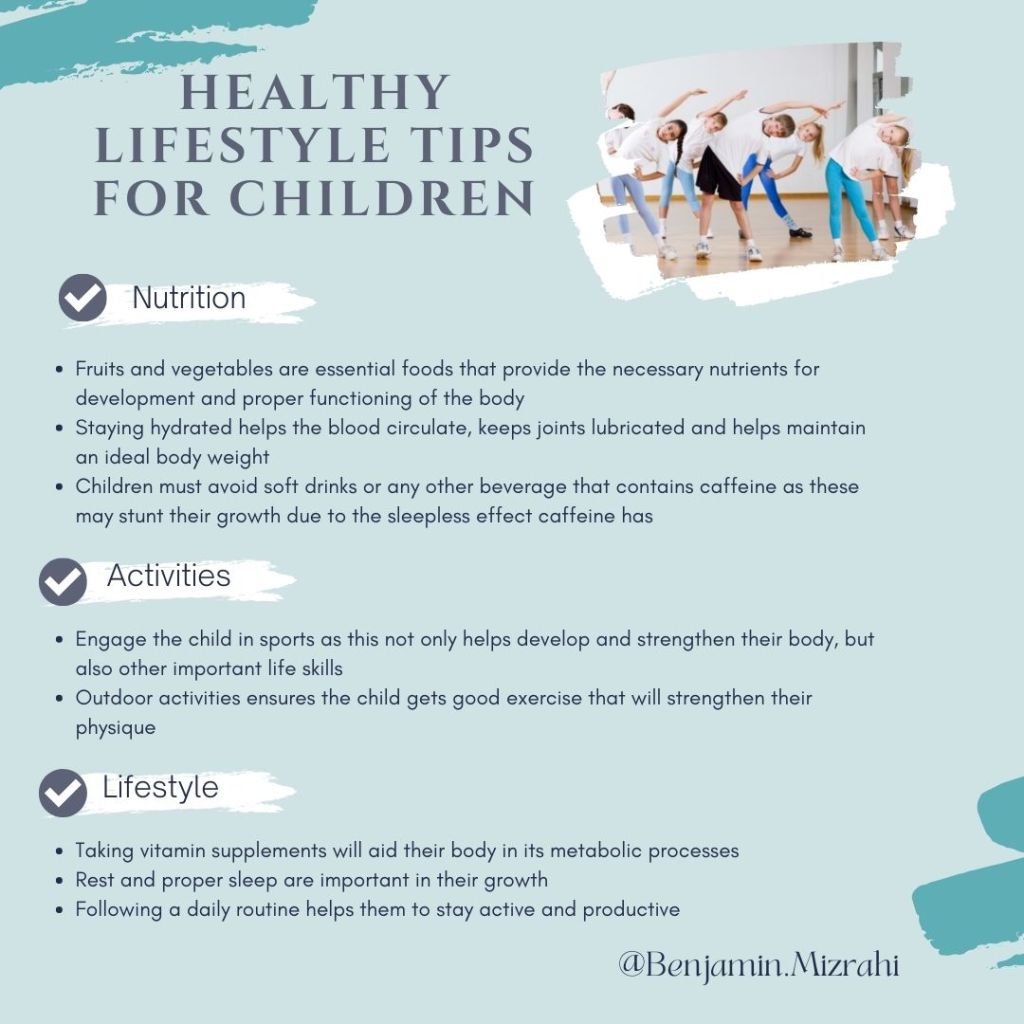
HEALTHY LIFESTYLE TIPS FOR CHILDREN

These are some quick tips for a child’s healthy development in three aspects: 

 
Nutrition 

  • Fruits and vegetables are essential foods that provide the necessary nutrients for development and proper functioning of the body 
  • Staying hydrated helps the blood circulate, keeps joints lubricated and helps maintain an ideal body weight  
  • Children must avoid soft drinks or any other beverage that contains caffeine as these may stunt their growth due to the sleepless effect caffeine has 

Activities 

  • Engage the child in sports as this not only helps develop and strengthen their body, but also other important life skills 
  • Outdoor activities ensure the child gets good exercise that will strengthen their physique 

Lifestyle 

  • Taking vitamin supplements will aid their body in its metabolic processes 
  • Rest and proper sleep are important in their growth  
  • Following a daily routine helps them to stay active and productive 

Coach Benjamin Mizrahi. Educator. Learning Specialist. Family Coach. Father. Husband.   

More articles on www.MrMizrahi.blog  

Tips to Improve Focus in Kids with ADH

Thinking of concentration as a skill that can be built up over time is a growth-focused approach to helping your child manage their ADHD. 

Stay positive, patient, and don’t give up. Your child looks to you to set the tone for any challenge they face. Be a model for them and implement some of these tips to start building focus: 

🔶 Break into Small Chunks 

Facing a huge task can seem insurmountable when you look at it all at once – especially for children with ADHD. Break big tasks into bite-sized jobs. Put all the focus on the smaller tasks, and when each is completed, take a break before diving into the next one. 

🔶 Practice Deep Breathing 

Research has shown that a group of nerves in the brain that regulate breathing are connected to the brain’s arousal center. When you keep your breath calm and slow, your brain is signaled to keep at an even keel, as well. Taking deep breaths can help calm them, reduce anxiety, and re-center their attention. For best results, practice when they’re calm so they get the hang of the technique. 

🔶 Encourage Breaks 

Concentrating is naturally harder for kids than adults. That’s why it’s important to let them take breaks between focus sessions – especially if your child has ADHD. Encourage them to get up, move around, and play during breaks so they can sit down again later feeling refreshed, revived and ready to be attentive and focused. 

🔶 Make Time for Play 

Exercising causes stress hormones to drop, encourages the growth of brain cells, and creates new connections between them. On top of that, studies have shown that exercise encourages the growth of brain cells in the region called the hippocampus, which is responsible for memory and learning. 

However, while exercise is a big deal, team sports aren’t the only way to get your child moving. Children may also get their daily exercise through unstructured play – so let them loose in the backyard or on the playground, too. 

Coach Benjamin Mizrahi. Educator. Learning Specialist. Family Coach. Father. Husband.   

More articles on www.MrMizrahi.blog  
Ways to be a More Present Parent

Stress often makes us a bit detached in our day-to-day routine. However, kids learn a lot more from our actions than they do from our words, so always being somewhere else mentally is almost as bad as being somewhere else physically. 

Here are some things that help me be present with my children: 

1. Wake up before your kids. 

That quiet time to center yourself before the day begins works wonders. If it’s not always possible, plan a time during the day, even if it’s 15 minutes, when you can be alone: Maybe during a nap time, quiet time, while your kids are at school, or when your husband is home. 

Instead of using that time to frantically get something done, choose something slow, relaxing, and that you enjoy. 

2. Exercise as often as you can. 

Yoga is one of the best exercises to try because it effectively can bring peace and mindfulness.  

3. Put the kids to bed early. 

Establish an early bedtime, or at least lights-out time. Creating a peaceful end to your days will help break them up instead of feeling like you’re in a never-ending cycle of need-meeting. 

Also, take advantage of bedtime time to talk to your children and ask them about their day. This ritual creates an easy opportunity for children to open about what’s on their mind. 

4. Put your phone away. 

Technology has an uncanny ability to suck us into its world and detach us from the people who are around us. Log less minutes on your devices and more moments with the people you love. 

5. Remember how fleeting childhood is. 

You won’t always be this needed or wanted by your children. When you look back on how you spent these years, you will never regret spending more time with your children. Time spent with family is always a positive investment. 

6. Have daily one-on-one time. 

Make a goal to spend five minutes of uninterrupted one-on-one time with each child every day. It’s amazing how much this simple commitment does for children’s happiness, behavior, and relationships. 

Coach Benjamin Mizrahi. Educator. Learning Specialist. Family Coach. Father. Husband.   

More articles on www.MrMizrahi.blog  

Why You Should Let Children Be Bored 

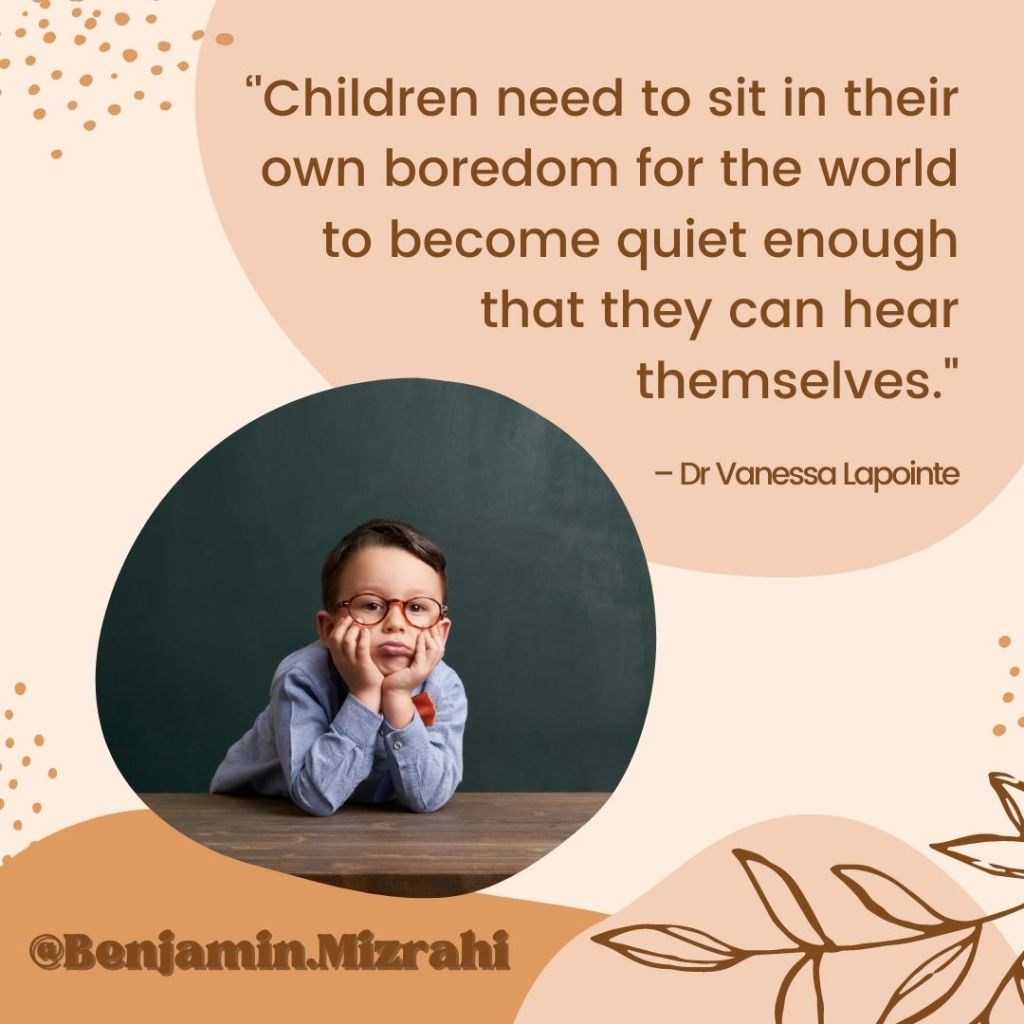
Is your kid whining “I’m bored” on repeat? No parent wants kids to sit around bored for hours, so what’s the right way to handle the situation? Children need to sit in their own boredom for the world to become quite enough that they can hear themselves. 

Here’s why boredom is essential for kids: 

🌟 Boredom sparks creativity 

Boredom gives your child time and reason to be creative and come up with their own ideas. When your child has self-led free time, they get a chance to use their imagination. You may be amazed at what they come up with. 

🌟 Boredom fosters an appreciation for excitement 

A bit of boredom is like a rainy day in the middle of summer. It’s a downer when it happens, but it makes us really appreciate the sunny days that follow. 

🌟 Boredom enhances problem-solving skills 

Being forced to come up with their own entertainment may lead to daydreaming, which will ultimately develop your child’s ability to problem solve.  

🌟 Boredom can bring you closer together 

Try being bored with your child. Put down the phone and ask your child to think of something fun for you to do together. 

🌟 Boredom leads to self-discovery 

Given unstructured time to think freely — about whatever naturally comes to mind — will help your child learn who they truly are. 

Coach Benjamin Mizrahi. Educator. Learning Specialist. Family Coach. Father. Husband.   

More articles on www.MrMizrahi.blog  

Taking Care of Yourself

Being a parent of a child with physical, emotional, or behavioral problems can be exhausting. When you haven’t taken any time for yourself, life can suddenly feel unmanageable. In order to give the best to your child and show your child how to care for themselves, you need to take care of yourself, too.  

It’s important for your child to see you as a human being who places health and wellness as a priority and has self-interests and hobbies. Your child will watch you and learn the importance of self-prioritization. Wellness and self-care practices like these can build a strong family value of caring for oneself – and one another. 

Here are a few common self-care ideas: 

  • Go to the doctor for your annual check-ups. 
  • Exercise regularly. 
  • Spend time alone or with friends. 
  • Do something you love away from your children/family. This can include reading a book at the park or taking a cooking class. 
  • If you have a spouse or partner, spend one-on-one time with him or her. 
  • Try to get as much sleep as possible. During late night waking and feedings, take turns with your partner, if possible. 
  • Practice meditation and/or mindfulness routines to calm and center yourself. 

Coach Benjamin Mizrahi. Educator. Learning Specialist. Family Coach. Father. Husband.   

More articles on www.MrMizrahi.blog  
What to Do When You Notice Your Child Is Struggling

Parents have a natural tendency to continuously help and protect their children. After all, you want the best for them. Letting your child struggle and even fail sometimes can be highly beneficial to his or her development. If parents approach child’s struggles mindfully, rather than reactively, they may notice that their children grow as a result of hardship rather than looking to for an emotional rescue. 

Here are some practical things you can do to make things better for your child in ways that build resilience and teach them that struggle is normal. 

1 | Stay present with your child instead of fixing, changing, or rescuing 

Instead of fixing, parents can be present, stay supportive, but not to take the problem on their own lap. Our children need to face their own problems of childhood, so they are equipped to face bigger challenges in adulthood. 

2) Allow your child to feel 

All emotions are ok, and all emotions are transient. So, there is no need to react or resist what we feel. The most natural way to process emotions is to allow ourselves to feel all our feelings until they pass. We can teach this to our children. 

3) Value and embrace struggle 

If we value struggle and see struggle as necessary and important, kids will more likely see challenges this way as well. All growth, learning and emotional development comes from struggle.  

4) Normalize setbacks, failures, discomfort as part of life 

It is normal for emotions to be continually coming and going not for us to always feel happy. When we normalize this pattern then there is no sense of something being wrong when we face a challenge, setback or discomfort. When we frame struggles and setbacks as normal; we are teaching a lot of resilience to our kids. 

5) Rather than fixing, encourage your child to problem-solve 

Kids want to be empowered and feel that they are capable. For many problems, like peer rejection, there is no simple solution but staying present and available and encouraging your child to solve it, is a great way for your child to build these muscles. 

Coach Benjamin Mizrahi. Educator. Learning Specialist. Family Coach. Father. Husband.   

More articles on EXECUTIVE FUNCTIONS COACHING (mrmizrahi.com)

Teaching Kids Respect

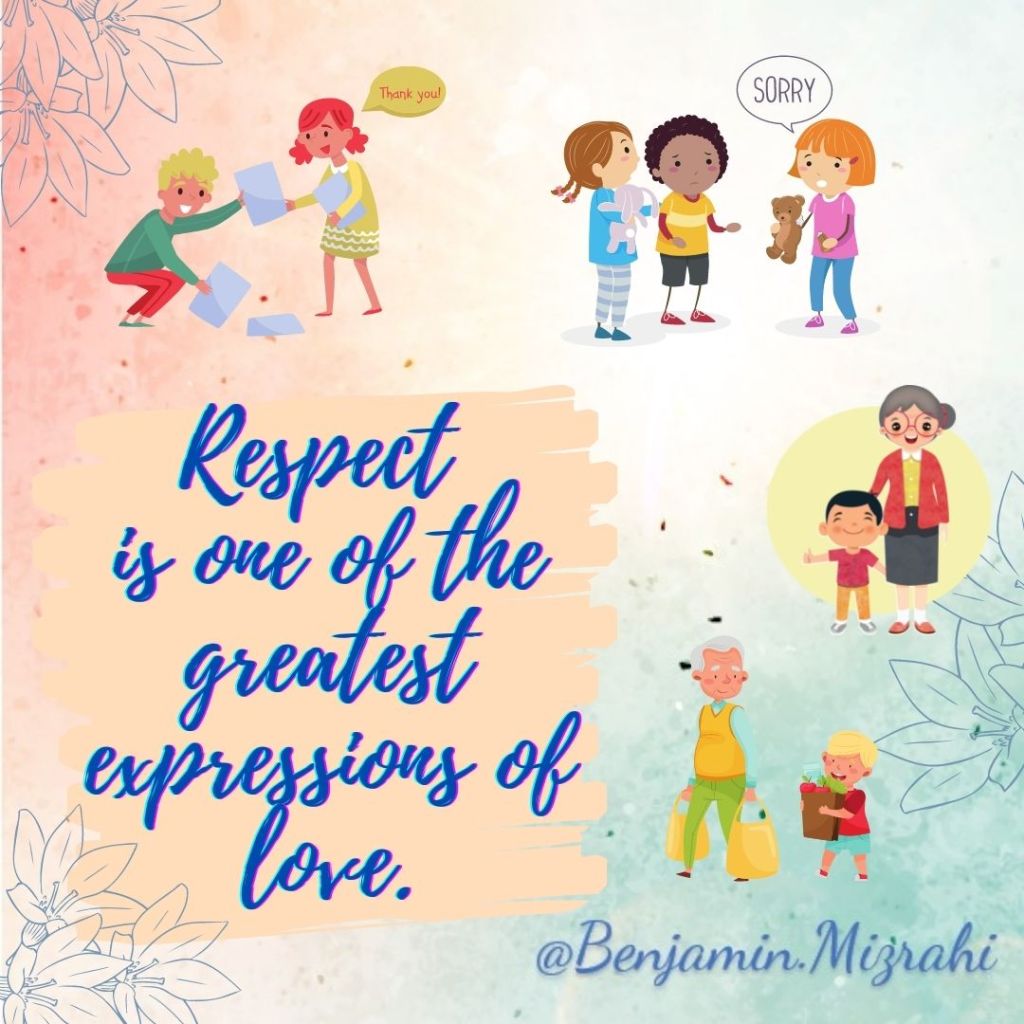
Respect is one of the most important virtues a child can have. Teaching your child how to respect others will ensure they develop positive relationships with their family, friends and communities throughout their life. Respect can be taught in many ways, but ultimately, it’s about ensuring your children treat others the way they want to be treated. 

Below are some of the most important traits your child can gain from learning the virtue of respect. 

🌟 Tolerance 

Your child is bound to face conflict throughout their life. While they might not always agree or understand what’s being said or done, teaching them respect will ensure they do their best to address conflict in a productive way. Teaching your child respect will allow them to communicate in a way that is effective and will encourage them to take responsibility for their own mistakes, and better tolerate the mistakes of others. 

🌟 Listening 

Learning how to communicate effectively means knowing how to listen, and this can be taught by understanding the importance of respect. Show your child how to listen intently, not interrupt and take their turn in order to help them better engage conversationally with others. Listening to those around us is how we learn and grow. 

🌟 Open-minded 

Teaching your children respect ensures they will get to know a person before making a snap judgement. This behavior will help them throughout their entire life, and ensures they treat everyone with kindness. As well, for some children, diversity is a hard concept to understand. However, teaching children respect at an early age ensures they accept everyone for who they are. 

🌟 Good manners 

Teaching your child good manners might seem difficult, especially at a young age. Saying a simple “please” and “thank you” can go a long way/ and, with practice, these gestures can become natural to your child.  

For all children, learning respect takes time, but it’s never too early to start practicing this essential life skill. Ultimately, teaching your children respect will help them to create more positive relationships with their family and friends. 

Coach Benjamin Mizrahi. Educator. Learning Specialist. Family Coach. Father. Husband.   

More articles on EXECUTIVE FUNCTIONS COACHING (mrmizrahi.com)

Teaching Kids About Emotional Regulation

Emotional regulation skills help children with ADHD tame meltdowns, outbursts, and other negative behaviors. Being able to identify and understand feelings are the first steps to regulating emotions, an ability that children will continue to develop throughout their lives.  

Emotional regulation helps kids develop independence, self-discipline, interpersonal skills and emotional intelligence. It also helps children understand the meaning of their relationships with others, build mental resilience and form their identities. 

Use these strategies to teach your child self-regulation techniques to maintain their mental and physical health: 

🔵 Accurately Label Feelings 

Effective emotional regulation hinges on emotional intelligence — the ability to be aware of, express, and manage our emotions on our own and in relationships. A healthy familiarity with emotion starts with a family open to all emotions. Emotional maturity develops over time; it’s normal for younger children to have a hard time with it. Read books, talk about emotion, and describe your own emotions to your child. 

🔵 Behavior Interventions 

Child-directed therapy, where kids learn to identify emotions first and build coping skills to meet what they experience, can be vital for anyone with ADHD. Parental involvement helps, as adults reinforce what their children may otherwise forget to work on. Child-focused therapy should offer direct guidance in forming practical new habits, as children learn to handle their own disruptive emotions. 

🔵 ADHD Medication 

ADHD is a medical disorder. This doesn’t mean that medication is the only tool to cope with it, but it does validate considering medication. ADHD medications are safe and effective when used appropriately. Despite common misperceptions, the correct medication should have benefits with no significant side effects. ADHD medications do not primarily address emotional reactivity, but they often help. 

Coach Benjamin Mizrahi. Educator. Learning Specialist. Family Coach. Father. Husband.   

More articles on www.MrMizrahi.blog  

LIFE SKILLS TO TEACH YOUR CHILDREN

A parent is obligated to equip their children with the necessary skills and means to survive and flourish in life. Here are some simple life skills you can teach your child at an early age: 

  1. Do the laundry 
  1. Cook their meals 
  1. Connect simple electronics 
  1. Care for plants and animals 
  1. Make use of tools  
  1. Write a letter 
  1. Make their own bed 
  1. Guide them through the internet and its capacities 
  1. Wrap a gift 
  1. Set the table right 

Coach Benjamin Mizrahi. Educator. Learning Specialist. Family Coach. Father. Husband.   

More articles on EXECUTIVE FUNCTIONS COACHING (mrmizrahi.com)

Ways to Strengthen a Parent-Child Relationship

Being a parent is one of the most challenging roles in the world. We always go above and beyond to make sure we raise happy and successful children. But no matter what style we choose to use, at the end of the day, it still boils down to the kind of relationship every parent has with their children. The stronger the parent-child relationship, the better the upbringing.   

Here are some techniques that can help you strengthen the relationship between you and your child: 

❤ Show Your Love 
Human touch and loving affection are needed at every stage of our lives for healthy emotional and neurobiological development. It is important that your child receives gentle, loving touch (i.e., hugs) from you several times throughout the day. 

❤ Say “I love you” often 
Even when your child is being difficult or does something you don’t like; this can be an excellent opportunity to remind them that you love them unconditionally. A simple “I love you” can have a major impact on your long-term relationship with your child. 

❤ Set boundaries, rules, and consequences 
Children need structure and guidance as they grow and learn about the world around them. Talk to your children about what you expect of them and make sure they understand. When rules are broken, make sure to have age-appropriate consequences in place and be consistent with them.  

❤ Listen and empathize 
Connection starts with listening. Acknowledge your child’s feelings, show them you understand, and reassure them that you are there to help with whatever they need. Try to see things from your child’s perspective. By listening and empathizing with your child, you will begin to foster mutual respect. 

❤ Play Together 
Play is so important to a child’s development. It is a fun way for you to strengthen your relationship with your child. It does not matter what you play. The key is to just enjoy each other and commit to giving your child your undivided attention. 

❤ Create parent-child rituals 
Quality, one-on-one time with your child can strengthen the parent-child bond, build up your child’s self-esteem, and lets them know that they are special and valued. 

Coach Benjamin Mizrahi. Educator. Learning Specialist. Family Coach. Father. Husband.   

More articles on www.MrMizrahi.blog  

The Benefits of Play

Play improves the cognitive, physical, social, and emotional well-being of children and young people. Through play, children learn about the world and themselves. They also learn skills they need for study, work and relationships such as: 

⭐ Play allows children to use their creativity while developing their imagination, dexterity, and physical, cognitive, and emotional strength.  

⭐ Play is important to healthy brain development.  

⭐ It is through play that children at a very early age engage and interact with the world around them. 

⭐ Play allows children to create and explore a world they can master, conquering their fears while practicing adult roles, sometimes in conjunction with other children or adult caregivers.  

⭐ As they master their world, play helps children develop new competencies that lead to enhanced confidence and the resiliency they will need to face future challenges.  

⭐ Undirected play allows children to learn how to work in groups, to share, to negotiate, to resolve conflicts, and to learn self-advocacy skills.  

⭐ When play is allowed to be child driven, children practice decision-making skills, move at their own pace, discover their own areas of interest, and ultimately engage fully in the passions they wish to pursue. 

When parents observe their children at play or join with them in child-driven play, they are given a unique opportunity to see the world from their child’s vantage point as the child navigates a world perfectly created just to fit his or her needs. The interactions that occur through play tell children that parents are fully paying attention to them and help to build enduring relationships. 

Coach Benjamin Mizrahi. Educator. Learning Specialist. Family Coach. Father. Husband.   

More articles on EXECUTIVE FUNCTIONS COACHING (mrmizrahi.com)

The 5 Love Languages for Kids

The 5 Love Languages for kids, enumerates the different manifestations of love, namely: Words of Affirmation, Physical Touch, Quality Time, Gifts, and Acts of Service. Applying each type of language for children means to: 

WORDS OF AFFIRMATION 

  • Tell them I love you 
  • Tell them how proud you are of them 
  • Find reasons to congratulate and praise them 
  • Formulate your words as to not hurt them 
     

TOUCH 

  • Hugs are a free commodity 
  • Hold their hand when walking to places 
  • Cuddling is mutually beneficial 

QUALITY TIME 

  • Try to bring them to events or sports games 
  • Go on walks 
  • Play sports together 
  • Bike riding 
  • Watch a movie together 

GIFTS 

  • Small, simple gifts 
  • Surprise gifts and parties  
  • Reward their achievements  
  • Leave little surprises such as trinkets and candy 
  • New clothes for special occasions  

ACTS OF SERVICE 

  • Help them with homework 
  • Clean their room from time to time 
  • Teach them new skills  
  • Volunteer for a good cause together 

Coach Benjamin Mizrahi. Educator. Learning Specialist. Family Coach. Father. Husband.   

More articles on www.MrMizrahi.blog