How You Can Help Your Child Cope with Rejection

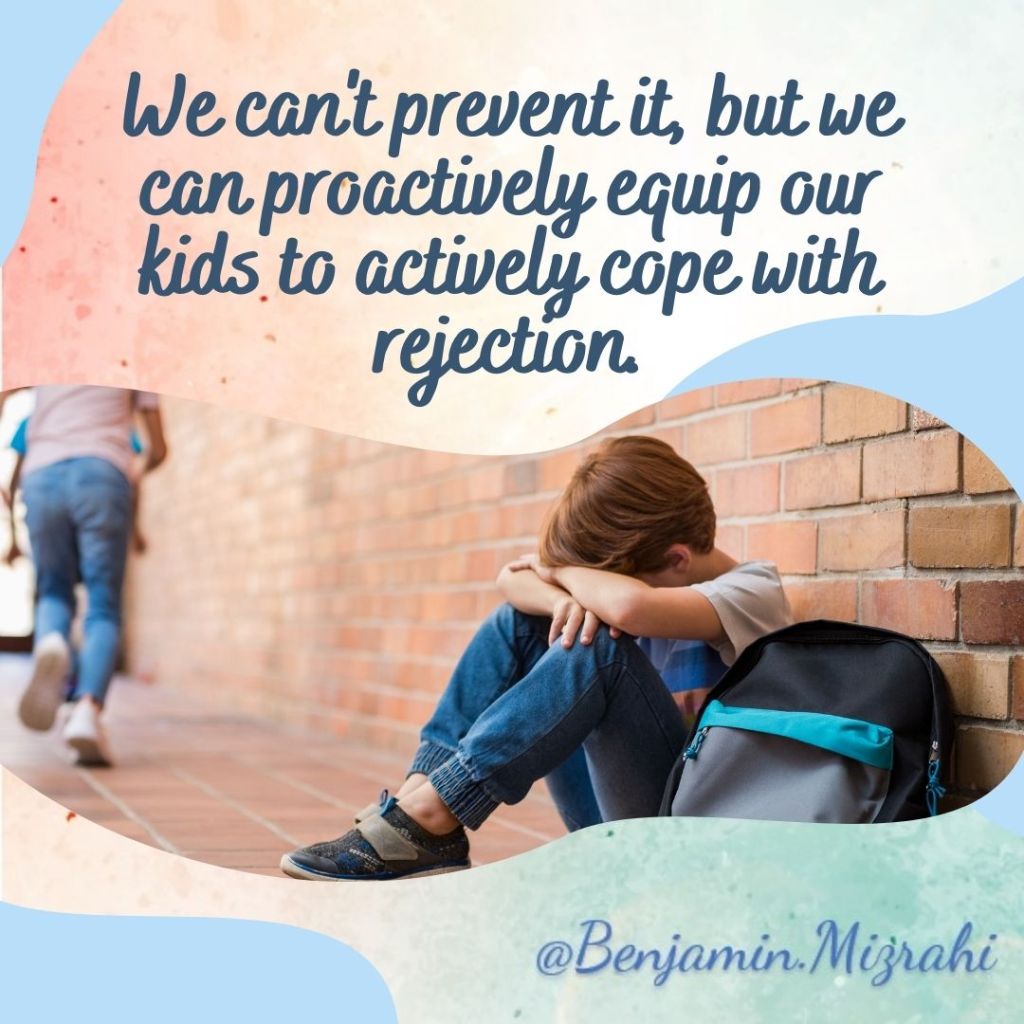
Rejection is hard enough to deal with as an adult, but it can be even harder for children. What can we do to help our precious children deal with all the emotions that come with feeling rejected? There are ways you can help your child learn to put rejection into perspective and move past it. Here are some things you can do: 

🔹 Not everyone will like you… and that’s ok. Teaching our children that rejection says nothing about them as a person is invaluable because they need to avoid labeling themselves based on superficial interactions. We should encourage our children not to give someone, (who probably doesn’t even know them that well), influence over their self-image. 

🔹 Share stories about rejection and getting over it. Teach resilience. Help your child come up with a plan to move forward. Coping strategies will make your child stronger and more resilient when faced with setbacks in the future. 

🔹 Surround your child with people that genuinely care about them. Children deal with rejection much better if they know that they are surrounded by people that genuinely love and care about them. It is important to place a team of caring individuals around our children to help support and encourage them.  

🔹 Help a child understand their self-worth.  
On a regular basis spend quality time with your children; taking every opportunity to tell them how unique, valuable, special and priceless they are and that there is no one else in the whole world exactly like them. THEY are important, even if someone else doesn’t see it.   

Coach Benjamin Mizrahi. Educator. Learning Specialist. Family Coach. Father. Husband.   

More articles on www.MrMizrahi.blog  

Tips for Parenting Shy Children

Parents can play a critical role in helping children moderate or overcome shyness and fearfulness. Labeling a child as “shy” can shape the child’s destiny from a young age. The best response to help children overcome their shyness and caution is to provide measured experiences to help children explore the world safely in order to gain confidence and feel supported through gentle coaching. 

A few tips for parents and caregivers on how to help shy children: 

  • Nurture your child by noticing her needs and responding to them. 
  • Encourage playdates, either at your house or a friend’s house. If your child is invited to a friend’s house, he might feel more comfortable if you go with him at first. You could gradually reduce the time you spend with him at other people’s houses. 
  • Practice show-and-tell or class presentations with your child at home. This will help your child feel more comfortable when she must stand up in front of her class. 
  • Encourage your child to do some extracurricular activities. Try to find the ones that encourage social behavior – for example, Scouts, Girl Guides or sports. 
  • Coach your child to express her needs and stand up for herself in social situations. 
  • Empathize with your child’s worries and avoid shaming him. 
  • Avoid negative comparisons with more confident siblings or friends. 
  • Help to build your child’s self-esteem by encouraging even small steps towards being less shy. 

Coach Benjamin Mizrahi. Educator. Learning Specialist. Family Coach. Father. Husband.   

More articles on www.MrMizrahi.blog  

PARENTING TIPS FOR 10-12 YEAR OLDS

This stage in their childhood marks a period of transitioning from dependent to independent, childish reasoning to signs of maturity, and the hallmark of this age is the beginning of puberty. There may be some things you can adjust about handling kids at this phase of their life. 

 
🟡 Nutrition 

There may be a spike in food intake at this stage of their development due to the possible growth spurts that require an increased number of calories. Provide them with a variety of food that will help them meet the necessary nutrients for their growth. However, this is not an excuse to overfeed your child as this may lead to health problems in the future. 

🟡 Physical Activity 

It is recommended that children at this age get at least 60 minutes of physical activity each day. They should partake in aerobic activities such as riding a bike, jogging, or other sports that make them move around. 

🟡 Socializing 

At this age, kids enjoy spending an increased amount of time with their peers. This doesn’t mean they dislike spending their time with you, but rather they are comfortable enough with their family that they feel free enough to spend time with friends, since they know you will always be there for them. 

🟡 Sleep 

Children at this age need at least 9-12 hours of sleep a day. But their sleep cycle may be affected by factors such as school, technology and the web, video games and the like. To improve their sleep schedule, you may have to limit their screen time and help them to budget their time more efficiently. 

Remember, tweens should learn how to become independent in terms of taking care of their own hygiene, responsibilities and establishing their role in the household. You do not need to micromanage every aspect of their growth, but instead to foster a nurturing home that helps them achieve their goals and ideal self. 

Coach Benjamin Mizrahi. Educator. Learning Specialist. Family Coach. Father. Husband.   

More articles on EXECUTIVE FUNCTIONS COACHING (mrmizrahi.com)

TIPS FOR ENCOURAGING YOUR CHILD’S INTERESTS

Childhood is an essential phase in a person’s life. Oftentimes their deepest ambitions are rooted from this point in time, and often these are not developed to maturity. As parents, you should be the guiding hand that encourages them to pursue their passions. Here are some tips for cultivating your child’s interests: 

  1. Let the child explore 

Oftentimes parents want to protect their child from the world, and it is their duty to do so. However, there should also be leniency in allowing children to be exposed to different aspects of the world and see where their passions lie. 

  1. Engage the child in their interests 

Be supportive in their interests, answer their questions about the subject, if you do not know the answer then find it together. Buy them the equipment for that hobby or take them somewhere that allows them to perform it like guitar shops or basketball gyms. 

  1. Enjoy the process 

Your child will have many interests during their childhood. There may come a point when you yourself will lose interest in their curiosities. Thus, as a parent, it may be helpful to also enjoy the process of it, so that you may see it not as a chore, but a mutually beneficial experience for both of you. 

Coach Benjamin Mizrahi. Educator. Learning Specialist. Family Coach. Father. Husband.   

More articles on www.MrMizrahi.blog  

The Best Way to Compliment Your Kids

Too many compliments or the wrong kind of praise can do more harm than good. When a child is branded as being “great” at something, he or she puts less effort into the assignment and may even dodge more difficult tasks that include that skill in the future, to continue receiving praise later. 

So, what compliments and praises are good for your children to hear? These three praising strategies will boost children’s self-esteem while still allowing them to challenge themselves at various tasks. 

 
🟡 Be specific. Generalities don’t make for great compliments, so make sure to point out exactly what they did well or what you liked. This will come across as more genuine. It will also show your child that you’re really paying attention by offering them clear and specific praise. 

🟡 Focus on effort, not outcome. Most compliments refer to the outcome rather than what it took for the child to reach it. But that makes praise ineffective unless the outcome is stellar. Praise your child no matter the outcome by speaking about their effort. This works better because a child can’t always control the outcome, but they can control their effort. 

 
🟡 Remark on good strategy. Good praise is not person-oriented, but process-oriented. In addition to praising your child’s effort, another helpful method is to speak highly about the strategy they used. 

Coach Benjamin Mizrahi. Educator. Learning Specialist. Family Coach. Father. Husband.   

More articles on www.MrMizrahi.blog  
Positive Affirmation for Kids

There are many benefits of teaching our children words of affirmation. As they grow and learn different behaviors, words of affirmation can be hardwired into their brains to create a nurturing self-belief in what is happening to themselves. 

Using affirmations is a great way for kids to start the day or to deal with challenging situations that come up during the day. Repetition of affirmations can help kids to interrupt negative or anxious thinking patterns that come with worry in order to refocus attention and change outlooks.   

🔸 Using affirmations to practice positive thinking can turn your day around 

The more positive thoughts your child has, the better they’ll feel, and the better their day will go. 

🔸 Affirmations for kids strengthen the ‘control center’ of the brain 

When your child uses affirmations for kids, they are literally disengaging their ’emotion brain’ and re-activating the part of the brain responsible for problem-solving, impulse control and emotional regulation. 

🔸 Affirmations with kids builds lifelong resilience 

The more your child practices intentional positive thought, the easier time their neurons will have traveling this path in the future. Essentially, you’re helping your child build a neurological on-ramp to resilience on the ‘highway’ of their future challenges. 

Coach Benjamin Mizrahi. Educator. Learning Specialist. Family Coach. Father. Husband.   

More articles on www.MrMizrahi.blog  
How to Support Healthy Risk-Taking

A better approach is to let kids figure out their capabilities by taking some risks. Instead of always freaking out, just watch. If you see determination on his face even if it’s mixed with fear – let him, be. Remain close by, if it makes you more comfortable, but resist the urge to reach out. 

Rather than immediately stop your child’s “crazy plans,” watch and observe. Ask what he’s doing. If you see something potentially unsafe, speak up. Express your concern, but then let your child solve the problem. Some kids will immediately adjust their plans. Others will resist. It’s OK to step in and stop things if needed. 

Let kids try some risky things under the supervision of an adult who models and discusses safety protocols. Allow your child to gradually assume more responsibility. In doing so they will feel that powerful emotion of pride through accomplishment. 

Above all, encourage and praise your child’s ambition and determination. His desire to tackle challenges and take risks will serve him well in the years to come. 

Coach Benjamin Mizrahi. Educator. Learning Specialist. Family Coach. Father. Husband.   

More articles on www.MrMizrahi.blog  

AUTISM: WHAT YOU NEED TO KNOW

Autism Spectrum Disorder (ASD) or more commonly known only as Autism, is a developmental disorder that affects communication and behavior. Symptoms generally appear within 2 years of life. 

The cause of ASD is not entirely clear, however, there is research which suggests that the factors which can cause autism are genetic with the influence of environmental factors and non-genetic factors. Therefore, it is important to be vigilant for early signs so that the child may get the help they need to develop. 

Early Signs  

  1. Difficulty with communication and interaction with other people 
  1. Restricted interests and repetitive behavior 
  1. Behavior that impairs the child’s ability to function properly in society 

 
Specifics 

  1. Not responding to their name 
  1. Avoidance of eye-contact 
  1. Flat facial expression 
  1. Avoids physical contact 
  1. Echolalia, repetition of words or phrases 
  1. Overall peculiar behavior accompanied by lack of response to other people or parents 

 
By being able to recognize concrete symptoms and evidence of autism, the child can undergo therapy or interventions so that they can receive the proper attention they need.  

Coach Benjamin Mizrahi. Educator. Learning Specialist. Family Coach. Father. Husband.   

utism Spectrum Disorder (ASD) or more commonly known only as Autism, is a developmental disorder that affects communication and behavior. Symptoms generally appear within 2 years of life. 

The cause of ASD is not entirely clear, however, there is research which suggests that the factors which can cause autism are genetic with the influence of environmental factors and non-genetic factors. Therefore, it is important to be vigilant for early signs so that the child may get the help they need to develop. 

Early Signs  

  1. Difficulty with communication and interaction with other people 
  1. Restricted interests and repetitive behavior 
  1. Behavior that impairs the child’s ability to function properly in society 

 
Specifics 

  1. Not responding to their name 
  1. Avoidance of eye-contact 
  1. Flat facial expression 
  1. Avoids physical contact 
  1. Echolalia, repetition of words or phrases 
  1. Overall peculiar behavior accompanied by lack of response to other people or parents 

 
By being able to recognize concrete symptoms and evidence of autism, the child can undergo therapy or interventions so that they can receive the proper attention they need.  

Coach Benjamin Mizrahi. Educator. Learning Specialist. Family Coach. Father. Husband.   

More articles on EXECUTIVE FUNCTIONS COACHING (mrmizrahi.com)

THE 4 INTELLIGENCES

Apart from the Intelligence Quotient (IQ), there are 3 other measures of intelligence that comprise the person, and these are: 

  • Intelligence Quotient (IQ) 

The measure of your ability to comprehend concepts, solve mathematics, memorization and recall. IQ is well known to be the measure of intelligence with standardized tests. This is a reflection of your intelligence. 

  • Emotional Quotient (EQ) 

Measure of one’s ability to control and understand their emotions to positively express them and properly communicate and empathize with others. A high EQ tends to reflect a more positive outlook in life and ability is able to maintain more wholesome relationships. This represents your character. 

  • Social Quotient (SQ) 

The SQ is the measure of your ability to build relationships with friends and maintain it for a long period of time. It is a reflection of your charisma and social prowess. 

  • Adversity Quotient (AQ) 

The measure of your ability to overcome hardships in life. The AQ highlights the person’s internal strength and will to push through adversity. By far, this is the most practical form of intelligence. 

 
You can perceive these intelligences in two ways: 

  1. These quotients are fixed for every person. Meaning, where they are proficient, that is their strength and cannot build up other intelligences.  

or 

  1. These quotients are skills that one can improve over time through effort. 

Thus, it is important to fortify one’s intelligences at a young age, that they may grow up to be well-rounded individuals. 

Coach Benjamin Mizrahi. Educator. Learning Specialist. Family Coach. Father. Husband.   

More articles on EXECUTIVE FUNCTIONS COACHING (mrmizrahi.com)

Activities to Help Your Child Develop Confidence

Self-confidence is something that we all build upon as we go through life. With the support and encouragement of their parents, family and circle of friends, every child can begin to build their confidence and empower themselves. 

These activities are simple, but effective for building confidence, which is vital to happiness and health: 

Make a list. Sit down with your child and together, brainstorm their strengths. Focusing on the positive can go a long way towards empowerment.  

Use positive affirmations. These words of encouragement can become rituals in your family that lead to positive self-talk over time. Simple phrases such as “you are loved” or “you are safe” can become second nature.  

Make time for play. Playtime is one of the best investments you can make in your child. The hours you spend playing with your children shows them that they are valuable and worth your time.  

Goal plan. Set some attainable personal goals with your child and then help them set out to achieve them. Celebrate their progress. 

Do an act of kindness. Acts of kindness such as helping a friend at school, or volunteering at a food bank, are incredibly important for kids. We feel good about ourselves when doing good for others. 

Provide them with small jobs. Children need opportunities to display their skills and feel that their contribution is valued. At home, this means asking them to help with household chores. 

Collaborate on some artwork for the home. Displaying a child’s artwork on the wall or refrigerator is a major confidence-booster for kids. Grab a canvas from the craft store and work on a piece of art for the home together! 

Coach Benjamin Mizrahi. Educator. Learning Specialist. Family Coach. Father. Husband.   

More articles on www.MrMizrahi.blog  

Tips for Preventing a Victim Mentality

When children take on a victim mentality, it becomes a form of defiance, used to avoid taking appropriate responsibility and being held accountable. If left unchanged, the victim mentality can eventually impact your child’s ability to have healthy relationships and to adequately function as an adult. 

It is vital that your child learns new skills in order to manage responsibility in the real world. Here are seven steps you can take to empower your child: 

🟡 Create Gratitude Rituals 

Spend time talking about what you’re grateful for every day. Even when you encounter difficult circumstances, role model a grateful attitude. 

🟡 Silence Negative Thinking 

Help your child silence their negative thinking by looking for exceptions to the rule. If they say, “No one ever likes me,” point out people who do. 

🟡 Face Uncomfortable Emotions 

Let them know that emotions are OK but that it’s important to handle those emotions in a socially appropriate manner. Teach them healthy ways to express their feelings and prevent them from hosting their own pity party every time they get upset. 

🟡 Teach Problem-Solving Skills 

Teach your child how to problem-solve. A child who takes action when they face hardship is much less likely to see themself as a helpless victim. Kids with good problem-solving skills can prevent small stumbling blocks from turning into major obstacles. 

🟡 Help Other People 

Helping other people can show your child that no matter how young they are, or no matter what problems they’ve experienced, they have the ability to help someone else. 

🟡 Teach Assertiveness Skills 

Kids with assertiveness skills can speak up and say, “Don’t do that,” or “I don’t like it when you do that.” Empower your child to use their words and you’ll reduce the likelihood that they’ll become a victim. 

🟡 Role Play Tough Situations 

Help your child learn to avoid a victim mentality by showing them how to proactively deal with tough situations. When they realize their choices in responding to tough situations, they’ll be more likely to take positive action.  

Coach Benjamin Mizrahi. Educator. Learning Specialist. Family Coach. Father. Husband.   

More articles on www.MrMizrahi.blog 

Teaching Kids About Boundaries

Implementing boundaries can be tricky. The real world is filled with rules and limitations. When rules and expectations are enforced without love, grace, and respect, the family atmosphere turns legalistic, without much room for grace and forgiveness. 

Kids who understand healthy boundaries learn what it means to grow up and be more like an adult, listen and respond to authority. They develop a stronger sense of safety and security and can focus on fun and enjoyment rather than trying to figure out what rules are going to get them in trouble. 

Using different activities to teach your children what their boundaries are, will help motivate them to follow the rules.  

👉 Teach your children what the boundaries are, including inappropriate and acceptable physical touch.  

👉 Demonstrate to your children how to work their problems out on their own.  Solving your children’s problems every time they experience something unpleasant will send the message that there are no boundaries for taking personal responsibility.  

👉 Spend regularly scheduled time alone with each of your children. It lets them know that you are a safe place to go when they are having trouble in their lives.   

👉 Give children a chance to express their successes, failures, questions, and concerns. Children who feel as if they have a voice are more likely to follow your rules and adhere to your boundaries. 

👉 Sometimes the best way to define or set a limit is with a good old fashion “no.” However, when “no” is overused on every nitpicky little irritation, it loses its value and creates a negative atmosphere. 

Coach Benjamin Mizrahi. Educator. Learning Specialist. Family Coach. Father. Husband.   

More articles on www.MrMizrahi.blog