Helping Your Child to be Good

When it comes to discipline, kids with ADHD do need the security of limits even if they don’t seem to pay much attention to the ones you’ve set. Over and above those things he really can’t help, your child needs to be held responsible for bad behavior you know he can control – but you need to approach discipline carefully. 

Keep the focus on helping your ADHD child be good rather than punishing him for being bad, and establish a brief set of house rules – with consequences – that you stick to. Bear in mind that you can’t simply give your ADHD child an instruction and then go to do something else while he does what he’s told – he very likely won’t. You need to structure the situation, sustain your child’s motivation and reward his positive behavior. 

Don’t just tell your child it’s bedtime. Say that bedtime is at 8pm, that you’ll be telling her it’s time to get ready for bed at 7:30 and that this will be her signal to put on her pjs and brush her teeth. Then she needs to report to you and the rest of the time up until 8pm is story or chat time. This structure gives your child a clear idea of what she’s supposed to be doing once you’ve given her notice, at 7:30. This structure and the hope of a reward – the story or chat – helps your child stay focused and motivated until she’s ready for bed. Provide encouraging and reinforcing comments as needed after your first announcement about bedtime: ‘Wow, you’re really moving along there!’. These verbal rewards help sustain your child’s motivation. 

Follow these tips: 

  • Keep it positive Instead of making your house rules a list of don’ts, make them a list of dos – for example, instead of phrasing it like this: ‘Jake must not interrupt if Mom and Dad are talking’ do it like this: ‘Jake can wait a minute’ and then say “Excuse me” if he needs Mom or Dad when they’re talking; instead of ‘Jake must not shout’, say, ‘Jake can ask nicely if he wants something’. 
  • Score good behavior It’ll give him the incentive he needs to co-operate if he gets an immediate reward in the form of points. Draw up a reward chart with pictures of what he’ll get when he has enough points and keep it doable – for example, 10 points could win him a new comic book. This works better than promising an unspecified reward at the end of the week if he tidies up his toys every evening – that objective is too far off and he’s likely to forget what he’s working towards and how well he’s doing.
  • Use visual reminders Children with ADHD are easily distracted from the task at hand, whether it’s getting ready for school or concentrating on homework. A kitchen timer is a useful little tool for keeping their minds on the job: you can say they have until the bell rings to get dressed, complete a page of homework and so on. 
  • Take one step at a time Don’t reel off a list of instructions to your ADHD child – they can’t manage multi-tasking and he’ll find it difficult to absorb anything after the first request. Tell him what you’d like him to do one thing at a time. The same goes for doing: turn off the TV if he’s studying; play with one toy at a time; tidy up after one game or activity before moving onto the next. 
  • Show, don’t tell When it comes to new tasks or activities, he’ll find it easier to pick things up if you demonstrate how to do them one action at a time, with any spoken instruction kept very brief and clear. You may need to repeat yourself, but use a clear slow tone and try not to get impatient if he’s having difficulty following you. 
  • Keep playdates painless Children with ADHD are particularly excitable, so having a whole platoon of friends over is a recipe for a discipline disaster. Restrict it to just one or two other children and invite them to your home, where you’ll be better able to supervise your child. Make sure the other children’s parents know that you have a few simple rules for your child and that his friends will need to follow them too. 
  • Set aside a sanctuary Try to set aside one corner of a room in your house as his calm down spot. Keep it low-key, without bright paint colors or busy wallpaper: perhaps a table and chair facing a blank wall. If he’s overstimulated and unable to calm down enough to behave, take him to sit there for a few minutes to help him focus. 

Coach Benjamin Mizrahi. Educator. Learning Specialist. Family Coach. Father. Husband.   

More articles on www.MrMizrahi.blog 
Our Kids are Allowed to Feel Their Feelings

Do you ever just have one of those crappy days where you’re just not feeling it and the people around you can tell by the look on your face that maybe they should stay far, far away from you or bring you some carbs and fuzzy socks?  
 
As adults, we’re allowed to have those days. 
 
We know that no one feels happy and energetic all the time and we don’t expect them to. 
 
Hopefully the people in your life support you well when you’re feeling blue or angry or anxious. 
 
Think about what helps you feel supported when you’re having big emotions.  
 
It’s likely that you just want someone to listen to you without judgement or without trying to fix you. 
 
You might want the presence of a comforting person you love…or you might need some space. 
 
Our kids are the same way. 
 
Oftentimes we don’t allow them to have crappy days or moments to feel angry or upset. 
 
This might be because we’re still learning that it’s ok to have our own emotions and we’re afraid we won’t know what to do to help them. 
 
So, we try to shut it down and don’t give them space to feel. 
 
Can you imagine what it would feel like if someone did this to you when you were feeling sad or angry or worried? 
 
We must allow our kids to feel their feelings. 
 
We can hold space for them by being present, listening, and not judging.  
 
It’s really that simple. 
 
Support your kids the way you would want to be supported. 

Coach Benjamin Mizrahi. Educator. Learning Specialist. Family Coach. Father. Husband.   

More articles on www.MrMizrahi.blog  

6 Ways to Show Faith in Your Child

Every Behavior is Communicating Something

It is easy to react and even feel offended by our children’s comments and behaviors. We instinctively react out of anger to protect our feelings and to preserve our identity as a good parent. 
 
However, when we respond out of anger and frustration to our child’s behaviors, we miss the message they are really trying to send. 
 
Is it easy to do every time? Of course not! We can’t be expected to, because we’re not perfect parents. 
 
But, if we want to have a genuine and responsive connection with our children and hear their true need, we need to dig deeper. 

Here are some guidelines to follow in the process of being an emotionally responsive parent:     

Be respectful of your child and of yourself.  Respect is at the heart of the parent-child relationship.  Treating your child with respect and honesty as you interact will help him or her gain a deeper understanding of self, others and the world.    

Attempt to remain in control of your emotions and reactions.  It’s important to stay in charge of your emotions and the situation.  If anger gets the best of you then acknowledge it with your child.  “I’m very angry that you drew on your face.  Let’s clean it up.”           

Let your child know that you are in charge and you are keeping them safe, emotionally and physically.  You enter the room and your children are arguing over a block.  You come close to them and listen to find out more about the conflict.  “I see you both want that rectangular block.”  Then your younger child attempts to bite your older child.  “You are angry.  You want that block.  I will not let you bite your brother.”  You come between your two children.  PAUSE.  There is another yellow block.  “Maybe one of you can use the other yellow block.”  Your younger child attempts to hit her older sibling.  “I’m not going to let you hit.  It’s time for you to find something else to do.  Maybe you can build later.”  There are tears and screams, but you continue to help your younger child find something else to do, while acknowledging their strong feelings.  You keep both of your children safe in the process.      

Acknowledge your child’s strong emotion even if they may seem to be a bit reactionary or over the top in the moment.  Sometimes your child will experience a reaction that seems a bit cartoonish.  Take a deep breath, PAUSE and realize that this is your child’s reality.  Narrate what you see happening while labeling your child’s feelings.   

Coach Benjamin Mizrahi. Educator. Learning Specialist. Family Coach. Father. Husband.   

More articles on www.MrMizrahi.blog  

https://mrmizrahi.blog/2020/10/01/6-ways-to-show-faith-in-your-child/

What Really Matters

Hello everyone!

I’m Benjamin Mizrahi. I’m a learning specialist and a family educator. Which means that I work with students on developing learning skills and I work with parents with families on raising children, specifically on how we can create an environment conducive to raising children nowadays during the pandemic and in general.

One of my biggest passion as a learning specialist is to create strategies and tools for students who learn differently, who don’t necessarily fit in the box that teachers nowadays offer in the classroom.

When I work with parents, I show them how there’s so many good things that they do and how they can be rearranged and monitored but in a very strategic way. 99% of the parents whom I came across are doing so much for their families.


Nevertheless, much of what they do is in a way that is not helping them manage the house, establish meaningful relationship with their kids… so what I do is that, we really work on what they have already been doing and just rearrange it in a way that is more strategic and helpful to reach their goals. Many times, I hear parents contemplating and even worried about what else they need to do. And most of the time I tell them, you do not need to do more, you need to keep doing what you are doing but a little bit differently. And that is what we, even myself, what we need to do nowadays, take of what we have been doing so far and just change the way we do it in a much more strategic way that can help us achieve our goals as parents.

The 4 Zones of Self Regulation

Hello everyone!  

I’m Benjamin Mizrahi, and today I would like to share with you a wonderful strategy that will not just help your children but first and foremost help yourself.  


You’re going to learn how to deal with situations where you lose control, where you are tired, where you are totally out of it, bored or happy, present or totally absent. 

 
Yes, I’m talking about the four (4) zones of self-regulation.  

So what about self-regulation? What does it mean to you?  
Yes! I’m talking to you.  

What does it mean for you to be self-regulated? 


I’m sure that words like “in control”, “grounded”, “happy”, comes into mind.  
Yes! Self-regulation relates to the awareness of our bodies’ needs and emotions.  
The state of alertness that is within our control, that is self-regulation.  
You can have your own definition, in your own words, and it’s important that you understand what self-regulation means to you.  
 
The zone of self-regulation talks about four (4) different stages or zones.  

We have the blue, we have the green, we have the yellow and the red.  
I want to start with the blue zone; the blue zone is where your level of alertness is very low. When we are tired, when we are bored… we are in the blue zone.  
 
When we are happy, when we are engaged, and when we are open for learning, when we are flexible, that means that we are in the green zone.  

And when we are in the yellow, we feel a little bit frustrated, our level of flexibility deteriorates, and we become less and less patient and unfortunately those moments when we enter the red zone, it’s when we lose control of what we say, of what we do. 
 
Our level of patience is basically zero (0%), we have no patience for those who are around u. In fact it gets worst as long as we stay with them, as long as we continue that interaction. During our time in the red zone, we also become “historical”, in terms of the wrong doings, that these people – directly or indirectly – did toward us.  
 
We’re talking about four (4) different zones, the blue, the green, the yellow and the red. Something very important to remember about the red, we do not end up just in the red zone. Something happens before and that is usually the yellow. When we are in the yellow zone, when we feel that we are getting more and more and more frustrated and less and less and less patient, that means that if are not going to address our needs at that point, we are going to end up in the red zone. And when we are in the red zone, we’re going to say or do things that we will regret.  
 
And you probably remember those times where you felt very much guilty for something that you did at home or anywhere else. Those moments of guilt usually come after you were in the red zone. So when we are getting impatient, getting inflexible, when we become more frustrated with our environment, that means that we are in the yellow zone, and we need to have a plan of action. The plan of action could be as simple as remove ourselves physically from the place that we are in. Go to a different room, maybe take a walk outside if you can, take a shower, that really helps a lot to a lot of people. Go make yourself some salad, dealing with food can be very therapeutic.  
 
So each one of us has different habit but it is very important that we will have a plan of action, meaning that we have at least two (2) or three (3) activities that we can do when we feel frustrated, we get angry, and we feel that our patience is going very low.  
Because if we’re not going to address those needs, we will end up in the red zone.  
 
What about the blue? The blue zone means that we are totally out of it, in terms of interest, we are bored, and we are disengaged. When we feel that we are in the blue zone, or the emotions that I’ve just shared with you, it means that our body and mind is signaling us with something. 
It could be something that we are worried about, could be that we are procrastinating certain activity or task that is not so pleasurable.  


A paper that we need to write or running some errands that we don’t like to do. Something is there and is putting us in the blue zone. We are totally disconnected. Its very important to address those needs, in terms of our emotions, and what kind of things needs to be done, and if it is not pleasurable, you can create yourself a plan of action in terms of what you are going to do and when with certain time limits.  
 
When you are in the green, this is where we want to be, right? The green zone is where we are happy, where we are engaged and ready to learn. When we are in the green zone, we want to connect and be present as much as possible. We want to really create a connection with whoever is around us because in those moments we create memories.  


One thing to remember is that we are not supposed to be always in the green zone. 
You are not supposed to be always in the green zone! You are a human being and that is why we have the four (4) zones. The blue, the green, the yellow, and the red. And you will find yourself in each one of them, it could be every day, it could be in one (1) hour, it could be in one week but you will find yourself in each one of those stage and you want to have a plan of action for each one of them.  

So good luck!  

4 Ways to Make Holidays Better for Kids

It’s easy for children to be smitten with the magic of holidays. Fun presents. Extra sweets. A vacation from school – there’s a lot to like. But with the freedom and excess of the season, sometimes kids can get a little carried away. For most families, there will be a point when the kids get overtired and cranky, or greedy about presents, or would rather play a video game than talk to Grandma.  

Here are some tips to keep kids happy and ready to enjoy whatever the season brings. 

1. Gifts, gifts, gifts: Getting presents is a high point of the holidays for any kid, but they shouldn’t be the only focus. As adults we know that giving presents can be just as rewarding as getting them, and we shouldn’t wait to teach that lesson to our children. 

Even when kids are too young to buy a present, they can still make one, or help you pick out something. Some of my best holiday memories are of helping my father look for the perfect gift for Mom, or going to the mall to look for presents with my siblings as we got older. Volunteering, participating in a local toy drive, or giving each of your kids a little money to give to a charity of their choice are all great ideas for getting children in a more generous mood. 

Also, remember that the best gifts that you give your children probably won’t be the material ones. Taking time for the whole family to get together to play a game, watch a movie, or decorate sugar cookies—these are the things that kids remember as they get older. 

2. Let them help out: There’s a lot of extra work to do around the holidays — putting up decorations, cooking big dinners, throwing parties. The Martha Stewart in all of us can take over, but it’s important to take a step back and make sure our kids are included, too. 

Children can help set the table, decorate the house, and wrap presents. If they’re too young to wrap, they can help by holding down the paper or getting the tape ready — there’s always something kids can do. And at holiday time, the preparations are often as fun and as meaningful as the end product. Plus, this way kids won’t feel left out — or be glued to the iPad for hours. 

3. Keep routines: We love the holidays because they give us a break from the everyday, but that can also make them stressful, especially for kids who find routine comforting. Try to keep some things constant. Kids still need snack time, they still need special attention from you, and they still need a chance to unwind before bedtime. 

At family gatherings when they notice the kids are “getting antsy,” psychologist Rachel Busman says she and her sister give them their baths, get them into pajamas, and turn on a movie. “We know when they need to wind down, and no one judges us for excusing ourselves from the table to do these things,” she says. “In fact, my sister and I enjoy some great conversations during this time.” 

4. Remember they’re kids: Some holiday traditions depend on kids being on their best behavior: lengthy services, parties with lots of strangers, elaborate meals that may not appeal to picky eaters. Try to keep those to a minimum and customize festivities for your kids’ frustration level. Don’t schedule more than one demanding event in a day, and make sure to include physical activity and plenty of downtime. Your kids will be grateful — and so will you. 

Finding the balance between meeting your needs for creating a memorable holiday and your children’s needs to act like children can be tricky. By honoring the qualities that make your children special and understanding their unique approach to the holidays, you provide a gift that will help you and your family have a smoother and more enjoyable holiday season. 

Happy Holidays! 

Set Firm Rules and Expect Respect

Kids who believe they can do anything they feel like doing, and get whatever they want, tend to be the ones who act out by whining or throwing a tantrum when their demands aren’t met. Children who understand that there are well-defined boundaries learn how to self-regulate and to respect limits. 

  • Tell them why. You don’t have to give your children elaborate explanations for why you expect certain behaviors from them. But if your child understands that there are simple reasons for your rules, he’ll realize they aren’t arbitrary and will be more likely to comply. Tell him, for example, “You need to go to bed at eight o’clock because your body needs a lot of sleep to stay strong and healthy.” Or “You have to put away your toys so we’ll know where to find them next time you want to play.” 
  • Offer lots of praise. Whether it’s making the bed, helping set the table, or letting his sister play with his blocks, make sure you reinforce rule-following by celebrating your child’s successes. Say, “It’s great that you remembered the rule to make your bed. I’m so proud when you behave like a big boy!” or, “You were so polite to say ‘please’ when you asked me for that crayon. Good job!” 
  • Follow rules yourself. Hanging your coat in the closet when you get home, putting your dirty dishes in the sink, not screaming when you’re frustrated … doing these things will show children that just as they have rules to follow, so do you. When kids see you behaving well, they’ll want to do the same. 
  • Cultivate a conscience. If a young child feels bad when he hasn’t followed your rule, don’t immediately try to minimize his discomfort. Feeling a bit of guilt is an essential part of learning to determine right from wrong. Use it as a teaching opportunity. Say, “I know you’re feeling bad. We all make mistakes, but we try to learn how to act next time.” 

Coach Benjamin Mizrahi. Educator. Learning Specialist. Family Coach. Father. Husband.   

More articles on www.MrMizrahi.blog 
Raising a Child Who Wants to Behave

Children quickly learn how to behave when they get positive, consistent guidance from you. This means giving your child attention when they behave well, rather than just applying consequences when your child does something you don’t like. 

Here are some practical tips for putting this positive approach into action. 

💗 Believe in Your Child’s Future 

It’s not easy to accept that there’s something not quite “normal” about your child. But a child who senses his parents’ resentment — and their pessimism about his prospects — is unlikely to develop the self-esteem and can-do spirit he’ll need in order to become a well-adjusted adult. 

Treat your kid as if he were already the person you would like him to be. That will help him become that person. 

💗 Be a Good Role Model 

Parents are a child’s most influential role model, so think carefully about your own behavior. If you’re unable to control yourself, how can you expect your child to exercise self-control? 

It’s perfectly normal to feel angry at your child from time to time. It’s not OK to continually shout at her. You wouldn’t dream of screaming and swearing at friends or coworkers, so you know you can control your anger if you must. 

💗 Don’t Be Too Quick to Say No 

All children need to be told “no” at certain times — to keep them from doing something dangerous. But many parents say “no” reflexively. And a kid who hears “no” a lot is more likely to rebel — especially if she’s impulsive to begin with. 

Smart parents know when to say “no,” and when it makes more sense to take a deep breath and answer in the affirmative — and avoid a nasty confrontation. 

💗 Pay Attention to Positive Behavior 

Many parents overlook all the positive ways in which their child behaves. The resulting negativity can cast a pall over the household that affects every aspect of life. 

💗 Anticipate Potentially Explosive Situations 

Parents spend a lot of time in reactive mode instead of thinking and planning ahead. A simple plan is all it takes to keep a positive experience from turning negative for all concerned. 

Whatever you do, be consistent. A last-minute change in schedule or an interruption of a familiar routine can wreak havoc with a child who already feels like he spends most of his time off-balance. 

💗 Don’t Buy into the Negative Remarks 

It’s no fun to hear others describe your child as “slow” or unmotivated. But don’t let negative remarks deter you from advocating for his educational needs. After all, kids with ADHD can succeed if they get the help they need. 

💗 Never Punish for Unintentional Misdeeds 

Imagine telling your child to make his bed. Now imagine finding him, minutes later, lying on his unmade bed playing cards. What should you do? 

The best approach might be to remind your child what you want him to do. Punishment makes sense if it’s clear that your child is being defiant — if he refuses to make the bed. But, in many cases a child with ADHD fails to comply simply because he became distracted. 

💗 Don’t Label Your Child 

Kids who repeatedly hear bad things about themselves come to believe these things. No matter how frustrating your child’s behavior, never call him “lazy,” or anything else that might be hurtful. 

Bear in mind that some of the problem behaviors you ascribe to ADHD may be common to all children of that age. It’s helpful to read up on the stages of childhood development. 

Coach Benjamin Mizrahi. Educator. Learning Specialist. Family Coach. Father. Husband.   

More articles on www.MrMizrahi.blog 
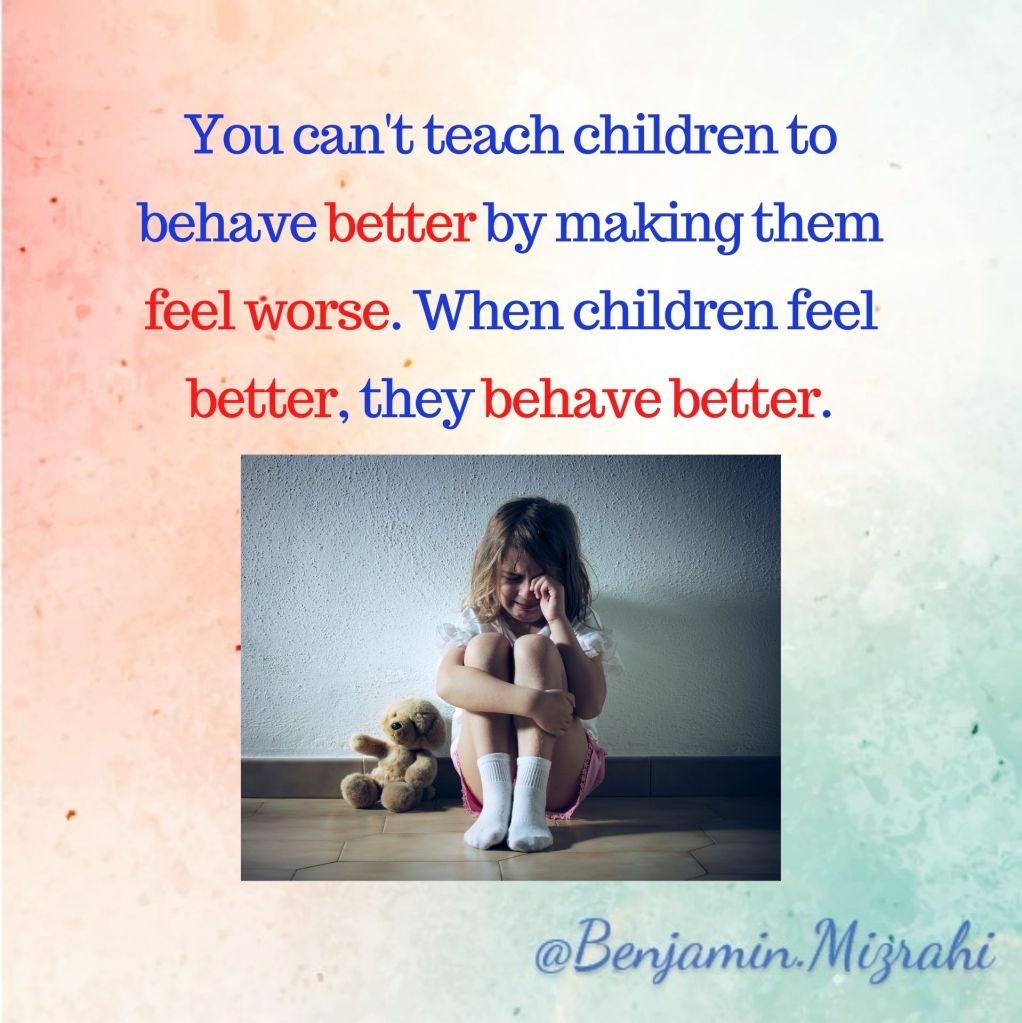
Know the Right Reasons for Your Child’s Wrong Behavior

When a child with ADHD misbehaves, sometimes it’s willful disobedience. More often, though, these “wrong” behaviors are out of her control. 

 Here are some of the ways we achieve calm in the face of ADHD challenges: 

1. Recognize that what looks like willful disobedience may not be. The first step is to understand your child with ADHD and why he does the things he does, especially things that look and feel like willful disobedience. Most children with ADHD have very low frustration tolerance, and many are inflexible. 

2. Guide a child through her frustration. How many times has your child asked for something and melted down when she didn’t get it? When a child is two or three years old, you expect that. When she is eight or nine years old, you think she should know better. At 12, you think that a meltdown is ridiculous. You try to impose your will and put your foot down, and the child spirals out of control. 

You think it’s all because she didn’t get her way. But it’s not. She’s not throwing a fit to strong-arm you into giving her what she wants — it’s not a “fit” at all. She is unraveling emotionally because she doesn’t have the skills to see that there’s more than one option. She can’t handle the frustration she feels when the thing she knows to be true isn’t. 

3. Don’t engage a child when she is melting down; remain detached. Remember that your child’s behavior is not a personal attack on you. By not taking it personally, you have a better chance of staying calm and under control. 

4. Work together to teach your child skills. If your child is frustrated because his play date is canceled, talk through the situation with him. Show empathy for his feelings to validate his emotions. Tell him you will reschedule the play date, and talk about what he will do when he plays with his friend. 

Talk about what you both might do with the free time that has suddenly opened up. This teaches him to think through options, and distracts both of you from being emotional about the situation. View everything as a problem to be solved, and take the opportunity to teach problem-solving skills. 

5. Remember that you have control of the situation when your child is trying to control you. Don’t give in to your child and make a bad situation worse. There are many ways to maintain your authority besides raising your voice or laying down a mandate. Yelling or threatening to punish your son when he acts up will only prolong the outburst; remaining calm and detached will shorten it. 

Calm Is Crucial. The key to calm parenting is to understand the triggers and functions of your child’s unwanted behaviors.  

The stress of parenting a child with ADHD is hard enough without yelling. Kids with ADHD are perceptive — the calmer you are, the calmer they are likely to be, and vice versa. 

Making an effort to remain calm with your son or daughter will bring a dramatic shift in your family dynamic and your relationship with your child. I know from my own experience that once you learn how to be calm, you will be a more effective parent. 

Coach Benjamin Mizrahi. Educator. Learning Specialist. Family Coach. Father. Husband.   

More articles on www.MrMizrahi.blog 
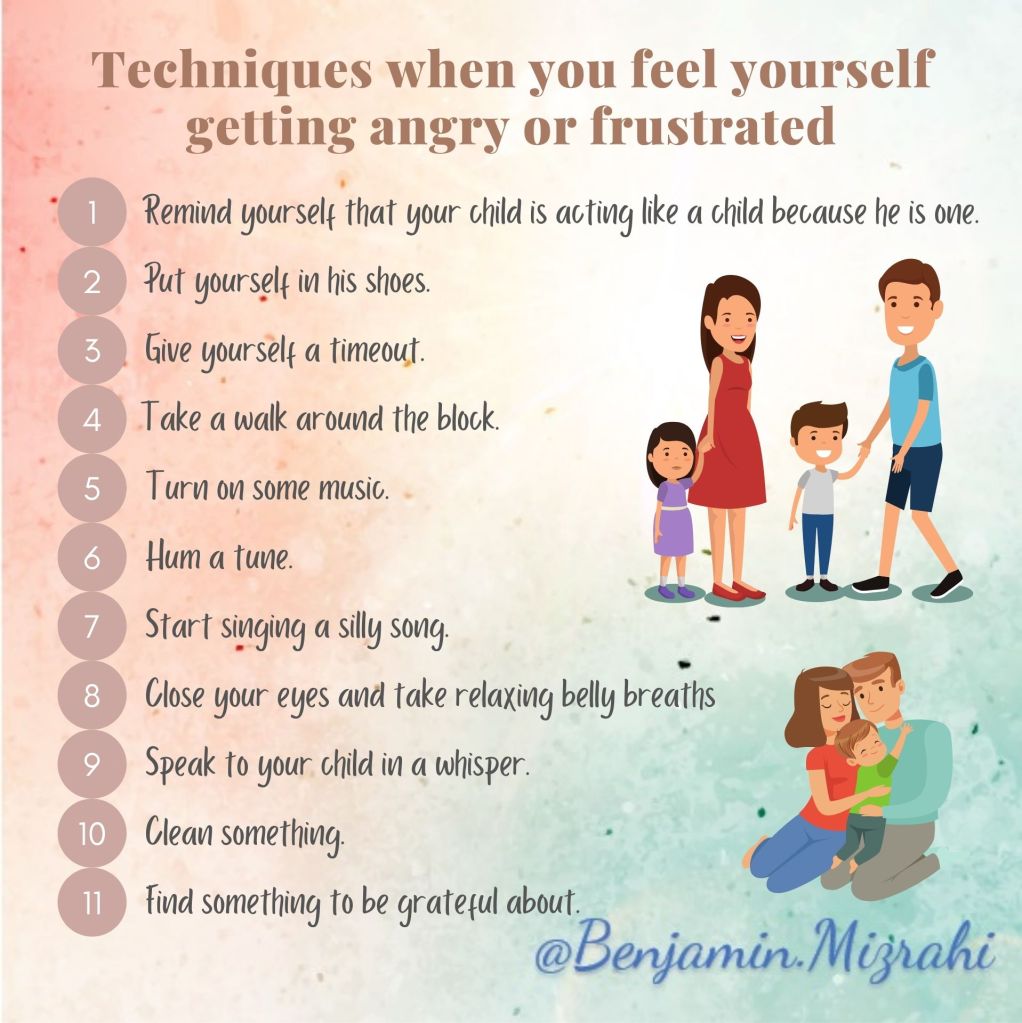
Help Kids Practice Patience

No one likes to wait, especially young kids. Developmentally and neurologically it’s difficult because children survive by letting their needs be known immediately. That’s why it’s especially important for parents to start teaching patience in the toddler years. You want your kids to develop tolerance for the feeling of impatience, which is often unpleasant, so they won’t misbehave or act impulsively when faced with that feeling in the future. 

  • Make them wait. Don’t always drop everything as soon as your child asks for something. Allow your child to feel the unpleasantness of waiting because it’s a great change agent. By not giving him the juice immediately, for example, you’ll help him get practice in managing his impatience. 
  • Tell them what they’re feeling. Toddlers aren’t able to express their frustration at having to wait for things, but you can help by labeling their emotions and offering praise when they demonstrate patience. If your preschooler has to wait his turn, you might say: “I know it’s tough to just stand here. But you’re doing a terrific job. You’re being patient, and that’s great!” When you validate your child’s struggle with something, it’s more likely he’ll try harder. 
  • Engage in activities that promote patience. Encourage your child to do things that don’t offer immediate results, like block building and puzzle solving, or planting a flower seed and watching it grow over time. Make sure they’re not only playing with high-tech gadgets that offer instant press-of-a-button results. 

Coach Benjamin Mizrahi. Educator. Learning Specialist. Family Coach. Father. Husband.   

More articles on www.MrMizrahi.blog 
Build Problem-Solving Skills

One of the major reasons, children behave badly is because they feel frustrated and powerless. When you give children the tools, they need to figure things out on their own, they will behave better because they’ll be better equipped to take care of themselves and won’t come screaming to you or act out every time, they encounter a challenge. 

🟡 Let kids make decisions 

Give children the opportunity to make choices as soon as they’re old enough to understand. Ask, “Do you want to wear your Elmo pajamas or your nightgown?” “Which flavor drink do you want to take to school, a Capri Sun fruit punch pouch or an orange juice pouch?” Once kids can manage these small decisions, take it up a notch: If your child is fighting with her sister, for example, instead of yelling “Don’t do that!” or giving her a time-out, ask “How can you handle this differently?” You may be surprised at the way she will come up with solutions. 

🟡 Encourage a “try, try again” attitude 

Sure, it’s a lot quicker for you to do everything for them, but it’s important to let preschoolers practice and succeed without your intervention—whether it’s tying their shoes, putting away toys, or sorting socks in the laundry. 

🟡 Make them think things out 

Stretch your child’s cognitive skills by challenging him to find answers for himself. For example, when your child asks a question about how to do something, respond with a question of your own: “What do you think you should do?” Such a response will eventually give him confidence in his own ability to figure things out. 

Coach Benjamin Mizrahi. Educator. Learning Specialist. Family Coach. Father. Husband.   

More articles on EXECUTIVE FUNCTIONS COACHING (mrmizrahi.com)

Discipline Strategy to Help Your Child Succeed

If your child has ADHD, should you discipline them in a different way than with your other children? 

The answer might surprise you. 

ADHD is a challenge, not necessarily an excuse for kids. Still, you might need to be a little more flexible in your expectations. 

We need to be more aware of how the ADHD impacts their ability to listen, follow through on tasks, and control their impulses. However, having ADHD does not take away the expectation that they will improve in these areas. 

So, you don’t have to discipline them differently. But you may need to do it more often and be more consistent. A lesson may take longer to sink in. 

Discipline strategy for kids with ADHD (or any child) is to teach them the skills they need to succeed before they have a problem. 

For example, all kids need a schedule or guidance to help them keep up with chores, homework, and other expectations. Kids with ADHD can’t be expected to “just get it” from verbal instructions. Instead, they often respond better to a visual schedule that they can follow. 

They also do better with very specific instructions. Instead of telling kids to “clean their room,” be specific, such as “all clothes off the floor,” and “all books on the bookshelves.” That way, kids clearly understand what to do. 

Rewards work well for kids with ADHD, but they, too, may need to be tweaked slightly. 

It’s probably not realistic to set that expectation for an entire day. If they mess up in the morning, you’ve lost the whole day. 

Instead, break the day up into thirds and give points for good behavior in the morning, the afternoon, and the evening. Once they’ve earned points, you can’t take them away. Some kids also need more frequent rewards. They may lose interest if they have to wait a week to earn one. Rewards can include praise from a parent or doing something special. 

Coach Benjamin Mizrahi. Educator. Learning Specialist. Family Coach. Father. Husband.   

More articles on EXECUTIVE FUNCTIONS COACHING (mrmizrahi.com)