Snuff out their fears, give a name to those emotions that they do not know how to express, dedicate time to them, let their dreams take off, and make them feel who they are: the most precious people in your world.
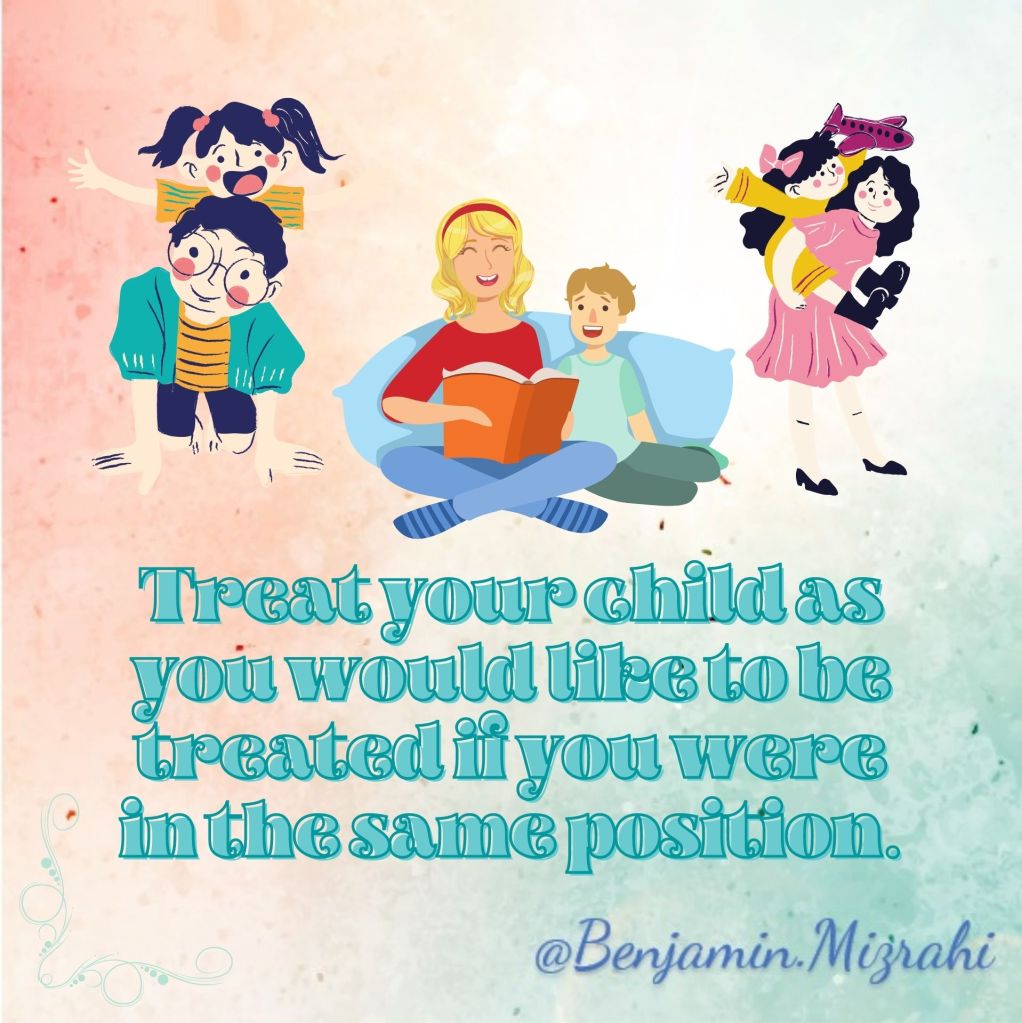
A child does not want to be yelled at and does not understand reproaches; your child deserves to be treated with the art of listening, patience, and the grandeur of affection, because children are not there to be “dominated”; they are there to be loved.
A mother’s instinct or a father’s natural ability to intuitively know the needs of their own children is doubtlessly the best strategy when it comes to educating them. Children come into the world with innate kindness, so they deserve to be treated with respect.
A child must be treated with affection and without fear. There are mothers and fathers who are afraid to fail in their role as parents. They think that they are failures if they don’t get them a place in the best schools or buy them the same brand-name clothes that their friends wear at school. They aspire, in some way, to offer their children what they themselves never had.
Everyone is free when it comes to choosing how to educate a child, but we often forget what children are like and everything that happens in their heads. We hang onto the thought of everything that we have to offer them without first finding out what they really need: us.
Our children do not really need brand-name clothes or electronic toys that they can play with alone. They need your time, your example, your good night hugs, and your hand to hold when they cross the street.
Coach Benjamin Mizrahi. Educator. Learning Specialist. Family Coach. Father. Husband.
Children with ADHD often have trouble making friends, but it turns out that parents can help. Learn why solo time with your child and planned playdates can help you take a more active role in how he makes new friends.
It’s common for children with attention deficit hyperactivity disorder (ADHD) to have trouble making friends. How can parents help?
Where do you start?
Start by listening. The more positive and trusting your relationship, the more likely it is that your child will accept your guidance. If he’s upset about a friendship problem, be empathetic. Give him a chance to express his feelings before saying what he should do differently next time.
Spend some time doing fun things together, just the two of you, without directing or criticizing his behavior. Building a relationship with your child pays off. Parents in my study groups have said that when they work on relationship-building at home, they see better behavior in their child’s peer relationships right away.
Look for the positive, even if it’s hard to find something to praise
For example, you see your child with another child, and almost everything she does seems wrong. She goes up and says, “Hi,” introduces herself, and says she wants to play. Then she treats the other kid as a play-slave, and says, “We’re going to do this. I go first. You stand here.”
There’s a lot to criticize. But you can praise what she did well: walking up and introducing herself in a friendly way. As for the rest, there may be 20 behaviors that you’d like to change but be selective. Pick the most important one or two-and be specific in what you say: “When you play a game, you get to move your pieces, but you have to let your friend move hers.”
Parents take a more active role in promoting friendships
You can help your child make better choices – for instance, a friend with the same interests who’s also a good personality match.
A great way to find the right playmates is to volunteer at your child’s school and for extracurricular activities. You see other kids, and you get to know other parents. It’s an opportunity to network and to suggest playdates.
Made playdates go more smoothly
Planning. Before the playdate, put away anything that might cause conflict, like a favorite toy that your child wouldn’t want other kids to touch. Plan enough activities so that you leave little or no unstructured time. If your child has repeatedly acted in a way that’s likely to cause trouble, caution him in advance about the most appropriate behavior. Be on hand with snacks or another distraction in case the kids start fighting – especially if you don’t know the other child well.
How closely should you supervise?
It depends largely on the age and on the child. You might want to be in the same room with a six-year-old, so you can head off a tantrum if you see it coming. For a 10-year-old, stay just within earshot and check in from time to time to see if the kid’s friends need your attention. If it’s too quiet, your child may have lost interest and may be ignoring her friend.
Whisper to your child if something’s wrong. If it’s the kind of behavior you discussed beforehand, a reminder may be enough. If it isn’t, or if the misbehavior is serious, talk to her in another room. Unless the situation is out of control, don’t cut the playdate short.
What do you do after the playdate’s over?
Debrief your child. Give him feedback, particularly on how he handled the behavior you focused on before the playdate. You might say, “It was really nice of you to congratulate your friend on winning the game, like we talked about.”
Use the experience in planning the next playdate. If you stay focused on improving trouble behaviors, you should see progress. It often happens that way in my study groups.
Coach Benjamin Mizrahi. Educator. Learning Specialist. Family Coach. Father. Husband.
Weekends are the perfect time for some unstructured play!
But why is it so important?
Unstructured play encourages creativity and imagination.
Children learn through play. This is how they work out problems, practice important social skills, and process emotions.
Unstructured play increases confidence. When children are able to think and create, using their own cognition and creativity it increases their confidence in themselves.
Attachment and bonding with your child are increased when you join in unstructured play with them.
Coach Benjamin Mizrahi. Educator. Learning Specialist. Family Coach. Father. Husband.
Not learning to tolerate failure leaves kids vulnerable to anxiety. It leads to meltdowns when the inevitable failure does occur, whether it happens in preschool or college. And perhaps even more importantly, it can make kids give up trying—or trying new things.
How do we avoid messing up? By spending as much time as possible with our kids and making them a priority. We do it by loving them, using encouraging words, and hugging them whether they feel comfortable with it or not. Here are the 10 things to teach your kids about overcoming failure.
1. Not Everybody Gets a Trophy
Losing is every bit as important in human growth as winning. Rewarding your child for doing nothing will teach him just that. Nothing.
2. Everyone has Different Talents
There are just some things we aren’t cut out for. It’s best to learn that at an early age. The good news is that your children are all champions at something. Guide them toward their gifts.
3. Have Class
Are you teaching your children how to fail with dignity? How a person accepts failure is an easy indicator of the character within. It also almost guarantees future success. Respect is gained outwardly and inwardly.
4. Learning from Mistakes
Mistakes humble you. They can hurt. Yet without them, we are stagnant. Every mistake we make is an educational experience. Every success is built upon a foundation of errors and corrections.
5. Teaching Others
When we fail, we gain experience. It’s important to share that knowledge. Use it to mentor others experiencing similar difficulties. Instill in your children the responsibility to share their mistakes in hopes to save another from making the same.
6. Leave it All on the Field
Explain to your kids to never cheat themselves on effort and they will always gain from it. No matter the outcome.
7. Perseverance
Determination wins many victories. We should not allow our children to give up on themselves. Perseverance eventually will lead to positive results and a lifelong lesson never to be forgotten.
8. Know How to Win
It might sound obvious but knowing how to win is the easiest way not to lose. Game planning is an essential part of a successful life.
9. Definition of Success
Looking into the future, what do you wish for your son? Society teaches shallowness to be equal to success. As a parent, it is up to you to define success.
10. Sense of Humor
The ability to laugh about mistakes sure makes those moments a lot easier to deal with. When you make mistakes in front of your kids, set that example. Don’t curse and scream at the sky. Just shake your head and laugh. It happens.
Kids tend to have the ability to pick up on cues and details that we, as parents, are blind to.
As parents, our priority lies with the well-being of our kids. It is no surprise that we don’t always follow through on what we preach to them.
The reason for this is simple:
We have higher standards for our kids than we have for ourselves.
With parenting, consistency is key. To provide a stable environment for children, we have to stop holding them to double standards. These are 5 common things parents do that can cause instability for children:
1) Unbalanced Screen Time Rules
You may have strict screen time rules, or relatively lax views. Regardless, it should be standard across the board for the family. It is important to develop standards for the entire family to follow.
Obviously, you may have to take an emergency call or text back a friend but limit the mindless games and social media-ing while you are spending time with your family.
2) Don’t be a Gossip Girl
As parents, we must demonstrate this by avoiding any gossip in front of our children. Initiate open discussions with your children about the harmful effects of rumors, bullying, and gossiping.
3) End Threats and Empty Bribes
Children don’t learn lessons from bribe-threat parenting. It is ineffective and causes confusion with children.
The American Academy of Pediatrics (AAP) recommends disciplining with natural consequences.
Although it may feel like more work in the beginning, children learn true lessons through natural consequences that they can rely on.
4) Complaining About Responsibilities
You can’t expect your children to jump out of bed every Monday morning with a rainbow of joy trailing behind them, eager to go to school if you express hatred towards your job.
Similarly, you most likely won’t see their faces light up when you ask them to take out the trash if you talk about how laundry is the bane of your existence. Speak about your duties and responsibilities in positive ways.
5) Respecting Family Members
Kids will fight; however, as parents we are responsible for ensuring they respect each other, apologize, and find a way to work it out between them.
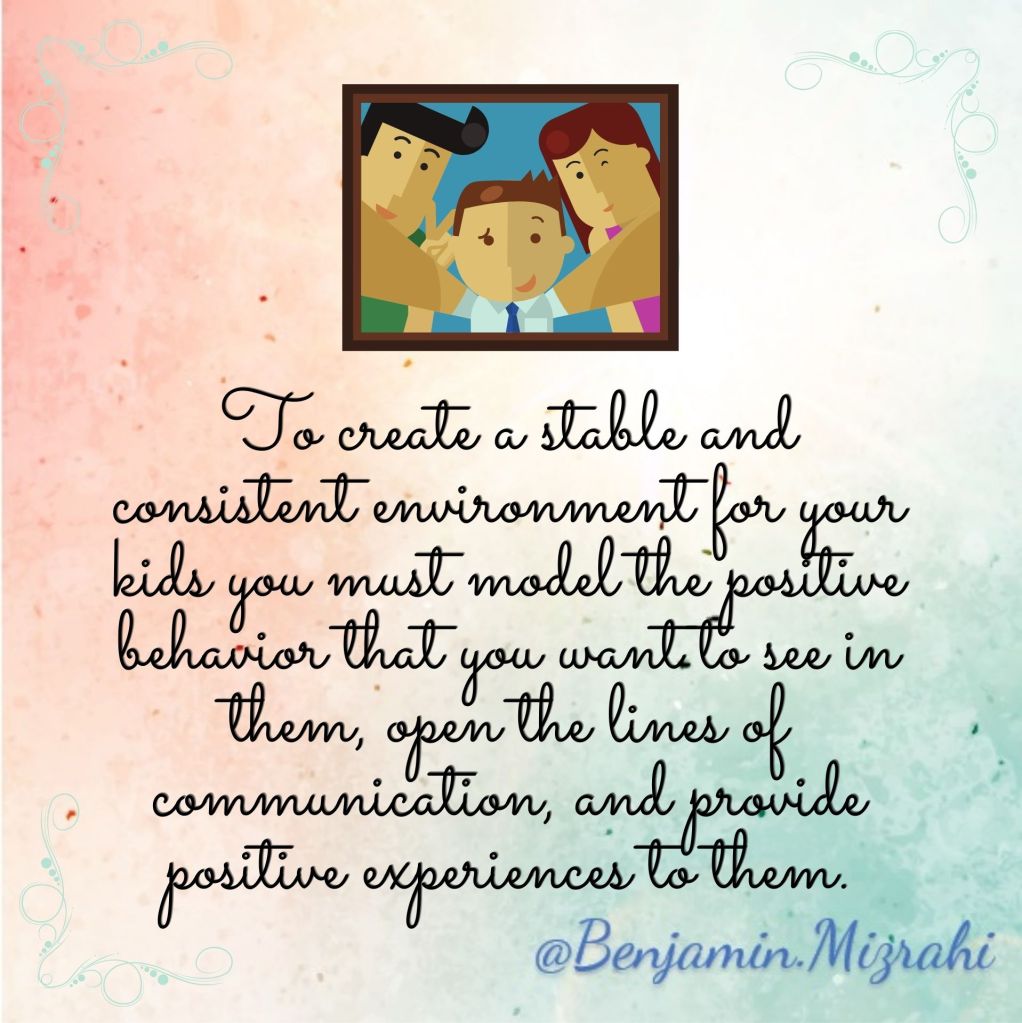
To create a stable and consistent environment for your kids you must model the positive behavior that you want to see in them, open the lines of communication, and provide positive experiences to them.
Coach Benjamin Mizrahi. Educator. Learning Specialist. Family Coach. Father. Husband.
Sibling fights seem to erupt more frequently and virulently when ADHD is in the mix. During quarantine, you can guard your family’s wellbeing and your kids’ relationship by squashing squabbles before they start and teaching emotional control, with help from this expert advice.
All children need four things: your ear, your empathy, your acknowledgment, and special time alone with you. This is how they feel supported and valued by the family.
In children with ADHD, hyperactivity and lack of impulse control can trigger even more annoying and problematic behaviors such as persistent interrupting, yelling, poking, badgering, and not playing fair, for example. This may be driving everyone in your household nuts at a time when you could really use a break yourself. Siblings often bear the brunt of this behavior.
Here are some ideas for reducing conflict as a team.
#1. Give voice to your neurotypical child.
Giving them a voice and validating their experience can minimize bad feelings. Every day or two, check in with your neurotypical child. Ask them how they’re feeling or what’s bothering them. Attending to their discomfort and allowing them to acknowledge unpleasant feelings helps diminish their stress. It also lets them know they are cared about and noticed, even in their role as the cooperative sibling.
It also gives you the opportunity to learn what’s hard for them and reassure the child that you love and care about them.
Always be ready to acknowledge acts of kindness. Saying “thanks for being patient with your brother today” fuels their desire to be helpful and lets them know you are on the same team.
#2. Avoid activities that usually lead to conflict.
Suggest some collaborative, rather than competitive, activities they can participate in together such as baking or working on a LEGO project. Ask for their ideas about what would be fun to do together.
If they do decide to engage in play that may be challenging, anticipate sticky moments in advance and troubleshoot resolutions with each child. You can say for example, “If you play basketball with your brother, what will lead to an argument?”
#3. Teach kids how to express their feelings rather than become their feelings.
Emotional regulation can be a struggle for kids with ADHD, so language is important. Ask them to assign a number to their anger (from 1 to 10, 10 being the highest). If they say it’s a 6, ask them what they can do to get their anger to a 4. You can provide solutions like time apart to cool off, a snack break, or a round or two of jumping jacks. Let them know they’ll have to go to their rooms unless they can get their anger under control.
Create a reward system around this to incentivize the kids and encourage them to continue practicing self-control. I work with a family that puts a marble into a jar every time the child uses the thinking part of the brain to get back in charge. Once the jar is filled up, the child is rewarded with a special toy or activity.
#4. If your child with ADHD is medicated, consider a temporary adjustment during lock down.
Everyone’s schedules are different now and a lot of medicines — especially stimulants — are designed to last through the school day. After about 3 p.m., and without after-school activities or sports to take the edge off, sibling battles tend to escalate as the day wears on.
We’re all starting to suffer from quarantine fatigue, but it won’t last forever. Navigating your family through rough waters requires parental leadership. Strive to anticipate the conflict and avoid it before it erupts into fighting. Also strive to hear and acknowledge difficult emotions, while teaching your child how to practice using their thinking brain to wrest control away from the anger. This is their chance to learn emotional control in a safe and rewarding environment.
If there’s a silver lining in this pandemic, it’s that spending more time together is an opportunity to practice self-control and experience new ways to play more contentedly together.
Coach Benjamin Mizrahi. Educator. Learning Specialist. Family Coach. Father. Husband.
Very often consequences are just punishments in disguise, or at the very least, unpleasant power plays that take away a child’s sense of capability, well-being and trust. Instead of helping and inviting cooperation, consequences are more often than not used in a way that chips away at your relationship with your child.
If chosen well, sometime consequences can help your child learn and make better behavior choices. The wrong kind of consequences just don’t motivate children to behave well. Your child might actually feel discouraged or so frustrated that their behavior gets worse instead of better.
Things to try when no consequence seems to work:
1. Know that you are not alone:
This isn’t really something to try, but something that’s just a relief to know. There are many parents who are struggling to find an effective consequence for their child. You are not alone. Strong-willed children are a joy and a challenge to raise. One of those challenges is finding something that does work for your child.
If you have a child with anxiety, depression, or trauma they may not respond as well to consequences. We recommend you try the ideas below. If you continue to not see change, seek a competent professional to help you and your family.
2. Customize consequences to your specific child.
Discipline is not a one size fits all. Each child is born with different strengths, weaknesses, temperaments, and motivations. Therefore, you will need to customize your approach with each child. The process of customizing does include some trial and error. That can feel really frustrating and take some time. However, if you stick with the process, you will eventually find something that works.
When testing out different consequences, you need to try it CONSISTENTLY and for at least a couple of weeks before you adjust and try something different.
3. Try some rewards, but not the typical reward you’re thinking of.
Sometimes when we’re working on extinguishing negative behaviors, we get too focused on ONLY negative behaviors. If a child feels like their parents don’t see any good in them, it can lead to more negative behaviors. Our kids need us to tell them what they are doing well. Do a quick self-evaluation. Are you pointing out at least 5-10 things each of your kids do well each day?
4. Try at home play therapy to help your child feel more connected to you.
Children generally behave better when they feel connected to their parents. At home play therapy is a heavily researched way to connect deeply and quickly with our kids of ALL ages.
It helps your child feel special to you and SEEN by you. It also helps your child feel safe showing you what’s important to them. That creates a special bond between you and the child.
Play therapy also helps parents. During the play therapy session, you get to just enjoy your child. You don’t have to tell them what to do or what not to do. You aren’t focused on their negative behavior. Rather, you just get to see how beautiful they are. It’s also kind of relaxing. Grown-ups don’t take a lot of time to just relax and be in the present. This allows you to do just that.
5. Learn about more options
Know that there is something that works for each child you just might not have found it yet. You may need some extra tools from a professional or from another parent you trust.
Imagine that you are trying to build a house using only a screw driver. That would be a challenging experience. It would be easier if you had a screw driver, a hammer, a saw, etc. The same is true of parenting. You may be working really hard at trying to find a consequence that works, but you may need someone to give you some additional tools, tools you’ve never thought of before. Needing additional tools doesn’t make you a bad parent. In fact, we think that seeking out tools makes you a great parent! Wouldn’t it be nice to have a tool belt full of options?
6. Think about what motivates your child.
Some consequences don’t work because they are too small and the child doesn’t care about it. On the other hand, some consequences don’t work because they are so extreme that the child loses hope and motivation. The best consequences are big enough to motivate the child to not misbehave, but small enough that the child isn’t in trouble all the time.
Coach Benjamin Mizrahi. Educator. Learning Specialist. Family Coach. Father. Husband.
It’s after midnight and your hyperactive toddler isn’t showing any signs of slowing down. You close your eyes and wonder how you will ever get to sleep if he refuses to go to bed. Knowing your friends’ kids have already been asleep for hours makes it more difficult to cope. Having a hyperactive toddler can be stressful; however, knowing that you can take steps to help him get to sleep can significantly reduce your stress level.
Designate a bedtime for your toddler. Put her to bed at the same time every night to establish a routine.
Give your toddler a bath one hour before the appointed bedtime. This will help relax him and will signal that the bedtime routine has begun.
Encourage your toddler to take part in quiet-time activities such as cuddling or reading a favorite book together. Make this a nightly activity that occurs right after the bath so she understands that bedtime is approaching.
Put your toddler to bed, turn on some soft music and leave the room. Do not return unless there is an emergency. Follow the same routine every night, until he accepts it.
Find a special song or poem that you and your toddler can recite each night just as you leave the bedroom. It will establish that the day has ended and it will provide security for your little one.
Do not deviate from the routine until your toddler has accepted it completely. The first few nights will be rough because the routine is new. Refuse to give in, refuse to deviate from the steps, and your toddler will accept the routine and begin looking forward to the special bath and reading time she has with her parent each night before going to sleep.
How many times have you had to referee a blowup because your preschooler took a friend’s toy or refused to share with her sister? Children are born believing that the world revolves around them. So, the sooner you help them understand that everybody has feelings and emotions, the less likely they’ll be to behave in ways that annoy or hurt other people.
Celebrate your child’s acts of kindness. In general, it’s best to find natural opportunities to teach empathy. Any time your child shows regard for someone else, you should reinforce her inclination with a simple narrative. For example, if you see your preschooler covering her doll with a blanket, say, ‘it was so kind of you to make sure that your dolly is warm and cozy. She must have been very cold.’
Ask, don’t tell. You can’t explain empathy to a toddler, but you can begin to get her thinking about other people’s feelings. Kids this age won’t understand lectures, but if you pose questions to them you can raise their awareness level. For instance, if your child won’t let her friend play with her stuffed animals, ask, “How do you think Emma-Rose feels when you won’t share your things with her?”
Help them read body language. Being able to interpret gestures and facial expressions is one of the basic ways that we develop empathy. Give your toddler pointers: “See how Aunt Margaret looked when you shared your cookie with her. Did you notice that she was smiling? You made her feel so good.” Your child may not fully understand at first, but when she does, she’ll be clued in to other people’s reactions — and better able to notice how her own behavior can affect others.
Coach Benjamin Mizrahi. Educator. Learning Specialist. Family Coach. Father. Husband.
There are good ways to discipline a child with ADHD. Nagging, yelling, and punishing are not among them.
Parenting a child with ADHD can challenge a parent’s patience — and good judgment. Just like all kids sometimes make bad choices regarding their own behavior, parents can make bad decisions disciplining this misbehavior. Instead of using firm and compassionate approaches, parents of kids with ADHD are often driven into the ignore-nag-yell-punish cycle. Sound familiar? Try these child discipline strategies to break that cycle once and for all.
💟 Do: Get Involved, Quickly
Quickly move people or objects to prevent bad behavior. For example, if your children start quarreling over a toy, you might say, “Alex, sit over there. Maria, stand here. I’ll take this and put it up here.” Similarly, if your child comes in from outside for supper and refuses to wash his hands before eating, immediately take his plate off the table and silently point to his hands.
💟Don’t: Ignore Your Child’s Misbehavior
You should respond to your child’s behavior, when it’s good and bad. Otherwise, your child may read your silence as “I won’t give you my attention or concern” or even “I reject you.” She might also assume that your silence means you approve of what she is doing — even when you don’t.
💟 Do: Be Brief
Keep your words to a minimum when disciplining. Some of the best parenting advice that can be given is summed up in the following statement: The fewer words you use to discipline your child with ADHD, the more effective (and heard) they will be. Tell your child once, very clearly, what you expect of him. Then stop talking.
💟Don’t: Be a Chatterbox
It’s important that you don’t go on and on about what your child is doing wrong. Words are like tires: Each time they rotate against the pavement, they lose tread, and become less efficient at starting, stopping, and steering. Eventually, they will have no “traction” at all — as tires will eventually become bald.
💟 Do: Keep Calm
Don’t let your own anger get the best of you. Tell yourself that you won’t open your mouth until you’re calm enough to speak at a normal volume and in a cordial tone. To calm down, spend a few minutes alone — something as simple as excusing yourself to get a glass of water may do the trick.
💟 Don’t: Shout
Try not to bark orders like a drill sergeant. Yelling shows a child that you, the almighty parent, have lost control. Shouting also opens up the door to your child to return the favor and to yell back.
💟 Do: Punish Fairly
Use appropriate punishment when responding to a misbehavior. The consequence for spilling milk might be that your child cleans up the mess, and then pours another glass and sets it in a safer place on the table. No reason to blame or yell at him, or even withhold food from him.
💟 Don’t: Overdo It
It’s important that you don’t go overboard with punishment. In most cases, harsh punishments, like spanking, encourage children with ADHD to become sneaky so as not to get caught next time. They may even cause your child to doubt your love for him — something you want to avoid at all costs.
Coach Benjamin Mizrahi. Educator. Learning Specialist. Family Coach. Father. Husband.
If you’re raising a child who has ADHD, you probably spend a lot of time focusing on his weak points — intentionally or not. There’s nothing wrong with trying to work on your child’s impulsivity or lack of focus — in fact, it’s important for parents to do so.
But focusing too intently on your child’s shortcomings may be doing a number on his self-esteem. How can you keep him believing in himself while also respecting the rules?
Nagging doesn’t work. Neither does yelling or spanking.
Why? These punishments only tear down children — which is particularly counterproductive for kids with ADHD.
So how can you boost your child’s self-esteem — and still enforce the rules? Start with these positive parenting techniques.
1. Be a behavior detective.Pay close attention to what your child does well. Find ways to extend those accomplishments to other areas.
2. Use the right words at the right time.The key to effective praise is timing. Lauding every action will seem phony. Offer authentic encouragement when your child truly succeeds.
3. Set up a rewards system.Reward successes with gold stars that your child can cash in for a reward. This gives your child real-world goals and long-term motivation.
4. Expand your definition of success.Straight A’s aren’t the only measure of intelligence or talent. Your child may be a natural artist, or a four-star chef in the making.
5. Discipline fairly and consistently. Positive parenting isn’t giving your child a free pass. It’s consciously noting the good alongside the bad – even when punishment is necessary.
Coach Benjamin Mizrahi. Educator. Learning Specialist. Family Coach. Father. Husband.







 EXECUTIVE FUNCTIONS COACHING