How to keep your personal space during Corona time?
We spend much more time at home than ever before. We try to define our workspace and where we work. You want to convey to everyone in your house that you need quiet space.
What can you do?
Use door post or signage like ” Please do not disturb”
I am going to share with you a PDF file, you can stick it to your door and explain to your family. 😊
When no one really disturbs you, feel free to acknowledge them and share your gratitude for following the rule.
Parents are often entangled amidst a multitude of responsibilities, be it managing household work, jobs, own enterprise, social gatherings and an endless array of items… With so much going around, minds of parents are found plagued by the guilt of not being able to spend enough time with their kids. As a result of this feeling, the question often asked is, ‘how can I find time to spend with my kids? How much is ‘enough’ time?’
Why parents must spend time with kids…
Children learn what they see – Children are most influenced by what they see around themselves. If parents are to instill good values and ethics in their kids, then there is no-one else better placed than themselves to showcase similar value and belief structure.
Strong support system matters. A lot! – More often than not, children with strong support system in childhood grow up to become emotionally strong individuals to deal with life. This is observed by a Harvard research which quotes “The single most common factor for children and teens who develop the capacity to overcome serious hardship is having at least one stable and committed relationship with a supportive parent, caregiver, or other adult”
Children’s energy needs right direction – It’s the easiest for a parent to identify key strengths and development areas for a child and guide him/her through the best path in initial years. After all, rarely do we find someone else who will be as committed to the overall development of a child as his/her parents are.
Pleasant childhood memories give strength for a lifetime – Good time with parents gives a lifetime of memories to cherish. We often recall our happy childhood memories as those which involve a bedtime ritual of storytelling, dad teaching cycling, playing card games as a family, cooking a meal together and so on. These moments remain precious and strength giving to kids for life.
Remember this when conscious parenting feels hard. ⠀⠀⠀⠀⠀⠀⠀⠀⠀ Remember this when your friend tells you that sleep training only took a few nights of crying and now their baby is blissfully sleeping through the night. ⠀⠀⠀⠀⠀⠀⠀⠀⠀ Remember this when others tell you that you really need to start using “more discipline” so that your child is better “behaved”. ⠀⠀⠀⠀⠀⠀⠀⠀⠀ Remember this when your family tells you that your child needs to be more independent by now and that you really need to stop coddling them. ⠀⠀⠀⠀⠀⠀⠀⠀⠀ Remember this on the days you feel all alone. ⠀⠀⠀⠀⠀⠀⠀⠀⠀ Remember this, because it is true. It is much easier to build strong, sensitive, empathic, wholehearted, silly, funny, spirited, boundary-pushing, authentic, cheeky children than it is to repair broken adults. ⠀⠀⠀⠀⠀⠀⠀⠀⠀ We know that we have a massive impact on the way our children’s brains develop. Why? Because relationships lay the groundwork for the brains our babies build. We want to lay the foundation for (healthy) mental health, because if we don’t we set our kids up for a lifetime of trying to find their way back. ⠀⠀⠀⠀⠀⠀⠀⠀⠀ It sounds kind of scary. Like a big responsibility. And it sure is! We have a massive responsibility as parents. We decided to become parents so of course it should fall on our shoulders now, not on our children’s later. ⠀⠀⠀⠀⠀⠀⠀⠀⠀ But I like to look at it as an opportunity. We get to change unhealthy generational patterns. And in the process, we reparent ourselves – we become more wholehearted and cheekier and fun-loving and rule-breaking and questioning and authentic people ourselves. And isn’t that what our world needs now, more than ever. ⠀⠀⠀⠀⠀⠀⠀⠀⠀ So, remember this when conscious parenting feels hard. What you are doing is monumentally worthwhile.
When you change your relationship with your kids, you are changing family patterns, habits, and narratives.
You are saying. I’m keeping the healthy stuff and I’m getting rid of the unhealthy stuff. I’m changing the chapters in my family story. I’m changing the generational and historical narratives. We don’t always have to do it the way we’ve always done it. I am doing things differently for myself and for my kids.
Those decisions change your child, your family, and ultimately the world in which your kids live in.
Focus your energy on the right things. Growth is a process, so it doesn’t happen overnight. Expect your child to make mistakes. So, will you. That’s okay.
Acknowledge it. Then, focus on changing the relationship, changing your mindset, and connecting in meaningful ways.
Stop battling your child into obedience. It obviously doesn’t work.
Your child pushes their sibling down while you’re at a friend’s house, you ask them to apologize, and they say NO and run off. You ask your teenager to clean their room and they respond with, I’ll do it when I get around to it, as they close the door in front of you. If you are feeling heat rise in your body reading this right now, pause. Take a long breath in. Let it out through your mouth while you say, “pbpbpbpbp”. As our children grow and discover and desire their autonomy, we can find ourselves in power struggle after power struggle. When we set a necessary limit or simple request, and our child responds with a refusal, our desire to be viewed as right or as the authority can push us into a power struggle. The desire to be right, to be viewed as the authority, to be respected, and so on are rooted in our egoic beliefs about who we are as a parent and how we “should” be treated by our child. In power struggles, no one wins. Both the parent and child are more likely to raise voices, demand, feel frustrated or angry, all of which are signs of dysregulation. So, when you find yourself in a power struggle (where safety is not or no longer a concern): Stop Breathe Remember you are the adult! Again, this doesn’t mean that because we are the adult, we “deserve” to win. There is nothing to be won. But as adults, we understand and remember that: – We do not need to be “right” and we do sometimes need to set limits – Our children will not always like our limits (this is okay) – We may not always like our child’s response to our limits (this is okay also) – If our child is dysregulated because of the limit, we can remain calm in our choice and empathize – When we sense that voice that desires to be “right and respected” we can stop, breathe, and say, “You’ve had enough to say already, the WISE parent in me IS HERE now.”
Positive attention is the way you show delight in your child and warmth in your relationship through:
smiling at your child
making eye contact and using caring facial expressions
being physically gentle and caring with your child
using words to celebrate and encourage your child
showing interest in your child’s interests, activities and achievements.
As a parent, we are pressured to teach our children all the right skills to succeed at school, with friends, and in life.
Teaching our children, the skills they need starts by deeply understanding and connecting with them.
Children connect with us and learn from us in the presence of a patient, empathic, gentle, and securely attached relationship.
Yes, they need boundaries, but they need a relationship with us first.
Over time, it’s important to give your child more positive attention than criticism or negative attention. If you can give your child positive attention most of the time, your child will have a strong sense of being secure and loved. This will also outweigh those occasional times when you feel frustrated or distracted, or you can’t give your child as much attention as you’d like.
Begin by validating feelings or showing understanding. Offer a choice when possible.
Examples:
I know you don’t want to brush your teeth, and we can do it together.
You want to keep playing, and It is time for bed. Do you want one story or two?
Kindness is important in order to show respect for the child. Firmness is important in order to show respect for ourselves and for the needs of the situation. Authoritarian methods usually lack kindness. Permissive methods lack firmness. Kindness and firmness are essential.
Many parents and teachers struggle with this concept for many reasons. One is that they often don’t feel like being kind when a child has “pushed their buttons.” Again, I want to ask, “If adults want children to control their behavior, is it too much to ask that adults learn to control their own behavior?” Often, it is the adults who should take some Positive Time-out until they can “feel” better so they can “do” better.
Let’s tackle firmness. Most adults are used to thinking that firmness means punishment, lectures, or some other form of control. Not so. Firmness, when combined with kindness, means respect for the child, for you, and for the situation.
Parents and teachers habitually lecture and make demands. Children often respond by resisting or rebelling. The following kind and firm phrases will help you avoid disrespectful language and increase cooperation:
Your turn is coming.
I know you can say that in a respectful way.
I care about you and will wait until we can both be respectful to continue this conversation.
I know you can think of a helpful solution.
Act, don’t talk. (For example, quietly and calmly take the child by the hand and show him or her what needs to be done.)
We’ll talk about this later.
Now it is time to get in the car. (When child is having a temper tantrum.)
We need to leave the store now. We’ll try again later (or tomorrow).
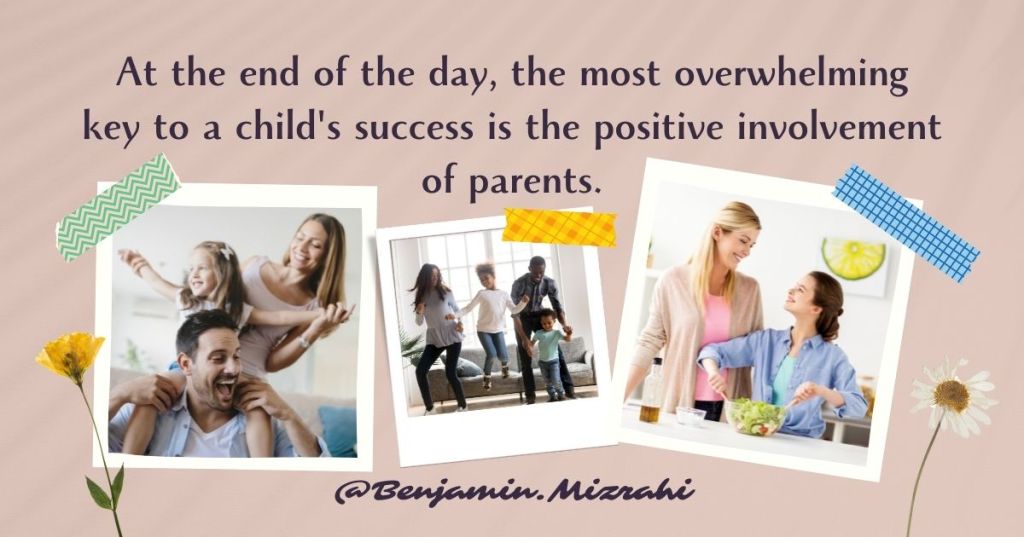
It is no secret that children love new toys. They love Christmas and birthdays because of the multitude of gifts they receive. However, the most important gift any child could receive is the continual presence of his parents in his life. As a parent, giving your time, energy and love to your child is one of the most important things you can do.
There are individuals who experience the best of the best while growing up. They receive all the latest toys, the new cars, the latest gadgets, yet their parents are rarely home. Their parents don’t bother trying to establish a close relationship. Instead, they try to buy their child’s love. As their children grow up, they don’t have a close-knit relationship. In fact, they rarely speak. Unfortunately, these children learn to grow up without the help of their parents, and now they don’t need their family unless it is for financial means.
The relationship between parents and children is established at a very young age. Children learn to rely on their parents for everything from changing their diapers to feeding them each meal. Even though parents may work full-time away from the home, they can still be present in their child’s life. They can still do all they can to develop a strong relationship with their child based on love and understanding. Here are a few reasons why presence is more important in your child’s life than the latest and greatest present.
Children need your example.
A child’s first school is the home. This is the place where children learn basic skills such as how to speak, walk, use the toilet, hold a fork, etc. Children learn these skills from watching others. Parents set an example for children. If a child sees a parent performing a certain task, the child feels it is also OK to do it. When you are present in your child’s life, you help shape your child into the person you know he can become. Children look up to you their entire lives and your actions speak much louder than any amount of money. Show your children, by your example and your actions, that you want what is best for them.
Involvement helps build child’s self-esteem. When you are involved in your child’s life, you help him gain confidence and build up his self-esteem. This is important to a child’s mental health. When these feelings do not exist, the child is more likely to be insecure and have feelings of low self-worth.
A strong relationship builds child’s communication skills.
When parents are present in a child’s life, they spend more time talking to the child. Whereas, when a child is just given a gift, they are usually by themselves for an extended period of time. Communication with parents is essential for establishing critical skills. Vocabulary, grammar and even basic socializing skills can all be learnt through constant communication between a child and a parent.
At first, presents may seem like a great way to win your child’s love but they will never take the place of being present. Children grow up too quickly. Don’t let their childhood slip by without being involved and letting your actions show your child how much your care.
It is great to be informed, to research, to grow your knowledge and understanding, and to parent with intention. Just remember, even with all of that, there are no perfect parents. Everyone makes mistakes, has bad moments, bad days and episodes that didn’t go well. No parent can handle every single parenting challenge with grace, patience and control.
Our ability to manage day to day, hour to hour reflects so many things. How much down time we’ve had. How tired we are. How much we feel supported. How well we’ve eaten. How well our other relationships and adult tasks are going. How many children we have to split ourselves between. The different temperaments and needs of our children. The list is endless.
We’re not here to wave a flag that says because of that – behave however you like, it doesn’t matter. But we’re very much here to remind you today that despite all our best intentions, no one is perfect and everyone messes up at times. Try not to be hard on yourself when you do. Learn from it, repair as best as you can, then let it go and move on. Parenting is hard. You’re doing your best!
Kids say lots of stuff. Some of it unpleasant. Some of it complicated. Lots of it that we have the urge to react to, correct or change.
We often hear our kids says something not-so-nice about others or about themselves and then want to replace their words with words and ideas of our own, life lessons from our experiences.
Here’s the thing: it’s not that useful. The shelf life is limited.
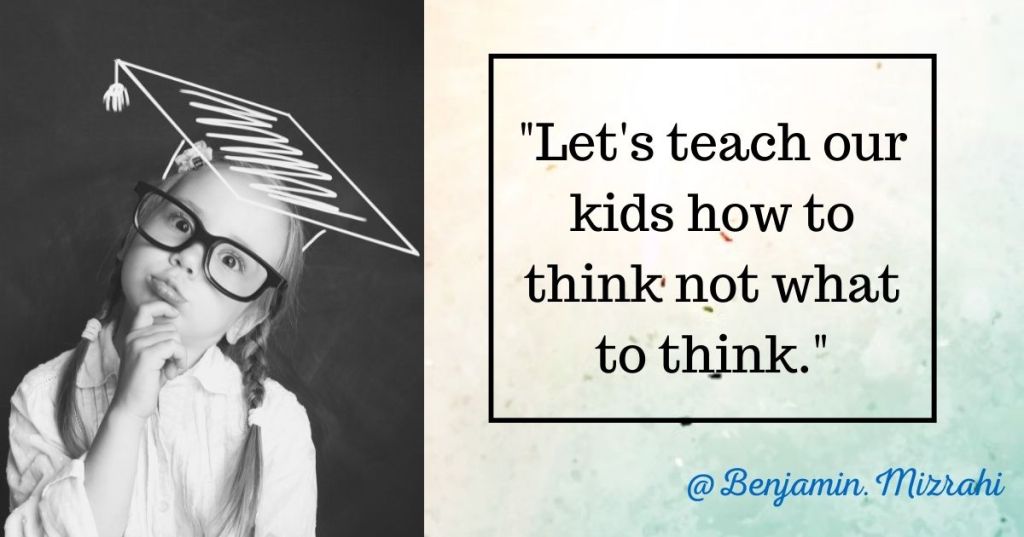
Why? Because whenever we focus on telling kids what to think… we miss out on an opportunity to teach them how to think. When we try to replace their stories with our own, we miss out on an opportunity to help kids learn to pause, reflect and *ask themselves questions* – the processes necessary for change and growth.
As parents we like life lessons too. Yes of course we can tell our kids things like: being first in line doesn’t mean anything about importance! Mommy has time for each one of you! reading chapter books isn’t a sign of intelligence!
And yet, every time we say something like this – some platitude – it just always feels like it falls flat. There’s almost nowhere to go from there, maybe only our kid saying, “Thanks mom” and then walking off, still feeling a bit defeated. Our attempts to teach our kids what to think only feels somewhat helpful to them.
So, what else can we do? Pause. Ask questions. Activate curiosity.
When our kids say the comments that prompt the platitudes – comments like, I have to be first in line! You don’t have enough time for me! I can’t read chapter books like my friends! – well, first pause. Take a breath. Then consider the following:
Tell your child, “I’m so glad we’re talking about this. It’s so important.”
Then tell your child, “I can tell this really matters to you. You really know that, and I can see it.”
Then learn more through inquiry. Some starters: Tell me more; And then what happened; Oh, keep going; Tell me how that works; Tell me how that feels; Tell me what would feel better; Let’s figure this out together.
When we pause and learn, we teach children to look at their own thoughts, to ask themselves questions, to be curious about the way they think and feel. What a gift to start this circuitry early in life.
As a parent now, are you making the effort to ensure your kids feel loved? Very often, it is the small things that count.
Here are ways to make your kids feel loved. When you become grandparents, you will be touched that they still remember them.
1. Turn off your smartphone.
When you get home or your kids get back from school, turn off your phone and give them your full attention at least for the first half hour or so. The kids love this because they know you are not going to be distracted by texts as they tell you what happened at school.
2. Turn off the TV and all gadgets at mealtimes.
It is not much fun when kids have to compete with TV commercials or everybody texting away. Mealtimes are rare moments to enjoy each other’s company. There are enormous advantages for kids. They eat more healthily as it is not rushed. They also enjoy the companionship of their parents and they are much less likely to have an eating disorder later on.
3. Make bedtime a precious moment.
Younger kids will always treasure those moments when you read them a story as they drift happily into sleep. It is enormously reassuring and it is a unique bonding experience for parents and kids. The extra bonus is that this also helps your child’s brain development.
4. Show physical affection.
Countless studies show that kids thrive on warmth and affection. The child feels loved and will have a greater self-esteem. There is no need to go overboard but a kiss or a hug once a day will do you both a lot of good. It lessens the chances of your kids becoming aggressive, anti-social and having other behavioral problems. While adolescents might be embarrassed at the physical affection, there should always be words of support and empathy to take its place.
5. Spend quality time with each child.
It is wonderful when a parent or both parents can spend one-on-one quality time with each of their kids. This is great because they will each feel special, when given that attention away from their brothers or sisters. It can be anything from playing sports, cooking, or helping with chores. There is no better way of showing your kids that you really love and cherish them.
6. Discipline them with love and affection.
The key to successful parenting is not to switch on the love when they do well and deny it when they misbehave. There are no conditions but just a steady flow of affection so that kids feel their parents’ love is truly unconditional.
7. Be a great role model.
How many times have you told your kids what to do, how to be polite and to always wear their seat belt? Oftentimes, parents forget that they must be the perfect role models because children are great copycats. No better way to show that you love your kids than to walk the talk. Be kind, affectionate and caring to others and teach your kids to be color-blind about race.
8. Involve them in decision making.
What to wear for school the next day or where to visit when you go on holidays can be decided together with your kids. Make sure your kids are fully involved and engaged. It is also great for kids to start learning how to make decisions with their parents’ guidance.
9. Never interrupt their stories.
When a child has a story to tell about what happened at school never interrupt them but hear them out. The same goes when they want to share a book with you or show you a picture story. They will feel loved and wanted. If parents ignore them or are far too busy, kids will be the first to suffer and it is likely to last into adolescence and adulthood unless we really make the effort now.
Love and affection are the foundation of happiness. By showing our kids this love every single day, we are giving them the greatest gift of all.
Caring interactions help shape brain development. When a parent shows sensitivity, responsiveness, and consistent caregiving at times of distress, it helps calm the nervous system by acting as a buffer to stress, and supports emotional regulation within the relationship (co-regulation).
Being able to be that person and that co-regulator for our toddlers is so important because they cannot hold on to their own stresses at this age, it’s too much and they are too little.
They need to be able to share it with someone who will be able to be a calm and stable shelter for their pain. The more you practice this, the easier it will be for them to eventually hold their own pain (co-regulation -> self- regulation)
It sometimes doesn’t seem like much, hugging, staying close, giving space, giving empathy- but it really is everything for infants and toddlers. Their growing brains depend on it.









 EXECUTIVE FUNCTIONS COACHING