Shielding Your Child from Mistake Isn’t Helpful

In our efforts to protect children, we take valuable opportunities of learning away from them. Mistakes are the essence of learning. As we have new experiences and develop competence, it’s inevitable we make mistakes. If failure is held as a sign of incompetence and something to be avoided, children will start to avoid the challenges necessary for learning. 

Protecting your kids from failure isn’t helpful. Here’s how to build their resilience: 

  • When your child asks for help: Try giving your child time for trial and error. If your child is non-verbal, give words to his actions so he can start to learn the process.   
  • When your child asks for an answer: A common parental instinct is to share all your hard-earned wisdom, but in most cases it’s best to support your children as they learn on their own. Start by asking them what they think or what they have tried. Support them as they experiment, make mistakes, and discover why they weren’t right.  
  • When something goes wrong: Instead of telling your children how to fix it or fixing it yourself, start by asking how they think they should fix it. Guiding children to reflect on the problem takes more time but provides rich opportunities for learning and skill-building. While children learn from mistakes, they also develop the self-confidence, self-concept, and moral judgement that comes from doing something like apologizing and working to right a wrong. 
  • When your child doesn’t do as well as you expected: Reflect together on what children did, how they excelled, and things they have learned. Their personal growth and achievement should be the focus of these conversations rather than the mistake or failure itself. Consider encouraging rather than heaping on praise to focus children on positive outcomes. 

Coach Benjamin Mizrahi. Educator. Learning Specialist. Family Coach. Father. Husband.   

More articles on EXECUTIVE FUNCTIONS COACHING (mrmizrahi.com)

PARENTING TIPS DURING CORONAVIRUS PANDEMIC

Times of crisis such as the current pandemic can cause major stress and fear in the household. It is important to check on everyone’s mental and physical health and as much as possible, stay safe. 

As much as possible, do not expose yourself to the virus 

Do not be the carrier of the virus into your home. If there is no need to go outside, then stay at home with your family. But if there is a need for you to go on errands or groceries, make sure that you wear complete personal protective equipment from masks and face shields along with disinfectant alcohol.  

Isolate and provide supportive healthcare for members who fall ill 

It is difficult to be lenient in times like these in terms of illnesses. If a family member gets sick, even if it is not confirmed to be the Coronavirus, isolate them in a spare room for 2 weeks and wear masks around the home. Provide supportive care and over-the-counter medicine for their recovery. 

Be willing to talk to your children about it 

As the World Health Organization said, silence and secrets do not protect our children, honesty and openness do. Help your child to understand what is going on and why we must follow the protocols set. If you do not know the answers to some of their questions, it is a good opportunity to learn it with your child. 

Create a structured schedule  

The pandemic has altered our daily routines significantly. This has in effect changed our sense of accountability in terms of following time, it has also changed our way of living life, most likely leaning towards the unproductive side of the spectrum. Creating a routine helps us to set rules for ourselves, such as waking up early and eating breakfast at a certain time of day. This way, at least we can be productive with time. 

Be creative in making entertaining activities 

Boredom and lack of productivity is also another plague in our homes in these times. Try to counteract this by playing legitimately enjoyable games, either with board games or video games. It is also important to play as a family so that your bond throughout the pandemic strengthens. 

Coach Benjamin Mizrahi. Educator. Learning Specialist. Family Coach. Father. Husband.   

More articles on www.MrMizrahi.blog  

How to Deal with Controlling Kids

Children aren’t born with the ability to understand rules – it’s a learned behavior. So, what do you do when your child has taken control of the household into his own hands? It’s important to understand why your child is acting out.  

When responding to controlling kids, the secret isn’t to control them more or to try to stop their need for control or to prove to them they don’t need to act controlling. 

Help them find something they can control that is okay with you and them. This gets you on the same team, helps meet the kids’ need for control and keeps them working within the boundaries you set in place. 

The key to controlling a controlling child is controlling yourself. It is unfortunate that the answers to tough problems often begin by looking in the mirror. But once we see a clear picture of ourselves, we can better help our kids. 

  • Control your reaction. Reacting to inappropriate behaviors not only feeds into the bad behavior by providing a form of attention, but also causes the parent more stress and anxiety. Break the vicious cycle by controlling the one thing you can: your own behavior. 
  • Your child’s mood will mirror your own. When you come home stressed, upset, or angry, your child picks up on that and acts in a similar fashion. They do not do this on purpose – it’s part of a natural reaction called imitation.  
  • Your child needs and wants structure. Children like structure and routine. They like to feel a sense of comfort and to know what to expect, and you’re the most important person who can provide that. If a child is in a state of constant change, she may feel anxious or tense, and inappropriate behavior will soon follow. A lot of children will act out because they are anxious but may not know or understand how to communicate that to others. 

Coach Benjamin Mizrahi. Educator. Learning Specialist. Family Coach. Father. Husband.   

More articles on www.MrMizrahi.blog  

The Importance of Hugging Your Child Every Day

Hugging brings many other benefits especially when it comes to child development. The nurturing touch of a hug enhances a child’s growth 

A few recent studies highlight the importance of parental affection for children’s happiness and success. 

🤗 Hugging a baby can boost her immunity 

🤗 It boosts a kid’s self-esteem 

🤗 It helps them stay optimistic 

🤗 Leads to better emotional health  

🤗 Boosts confidence in the child at an early age 

🤗 Gives your child a sense of security and enforces parent-kid bonding 

🤗 Makes the child feel important 

🤗 Promotes an increase in trust which is an essential element in building relationships with kids as well as other people 

🤗 Helps them cope with social and other types of stresses that a kid might face 

🤗 It makes them smarter 

🤗 It teaches them to develop empathy 

The oxytocin hormone is released during the act of hugging which has a bunch of positive benefits: 

👉 Helps your kid stay healthy and improving their immune system 

👉 Promotes faster wound-healing and helps decrease inflammation  

👉 Helps reduce the feeling of fear and increases the readiness to take risks and trust others 

So, the next time you hug your child, with their permission, remember you’re also doing great things for their physical and mental health.   

Coach Benjamin Mizrahi. Educator. Learning Specialist. Family Coach. Father. Husband.   

More articles on www.MrMizrahi.blog  

VERBAL TIPS FOR TAMING TANTRUMS

Tantrums are a normal reaction that a child could express if they feel frustrated or angry. We might often feel offended or angry as well because we interpret these outbursts as a sign of disrespect. But it is important to note that children are still emotionally immature and are unable to process their feelings as well as we expect them to. Thus, it is important to address these tantrums in a manner that does not make the situation worse and ensure that the child does not feel isolated. 

Calm down → How can I help you? / What is bothering you? 

Stop crying → I can see this is hard for you/ It’s okay, we can work this out 

Be quiet → Can you please soften your voice 

Don’t hit → Please be gentle 

Stop yelling → Take a deep breath, and tell me what happened 

I’m done → I’ll be here for you 

Coach Benjamin Mizrahi. Educator. Learning Specialist. Family Coach. Father. Husband.   

More articles on www.MrMizrahi.blog  

6 Ways to Show Faith in Your Child

PARENTING A CHILD WITH ADHD

Raising a child with attention deficit hyperactivity disorder may be a difficult task for parents. Due to the nature of their disorder, they may be a bit unruly and hard to manage. It will take patience and unconditional love for our children to pull this off, however, it does not mean you are to do it alone. Here are some tips from KidsHealth of the Nemours Foundation. 

🟨 Be involved 

Learn as much as you can about ADHD. You have to take a hands-on approach in the wellbeing of your child. Follow the prescription and instruction of the doctor. 

🟨 Discover how your child is affected by ADHD 

Every child is affected differently. Find out how your child is being influenced by ADHD by observing which areas they have the most difficulty in. By pinpointing their areas of difficulty, you can then begin to work on those for improvement. 

🟨 One at a time  

Children suffering from ADHD will have an impaired ability to focus. Be accommodating of this fact. When teaching new concepts to children, make sure to introduce these one at a time, and praise their achievements no matter how small. 

🟨 Discipline with purpose and warmth 

Discipline in a manner that the child will know exactly what they did wrong. Constant nagging and reprimanding will not help stop the behavior, but rather put more doubt and ambiguity in their understanding. It is also important to do so in a manner that is loving that your bond will grow deeper, instead of planting anger in their heart. 

🟨 Set clear expectations 

Being clear with what you expect from the child helps them to set boundaries on their own. They learn how to control their actions and impulses, or at least train them to. Focus more on what to do, rather than reacting on what NOT to do. 

🟨 Build your relationship with your child 

Often, children with ADHD will feel they’re letting others down, or feel that they are not good enough. Always be there to support them and build their self-esteem. 

Coach Benjamin Mizrahi. Educator. Learning Specialist. Family Coach. Father. Husband.   

More articles on www.MrMizrahi.blog  

6 Ways to Show Faith in Your Child

Normalize Apologizing to Your Children

Most parents teach their kids to say “sorry” from a young age. Half the time our kids don’t really feel remorse when they make amends, yet we push them to do it anyway. So how do you set a good example? 

The best way to set a good example is to model it. Kids mirror your behavior. When you have done something wrong, regardless of your position, you should correct it and apologize. We don’t force apologies; we model them when needed. Apologizing is a way to show someone they matter to you, it builds trust, helps them feel heard and can deepen your connection. 

  • Admit what you have done wrong and ask for forgiveness. 

A better example is something like, “Mommy lost her temper. I am so sorry. I should not have acted that way. Will you forgive me. I will do better next time.” A good apology is one that owns the offense, asks for forgiveness, and makes effort to change in the future. 

  • Don’t blame or shame your child. 

Make sure your words are words of love and healing, not blame and shame. After that, appropriately deal with the disobedience. 

  • It is not about winning and losing 

Stop thinking you are on opposing teams. You are in this together as a family. Don’t ignore the power of apologizing. 

Do you apologize to your children when in the wrong? 

Coach Benjamin Mizrahi. Educator. Learning Specialist. Family Coach. Father. Husband.   

More articles on www.MrMizrahi.blog  

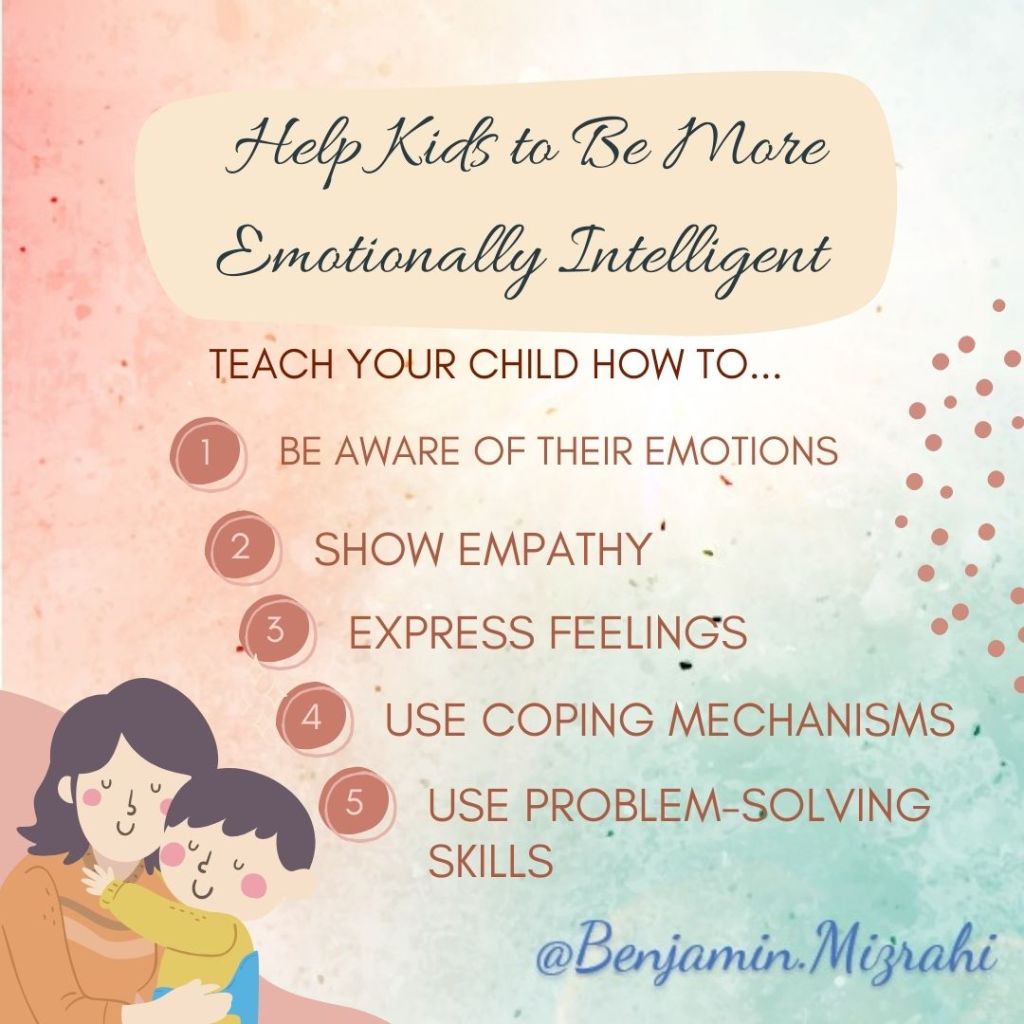
Ways to Help Kids Be More Emotionally Intelligent

Strengthening your kid’s emotional intelligence matters because his inability to manage his emotions can create a domino effect in other aspects of his life. Emotional intelligence is relevant for kids, and there are many simple ways to start fostering your kid’s emotional awareness starting today. 

1. Help your child to be aware of their emotions: When your child displays a certain emotion, and even more so when they are upset or displaying a negative emotion, acknowledge it and label what they are feeling. This will help them understand their own emotional state better, and eventually, they will learn to regulate this same emotion with more control. 

2. Acknowledge their emotions and show empathy: When you respond to your children’s emotions empathetically, they learn the appropriate response to situations too. This also validates their feelings and helps them understand their own behavior better. Thus, teaching them to self-regulate their emotions. 

3. Model appropriate ways to express feelings: In addition to knowing that their feelings are understood, kids also need to learn how to appropriately express their emotions. This helps them learn how to deal with their emotions and to move past them instead of holding them in or repressing them. 

4. Teach them healthy coping mechanisms: Teach your children how to respond to negative emotions. Teach them to breathe or count to ten when they are feeling a negative emotion.  

5. Teach them problem-solving skills: Once feelings are acknowledged and understood, there sometimes comes a need to problem-solve or address any issues that need to be dealt with. Initially, you can take the lead but eventually, step back and act as a guide while they navigate their problems themselves. 

Coach Benjamin Mizrahi. Educator. Learning Specialist. Family Coach. Father. Husband.   

More articles on www.MrMizrahi.blog  

Effective Alternatives to Physical Punishment

Emotional hypersensitivity is a core ADHD trait, so the physical act of spanking can lead to emotional hurt. As challenging as it sometimes is to do, taking a positive approach can be more effective in teaching your child to act her best.  

While spanking has been shown to negatively impact bonding with parents, a positive approach ensures that, when it’s time to discipline your kids, they’ll be more receptive to your authority, not afraid of you. 

Here’s how you can respond to your child’s behavior instead of spanking: 

  1. Choose appropriate, effective punishments. 
    If possible, choose a punishment that is a natural consequence of the misbehavior. If you find that a particular “punishment” does not seem to work even when applied consistently, it is not “punishing” for your child, and you should try another. 
  1. Ignore misbehavior that is not harmful. 
    When you have all harmful behavior under control, you can gradually start to work on other annoying behaviors – one behavior at a time. 
  1. “Time-Out” works best when used to prevent the child from getting rewarded for misbehavior. 
    Use this technique to remove the child from the room where other children are likely to provide praise, laughter, etc. Make sure to use it immediately and as unemotionally as possible. 
  1. Rewarding a child’s good behavior is much more effective than punishing bad behavior. 
    Reward has the added advantage of helping a child feel good about himself; whereas punishment tends to make a child feel bad about himself and resentful toward you. 

Coach Benjamin Mizrahi. Educator. Learning Specialist. Family Coach. Father. Husband.   

More articles on www.MrMizrahi.blog  

Ways to Meditate with a Busy Brain

Meditation is an active process that trains the brain to focus and be present. If you or your child has attention deficit hyperactivity disorder (ADHD), the possibility of meditating may seem challenging. 

Even children and adults with ADHD can strike a peaceful state of mind with these steps. 

1. Use music as your focus. 

Meditation need not happen in silence. 

Practice breathing in and out mindfully to the melody of an instrumental song. 

2. Acknowledge and release clamoring thoughts. 

When your attention drifts to something else, gently disengage and return your focus to your breaths. At first, you will repeat this process a lot, and that’s OK. 

3. Don’t “should” yourself. 

If meditation is hard at first, repeat these mantras: 

  • “Meditation is a practice.” 
  • “There are no wrong ways to meditate.” 
  • “I will refrain from judging myself.” 

4. Try moving meditation. 

Calm your antsy body with a simple, repetitive motion – like walking – while you meditate. 

5. Start small. 

Begin by meditating for five minutes, a few times a day. 

When that becomes comfortable, increase the length of your session. 

6. Make it a habit. 

Enlist a coach, a friend, or an app to encourage you to stay on track until the practice is part of your daily routine. 

7. Use mindfulness in your daily life. 

Meditation can help you manage strong emotions at work or at home. It teaches you to step back from the noise and put your attention on your chosen focus. 

Coach Benjamin Mizrahi. Educator. Learning Specialist. Family Coach. Father. Husband.   

More articles on www.MrMizrahi.blog  

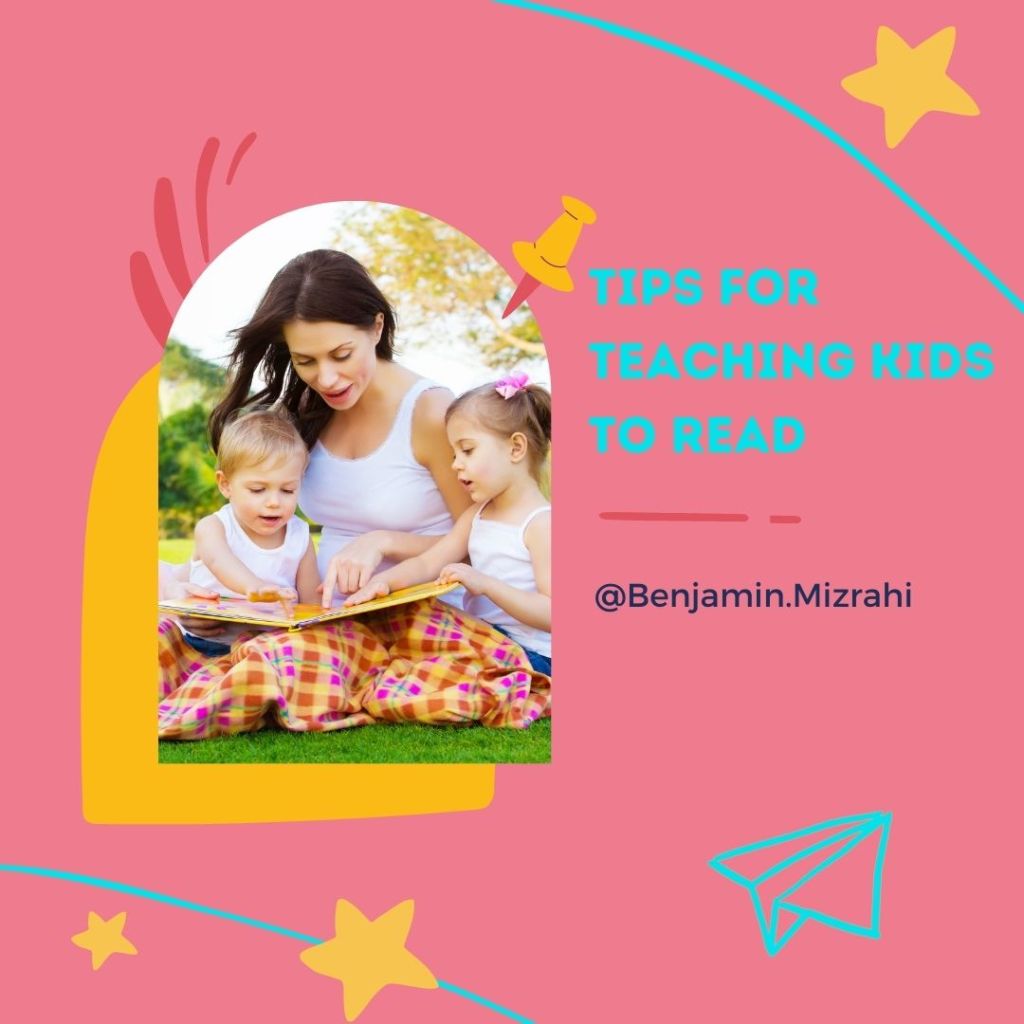
TIPS FOR TEACHING KIDS TO READ

Children at the ages of 3-5 are at the critical stage for reading growth. They begin to build their vocabulary and necessary skills for language literacy such as associating words to objects and actions and the learning of the alphabet. Here are some tips in helping your child to develop their reading and writing skills: 

 
Use nursery rhymes to build phonemic awareness 

 
Nursery rhymes are good practice for reading because it helps children to recognize and recite the proper enunciation of words and syllables which helps them to read words aloud. 

 
Make use of word cards 

 
Proper reading starts small. Write out simple one syllable words on flashcards and practice reading with your child. It is important to help them properly enunciate these words to instill the proper way of reading and pronouncing. 

 
Play word games for pastime 

 
Playing word games helps to build their word recall. Some ideas for these are asking questions like “what words rhyme with hat?” or “what color sounds like hello?”. 

 
Build their vocabulary with constant, practical examples 

 
The best way of remembering a concept is constant exposure to it. When introducing a new word to a child, it is best to help them remember by citing the word whenever you encounter that word, such as saying “look, it’s a building!” when passing by one. 

 
Print out or buy individual letters for word-building exercises 

This practices the child’s letter arrangement and spelling when formulating words. It is an exercise that emulates writing. 

 
These are only some ways of teaching very young children in reading and writing. It is important to note that these two skills are not separate, but rather both develop simultaneously as the child develops their skills in language literacy. The most important tip of all however, is to be patient with your child. Everyone is unique and develops at their own pace and pressuring them to learn will not make the experience pleasant. 

 
Coach Benjamin Mizrahi. Educator. Learning Specialist. Family Coach. Father. Husband.   

More articles on www.MrMizrahi.blog  

WHAT IS YOUR PARENTING STYLE?

According to Baumrind, there are four distinct parenting styles, each having their own strengths and weaknesses. These are: 

 
Authoritarian 

Authoritarian parents are thought of as strict disciplinarians. They are unbending, little to no negotiation is possible, communication is one way. Their expectations need to be met or else punishment is enforced. Children of authoritarian parents most often obey the rules, but at the price of a lower self-esteem because their opinions are not valued. 

 
Authoritative 

These types of parents set clear and reasonable expectations yet set definitive consequences for failing to achieve these. The reasons behind the rules are explained, and communication is frequent between parent and child. This mode of child-rearing most often results in the children becoming responsible adults who feel free in expressing their opinions. 

 
Permissive 

Permissive parents allow children to do what they want with limited guidance or direction. Expectations are minimal or not set at all. They become more of a friend than a parent, and most often the children struggle academically due to lack of direction and expectation. This type of parenting has an environment of great freedom but does not enforce responsibility, and that can lead to behavioral or health problems for their children. 

 
Uninvolved 

Uninvolved parents give their children freedom to do what they want and are often out of the way of their development. They often have no knowledge of what their children are doing and expect them to raise themselves. Often, these types of parents are overwhelmed or struggling with themselves or perhaps don’t know what to do in raising their child. Children most often do poorly in school and have low self-esteem. 

 
Coach Benjamin Mizrahi. Educator. Learning Specialist. Family Coach. Father. Husband.   

More articles on www.MrMizrahi.blog