How to Reassure a Worried Child

When it comes to feelings of safety and security at home, nothing is more powerful for a child than a sense that the grownups in his life are ‘OK.’” How to send healthy signals that alleviate worry and stress. 

Do damage control. 

Snappy comments between parents can be taken out of context. Children are listening to our conversations, even when we think they’re occupied. If you have been grumpy, admit it and reassure your child that it is not about him: “I guess I feel like a bear this morning. Maybe I should try to be more patient.” 

Show your appreciation for your spouse. 

Help your kids feel good about your relationship by saying things like “Didn’t Dad do a great job of fixing the garage up for us?” or “Mom fixed us the best dinner tonight. Let’s all say thank you to her.” 

Be affectionate every day. 

A goodbye kiss, a hug while doing dishes, and a shared laugh send powerful messages to the kids. They create an atmosphere that says, “We care for and love each other in this family.” 

Involve your children in doing something special for your spouse. 

At birthday or holiday time, take your children on a special shopping trip for dad (or mom). Don’t browse for yourself or let the kids pick out toys they want. Make the trip about finding the perfect present. This will help them learn to notice what is special to others. 

Don’t argue in front of your children. 

Engaging in, and resolving, conflict demonstrates a good relationship. You can’t eliminate differences of opinion with your spouse, but serious clashes may frighten young children. Whenever a disagreement is about your child — his ADHD treatment, her performance at school — hold your discussions in private. If a child hears his name in the context of an argument, he may worry that he’s causing problems between you. 

After you work through an argument that your child might have heard, make a point of telling him that everything has been resolved. For example, “Mom and I talked about taking a trip to grandma’s house this spring. Even though we disagreed at first, we decided that it would be best to postpone our trip until the summer.” 

Your children need to feel that their home is a place of warmth. Disagreements and stress can’t be avoided entirely, but you hope that your child can say in years to come, “Yes, I grew up in a loving and caring home.” 

Coach Benjamin Mizrahi. Educator. Learning Specialist. Family Coach. Father. Husband. 

More articles on www.MrMizrahi.blog  
How To Wire A Child For Co-dependency

Co-dependent adults struggle to identify who they are and what they need to be independent from others; it’s as if their sense of self is dependent on the approval or well-being of someone else.  This is the essence of an “outside-in” lens for the world: Other people show me who I am.  I’ve only learned to find myself and feel safe when other people are happy with me. 

Co-dependency is really about self-alienation, because you’ve been taught that your own wants and feelings threaten the stability of a relationship, so you need to get as far away from yourself as possible. Individuals wired this way are attracted to partners who are narcissistic and low on empathy, the perfect opposing puzzle piece for co-dependent traits. 
 
Co-dependency may appear in adulthood but it starts in early childhood; remember, we are wiring our kids for their relationship patterns. 

During childhood, kids are asking these questions: “Who do I have to be to achieve emotional safety? How safe are my own feelings and needs?” 

There are very few things that I tell parents not to do.  High on the list are Don’t Hit, Don’t Terrify, and… 
 
DON’T LINK YOUR CHILD’S EMOTIONS WITH YOUR OWN. 

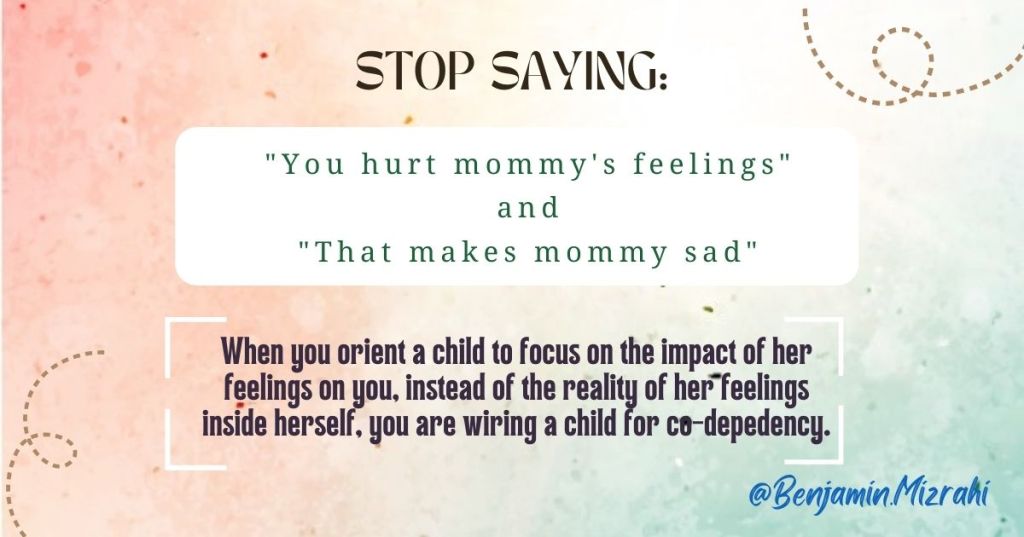
Don’t wire your child so that her feelings sit right next to their impact on you. This is not a way to create empathic kids; it is a way to create co-dependent adults. 
 
HOW DO WE CREATE EMPATHY AND AVOID CO-DEPENDENCY? By creating *distance* between our kids’ feelings and our own – seeing feelings not for their impact on us but for the pain they cause our child. 
 
Instead of “That hurts Mommy’s feelings,” say, “You must be really upset about something to speak to me that way.” Instead of “That makes Mommy sad,” say, “I can’t listen well when you’re speaking to me in that tone. I want to hear about what’s happening to you. I care about your feelings and you’re allowed to have them.” 

And when you do have big feelings? Take responsibility for these as your own. Tell your child, “You’re noticing that I’m upset. Yes, it’s true. And here’s something else true: My feelings are MINE. You don’t cause my feelings and you don’t have to take care of them.

7 Reasons Why You Need To Advocate More Than Other Parents

Here are the reasons why you need to advocate more than other parents:

1. Succeeding at school is therapy for a child with ADHD

2. Children with ADHD have maturity delays of up to 3 years⁣

3. Half of children with ADHD also have a learning disability

4. Executive function deficits can be more debilitating than ADHD symptoms ⁣

5. Your child’s teacher may not see her IEP or 504 for months

6. Last year’s teacher won’t necessarily talk to this year’s teacher⁣

7. The emotional underpinnings of ADHD can throw everything off track

⁣ 
Know that you are not enabling or helicoptering. You are taking an active, hands-on role in the education of your child with ADHD. ⁣

Distance Learning Preparations: Daily Routine Rules

Distance learning is not ideal for all students with ADHD. Surviving the coming school year will mean reducing anxiety and tension at home while also maintaining realistic expectations, providing appropriate supports, and advocating for our children with eyes wide open. 

Embrace the unknown. This is the first, incredibly difficult step for families making the school transition this year. Flexibility is key. But that doesn’t mean you shouldn’t build a predictable structure at home. 

  1. Plan activity periods or blocks. Divide the remote school day into periods that work for your child. This can look like morning, afternoon, and evening blocks, divided by breaks in between. Use reminders – alerts on phones or computers (children tend to pay more attention to these) – for class time, rest periods, and other tasks. Ask your child what a productive, engaging learning day looks like. 
  2. Include timed breaks with specific options. Work in times for snacks, physical activity, chores, screen time, and screen-free activities. Offer kids short and long breaks, and provide a list of activities they can do during those times. If you’re working from home and have younger children, use screen time to your advantage and to meet your own needs. Try to schedule their screen time, for example, during your work meetings. 
  3. Plan for safe socializing with peers. Before the colder months approach, help your kids safely see their friends as much as possible. Review the latest guidelines on social distancing, and make sure your kids have masks and hand sanitizer with them at all times. Talk to your children about how to handle scenarios where others may not be engaging in safe behaviors. Remind them of the real ramifications for themselves, their friends, and others in the household of not being safe. 
  4. Help kids connect with their teachers. Talk with your child’s teachers about setting up weekly check-in sessions by phone, text, Google Classroom, Hangout, or Zoom. One-on-one contact is especially important for teens. 
  5. Steadiness over perfection. Be open to revisions if plans aren’t working. Ask your kids, friends, family or the web for suggestions. Be transparent and offer brief explanations when making changes to expected tasks. Not doing so may lead children to believe that they can be flexible with arrangements and avoid sticking to the plan. 

See Mistakes as Opportunities for Learning

Many children are taught to be ashamed of mistakes. Adults who teach blame for mistakes mean well. They believe that shame will motivate children to do better. It might, but at a heavy cost to their healthy sense of self-worth. If you were raised this way, it may be time to “re-parent” yourself, so that you can create new beliefs about mistakes.

Respond to mistakes with compassion and kindness instead of shame, blame, or lectures.

When appropriate, use curiosity questions to help your child “explore” the consequences of their choices.

During dinner time invite everyone to share a mistake they made during the day and what they learned from it.

Focus On Values, Not Rules

Focus on values, not rules. When you have clearly defined what’s important to you as a family, your child internalizes your values and can use them to guide their behavior in any situation. Remember that it takes time and practice before your child will internalize some values and live by them. Be patient and be hopeful. 

The more conscious parents are of the values they wish to pass on to their children and the more they know about effective ways of transmitting these values, the more likely it is that their values will be communicated and adopted. 

This process occurs over time, as children are not able to understand or incorporate some values for a long time. But children will benefit from having parents who work to transmit their values in a patient and nurturing way. 

Get Comfortable When Your Child is Being Uncomfortable

As parents, we spend a lot of time making our kids comfortable. No matter where your kid’s starting point may be, it’s important to explore the concept of being uncomfortable and, as parents, learn to tolerate that discomfort when our kids feel anxious, nervous, or afraid. It’s not easy. Parents’ instinct is to protect their kids from any pain.  

How will you get comfortable when your child is being uncomfortable?

It would help if you learned to coach your children to tolerate their discomfort. If you allow them to figure out coping strategies, they will be better able to respond the next time an uncomfortable or painful situation arises. For your kids to develop their grit and learn to expand their comfort zone, you need to be supportive, engaged, and empathetic without immediately swooping in to ease their discomfort.

When your child is in the middle of frustration, sadness or disappointment, and you are very centered and confidently supporting with understanding, you are modeling it right. Your words and body posture tell them, “ I am here for you, and I am strong enough to support you and help you.“

Why Parent Regulation Is More Important

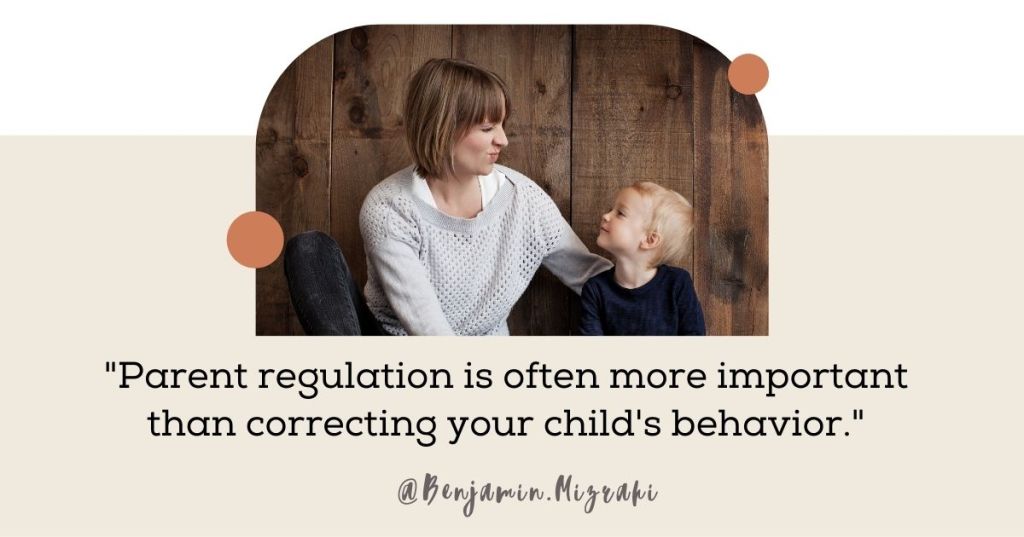
Parent regulation is often more important than correcting your child’s behavior. Certain behaviors from our kids can be very triggering for so many reasons, so your calm state is even more important.

How do you begin to better regulate yourself as a parent, so your kids can be better regulated?  

Start by saying kind, gentle, and calm words.

Tell your child how much you adore them (be specific, be genuine, be transparent).

Validate their experiences.

Empathize with their emotions.

Join them in talking about their struggles.

Normalize their experiences. 

Watch how that warm parenting transforms your child and ultimately the parent-child relationship. 

Our Words Have Power

Our words have power. Use them to BUILD UP and CONNECT. 

This is some serious food for thought, but NOT meant to make you, as a parent, feel like you are failing or guilty of not doing better. No one is perfect. No parent is perfect. You strive to do your best and make changes and adjustments along the way. If this quote helps you strive to do better, keep it close to your heart.  

Building Strong Connection To Your Children

We as humans are very good at meeting our physical needs to ensure that we are fed, clothed, watered and have sheltered. However, we also have emotional and spiritual needs which we tend not to be so great at fulfilling. 


When kids are acting up it’s usually because a need is not being met. Whether that be that they’re hungry, tired or cold etc. remember it could also be that an emotional need is not being met. 


So next time they’re pushing your buttons remember not only their physical needs but also the emotional ones that are crying out for connection. 

While it goes without saying that we all love our children, today’s busy family lifestyle can make it tricky to ensure everyone gets their required dose of Love and Connection. As we bustle through the day, getting everyone ready, out the door to their daily activities then back again for dinner, bed and bath, it can be hard to make time for quality connections. Unfortunately, unmet needs for connection can result in uncooperative behavior. 

Connections don’t need to be timed; they just need to be meaningful to your child. Every child has a different level of need for love and connection, different things will go towards filling it. 

Some suggestions to their daily activities: 

  • One-on-One time – this could be date days, special activities for just the two of you or even just a quite chat at bedtime. 
  • Read them a story 
  • Play a game 
  • Be playful – join in their silliness rather than reprimand it 
  • Develop a ritual – this could be a special way of saying goodbye, a bedtime routine, or a secret handshake. 
  • Give them praise 
  • Tell them what you love about them 
  • Have cuddle time 
  • Eat meals together 
  • Have a shared interest or hobby 

How To Play With Your Young Children

Many parents intuitively know why play is important to children, but despite its many benefits, we rarely associate play with learning. For most people, learning involves acquiring a specific new skill, such as memorizing alphabets, counting, writing, etc. They often believe that playing is only for fun and involves no actual learning. However, according to studies, playing is learning. Children learn through playing. 

The importance of play in early childhood cannot be underestimated because playing is essential to a child’s growth. 

Here are some pointers for parents who are not sure how to play with their very young children.

1.Relax and enjoy the activity. Do not try to take charge, but allow your child to take the lead. Your role is to show interest and approval and provide encouragement. If your child begins to behave unacceptably, it is important to let him know what he is doing wrong and teach him what he can do differently next time.

2. Make sure that the toys or materials are age appropriate. This is often taken care of by the child’s interest.

 3. Learn to ask open-ended questions while you play, such as: 

 What do you think will happen if _____________________? 

 Can you think of another way to ______________________? 

 What else can you build with those blocks? 

 Where else could that puzzle piece go? 

4. Encourage further exploration

 If your child seems to be getting frustrated, you can make suggestions for another way to look at the problem. For example, to the child who is upset because his tower keeps falling over, you can show him how to use bigger blocks at the bottom. 

5. Model good sportsmanship

 When children get old enough to begin playing competitive games such as races or board games, you can model good sportsmanship. 

 Be a good loser by expressing how much fun you had participating in the activity and by congratulating the winner. Equally as important is to be a good winner by not gloating or being too competitive with young children. 

6. If you and your child are not enjoying the activity, stop it. Play should be something that is enjoyable for everyone involved.

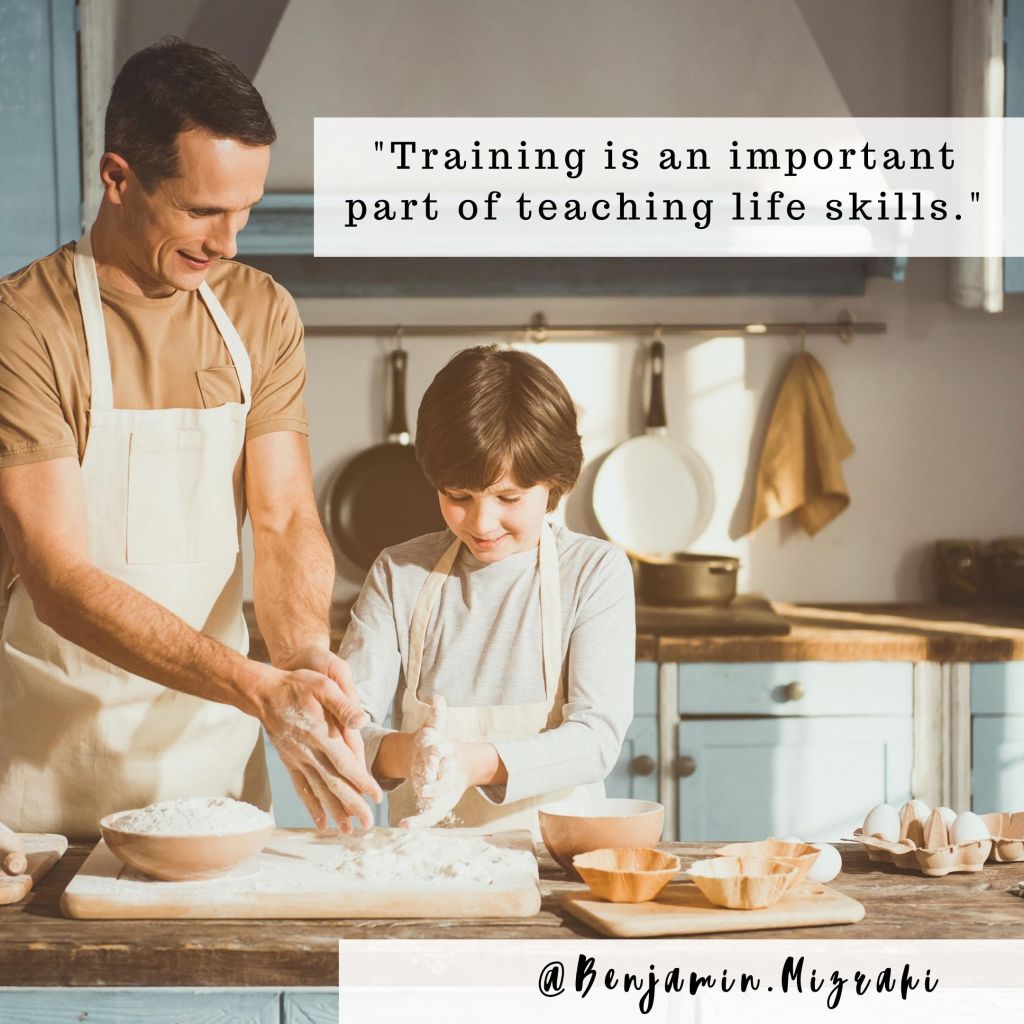
Importance of Training Your Child

This is not as obvious as it may sound. Adults often expect children to accomplish tasks for which there has not been adequate training. Parents may expect children to clean their rooms, but never teach them how. Children go into their messy rooms and feel overwhelmed.

Taking time for training means being very specific about your terms and expectations. Taking time for training does not mean children will ever do things as well as you would like. Improvement is a lifelong process. 

Don’t expect children to know what to do without step by step training. What do you mean by clean? 

  1. Kindly explain the task as you perform it, while your child watches. 
  2. Do the task together. 
  3. Have your child do it by herself while you supervise. 
  4. When she feels ready let her perform the task on her own.