Activity Duration: 5 to 10 minutes
Activity to develop divergent thinking
Divergent thinking makes it possible to create links that seem hidden at first, while organizing the elements in an original way. Try this activity with your child and he or she will have to use divergent thinking to meet the challenge.
What you need:
An umbrella
How do you play?
Invite your child to find other functions that the umbrella could have (example: cane, sword, stick, raft, spinning top, shield, broom, etc.)
ADVICE
Bring your child to think about the strategy used to find these ideas. Ask him the following questions:
“Have you built pictures in your head?”
“What questions did you ask yourself?”
“How did you decide if the use you thought of was original?”
Variant
You could do the same exercise with other inspiring objects (for example a bowl, stocking, etc.)
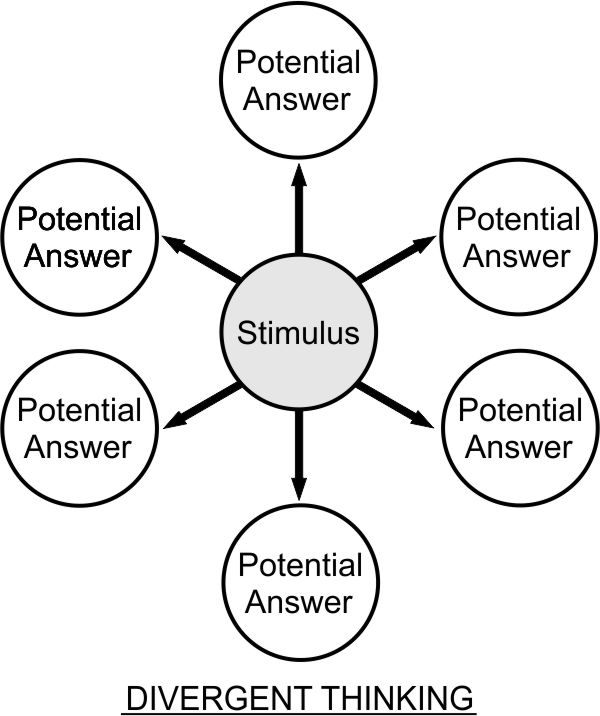
The goal of divergent thinking is to generate many different ideas about a topic in a short period of time. It involves breaking a topic down into its various component parts in order to gain insight about the various aspects of the topic. Divergent thinking typically occurs in a spontaneous, free-flowing manner, such that the ideas are generated in a random, unorganized fashion. Following divergent thinking, the ideas and information will be organized using convergent thinking; i.e., putting the various ideas back together in some organized, structured way.
To begin brainstorming potential topics, it is often helpful to engage in self analysis and topic analysis.
Self Analysis
Ask the following questions to help brainstorm a list of potential topics.
How do I spend my time? What are my activities during a normal day?
What do I know about them? What are my areas of expertise? What am I studying in school?
What do I like? What are my hobbies? What are my interests?
What bothers me? What would I like to change in my world or life?
What are my strongest beliefs, values and philosophies?
Topic Analysis
Ask the following questions to help narrow and refine a broad topic into a specific, focused one. Substitute your topic for the word “something.”
How would you describe something?
What are the causes of something?
What are the effects of something?
What is important about something?
What are the smaller parts that comprise something?
How has something changed? Why are those changes important?
What is known and unknown about something?
What category of ideas or objects does something belong to?
Is something good or bad? Why?
What suggestions or recommendations would you make about something?
What are the different aspects of something you can think of?
Techniques to Stimulate Divergent Thinking
1. Brainstorming. Brainstorming is a technique which involves generating a list of ideas in a creative, unstructured manner. The goal of brainstorming is to generate as many ideas as possible in a short period of time. The key tool in brainstorming is “piggybacking,” or using one idea to stimulate other ideas. During the brainstorming process, ALL ideas are recorded, and no idea is disregarded or criticized. After a long list of ideas is generated, one can go back and review the ideas to critique their value or merit.
2. Keeping a Journal. Journals are an effective way to record ideas that one thinks of spontaneously. By carrying a journal, one can create a collection of thoughts on various subjects that later become a source book of ideas. People often have insights at unusual times and places. By keeping a journal, one can capture these ideas and use them later when developing and organizing materials in the prewriting stage.
3. Freewriting. When free-writing, a person will focus on one particular topic and write non-stop about it for a short period of time. The idea is to write down whatever comes to mind about the topic, without stopping to proofread or revise the writing. This can help generate a variety of thoughts about a topic in a short period of time, which can later be restructured or organized following some pattern of arrangement.
4. Mind or Subject Mapping. Mind or subject mapping involves putting brainstormed ideas in the form of a visual map or picture that that shows the relationships among these ideas. One starts with a central idea or topic, then draws branches off the main topic which represent different parts or aspects of the main topic. This creates a visual image or “map” of the topic which the writer can use to develop the topic further. For example, a topic may have four different branches (sub-topics), and each of those four branches may have two branches of its own (sub-topics of the sub-topic) *Note* this includes both divergent and convergent thinking.
The name Elsagate is derived from bizarre videos featuring Elsa from the Disney cartoon Frozen and Spiderman indulging in despicable acts no child should ever see. Gore, violence, sexual fetishism, abuse and rape are the prevailing themes in such videos. The term “Elsagate” itself has also evolved and it is no longer used to describe just videos featuring the Frozen franchise character, it is instead used to describe any video, animated or not, targeted at children, that contains these disturbing messages.
Hundreds of these videos exist on YouTube, and some generate millions of views. One channel “Toys and Funny Kids Surprise Eggs” is one of the top 100 most watched YouTube accounts in the world – its videos have more than 5 billion views.
Its landing page features a photo of a cute toddler alongside official-looking pictures of Peppa Pig, Thomas the Tank Engine, the Cookie Monster, Mickey and Minnie Mouse and Elsa from Frozen.
But the videos on the channel have titles like “FROZEN ELSA HUGE SNOT”, “NAKED HULK LOSES HIS PANTS” and “BLOODY ELSA: Frozen Elsa’s Arm is Broken by Spiderman”. They feature animated violence and graphic toilet humor.
Image CANDYFAMILY/YOUTUBE
YouTube did not offer a spokesperson for interview, but in a statement said: “We take feedback very seriously. We appreciate people drawing problematic content to our attention, and make it easy for anyone to flag a video.
“Flagged videos are manually reviewed 24/7 and any videos that don’t belong in the app are removed within hours. For parents who want a more restricted experience, we recommend that they turn off the Search feature in the app.”
The company also suggested that parents use the YouTube Kids app, which is available for mobile phones and tablets, and turn on “restricted mode” which limits flagged content. It can be found at the bottom of any page on the YouTube site, but cautions that “no filter is 100% accurate”.
And since Trending began investigating, several of the channels that we brought to the attention of YouTube have been removed – including the one containing the video of fake Peppa visiting the dentist.
The videos may not be coherent, but many proponents of the Elsagate theory claim this is an organized and orchestrated attempt to condition children into believing abuse is perfectly natural. Furthermore, they state these videos are normalizing pedophilia and different forms of violence, grooming children. Creating an entire generation of potential abusers and victims.
One can only hope that is not the case, but patterns keep emerging. Artist, writer, technologist and publisher, James Bridle, in his piece about Elsagate, published on Medium and quoted in the Guardian, had the following to say.
“Someone or something or some combination of people and things is using YouTube to systematically frighten, traumatize, and abuse children, automatically and at scale.”
Solutions
Solutions to prevent kids from viewing those videos:
I would like to share some tips from Parenting.com on how to keep your child safe on internet:
1. Step into their cyber-world
“Parents have to get involved. Just as they know every detail of the playground around the corner — the jungle gym, the swings — they need to know their kids’ online playground as well,” says Tim Lordan, staff director of the Internet Education Foundation, a nonprofit group that produces the online safety guide GetNetWise. It may be hard to keep your eyes open after visiting what seems like the 100th website devoted to Barbie, but playing copilot to your child is the best way to make sure she gets a smooth ride. By the time she’s 7, you won’t need to be glued to her side, but you should be somewhere in the room or checking in frequently.
2. Set house rules
Decide how much time you’re comfortable with your children being online and which sites they may go to. You might post a short list or even a signed contract (like the free ones at www.SafeKids.com) next to the computer. So there’s no confusion, talk about the rules — and the consequences for breaking them. “Our house rules say the kids are allowed half an hour of computer time on ‘their days.’ One child has Mondays and Wednesdays, and the other has Tuesdays and Thursdays. Then they get one hour each on the weekend,” says Jamie Smith of Mount Pleasant, Michigan, mom of Hailey, 12, and Kody, 9. “They have certain sites they can visit without special permission. Any others have to be approved by me or my husband.”
3. Teach them to protect their privacy
While they won’t fully understand the consequences of revealing personal information online, you should still make sure your children know:
* never to give their name, phone number, e-mail address, password, postal address, school, or picture without your permission
* not to open e-mail from people they don’t know
* not to respond to hurtful or disturbing messages
* not to get together with anyone they “meet” online.
More tips to follow
4. Know that location is key
Keep the computer in a central spot, where it’s easy to monitor its use. “We have five computers in our house, but only two — mine and the PC in the family room — are hooked up to the Internet. That way, I can frequently check up on what they’re looking at,” says Cecilia M., a mom of three in Teaneck, New Jersey.
5. Be their go-to person
Instruct your child to come straight to you when she sees anything that makes her uncomfortable, and assure her that you won’t overreact, blame her, or immediately rescind her online privileges.
6. Turn your ISP into your ally
Before buying a safety product, experts recommend that you work with what you’ve got, starting with your Internet service provider (ISP). America Online, MSN, SBC Yahoo!, EarthLink, and others have reliable, free parental controls that can limit children’s access to websites and communication features (e-mail, instant messaging, chat) by age, content categories, time, and other choices.
7. Make your browser work double-time
If your ISP lacks that capability, you still have some safe-surfing options at hand on your browser (the program that enables you to view web pages). Internet Explorer has Content Advisor (under Tools/Internet Options/Content), which filters out language, nudity, sex, and violence on a 0 to 4 scale. Netscape and Safari (for Mac users) have parental controls like filtering as well. Using your browser won’t get you the comprehensive results that a safety product or your ISP would yield, but it can be suitable for the times you’re sitting next to your little one surfing the net.
8. Tune up your search engine
Your search engine can be pressed into service for free. (But be aware: A savvy child could switch the settings back.) Once you set restrictions, Google will block sites with explicit sexual material (Preferences/SafeSearch Filtering). AltaVista puts several types of offensive content off-limits with its Family Filter (Settings/Family Filter setup).
9. Stay in a kid-friendly zone
For beginners as young as 4, consider confining online exploration to web addresses that list child-safe sites on everything from TV, movies, music, and games to world history, science, and trivia. Some good choices:
* web directory Yahooligans
* answer supplier Ask Jeeves for Kids
* the American Library Association’s Great Web Sites for Kids
* the U.S. government’s “Dot Kids” domain .
10. Call on software for assistance
While no technology is fail-safe, it does add another layer of protection. “The key is to make sure you have something that reflects your values and is just technological help, as opposed to trying to take over your role as a parent,” says Parry Aftab, executive director of WiredSafety.org, a nonprofit Internet safety and education organization with several websites. So make sure you can make changes to fit your family’s needs.Though these six tools will cost you, most offer a free trial period, and all are champs at doing your bidding. Just ask yourself, what’s your primary goal?
* Shutting out the smut (and other undesirables)
Best for parents who want maximum protection with minimal effort, CyberPatrol 6.2 deflects objectionable web content with a twofold filtering technique. It blocks sites on its comprehensive list of restricted web addresses, then does keyword pattern searches for offensive material on non-blacklisted sites that may have slipped through the cracks. You decide: How much to customize. You can allow certain categories (Sex Education but not Adult/Sex, for instance); add your own blocked or allowed sites or keywords; and more. What your child sees: Varies from a bold “Access Restricted” notice (with the CyberPatrol “To Surf & Protect” shield) to a discreet “This page cannot be displayed” message. Cost: $40 for one year/$60 for two; Windows, www.cyberpatrol.com
* Keep the Internet under lock and key ControlKey 2.0 is The Enforcer. No key means no Internet access. The small blue device (part of the company’s SecuriKey product line) plugs into a USB port and also serves as a watchdog for you. Children can do homework-related research but not waste time IM’ing; they can open their own documents but not your desktop check register. Setup is a little tricky and time-consuming. But once installed and configured (according to what you want to control or protect), it’s easy to use and a good choice for parents who want stronger restrictions or are dealing with kids who broke the rules. You’ll just need to guard it like your car key. Register so the ControlKey “token” can be replaced ($45) if lost. You decide: What to lock up: access to files you’d like to keep private? A particular computer game? Certain sites? What your child sees: “Access Denied” message (when the computer is restricted) or “This page cannot be displayed” (Internet restricted). Cost: $60; Windows, 800-986-6578 or www.controlkey.com
* A pristine site for young surfers
Instead of keeping out what’s bad, Kidsnet keeps in what’s good, and only that. Every website on its vast “white list” has been vetted and classified according to Internet Content Rating Association and Kidsnet standards. Home page Hazoo is well stocked with web offerings (even a Google search box), ranging from pbskids.org to hilaryduff.com. You decide: What to exclude and include and how subtly to draw the distinction. What your child sees: “Ahoy mate!” A pirate or another cartoon appears on a “redirect” page, telling kids why they can’t go to an off-limits site and offering two alternatives.Cost: $30/year; Windows, www.kidsnet.com
* Something to keep you safe online, too Norton Internet Security 2006 provides everything: parental control over web content and Internet access, virus defense, spam blocking, privacy preservation, and firewall fortification. That makes it a good choice for families with general security concerns and less commitment to content-oriented parental controls (a small part of the protection package) and for those with older children plagued by spam and other system interlopers.
While setup takes a while — you’ll need to uninstall conflicting software, and it’s best to back up your computer before you start — it’s easy to customize and manage all five programs included from a main “System Status” screen. You decide: When to turn on parental controls; which of 31 content categories are blocked; whether to restrict programs that access the Internet; how high to set controls over sending private information. What your child sees: Message that Norton “blocked access to this restricted site” and why. Cost: $70/$90; Windows/Macintosh, www.symantec.com
* Knowing exactly what they’ve been up to online
When a child is using the computer, Spector 2.2 takes snapshots of what’s onscreen at intervals and stores them in a hidden file to record all they do. You then view the file like a video (play, pause, fast-forward, rewind).
It’s best for parents who have reason to believe a child is breaking the rules or is being victimized (or who want to keep a record, just in case). Just be aware that a program like this can erode trust if you use it to spy on kids without cause or on the sly. You decide: Degree of sneakiness, between stealth mode and visible (a tiny red box in the system tray); whether to record everything or only activities involving Internet access; how often to capture images and when to delete them. What your child sees: In stealth mode, the program is invisible. Cost: $100; Windows/Macintosh, 888-598-2788 or www.spectorsoft.com
Today, I wanted to share with you a great article I found on LifeHacker which talks about how you can help your kids develop better social skills:
“… Your children’s social development will be a critical part of their success and happiness as they get older—even more important than their academic skills or intelligence. (Also, no one wants to be that parent who’s raised “Mean Girls”-like bullies.) You have a chance now to greatly influence your kids’ social intelligence and teach them things even we awkward adults are still perfecting, like how to build friendships and deal with rejection. They’re important lessons we all keep learning, and the sooner we start, the better.
The Social Skills All Kids Need to Learn
It seems like some kids (or people of any age) are more naturally socially adept than others—you know, the kind of people others gravitate to and for whom making friends comes easily. Don’t worry if your children don’t fit that mold or aren’t winning any popularity contests. Like any other skill, social skills can be learned, and, besides that, “being social” or outgoing isn’t the end goal in itself.
What is important, however, is that kids are able to form meaningful bonds with others, can empathize and interact with others appropriately, and have the skills to adapt in uncomfortable situations. Unfortunately, as the University of Memphis points out:
Many students do not know how to handle interpersonal social situations that involve following directions, holding a proper conversation, listening, giving compliments, proper behavior during transition times, teasing, bullying, or just “hanging out” with friends.
Those are basic skills we want all kids to be able to have. Depending on your children’s ages, they might also need more specific social skills.
Skills for Preschool and Elementary School Kids
Vanderbilt University found the top 10 social skills kids need to succeed in school, based on surveys of 8,000 elementary teachers and two decades of classroom research, are:
Listen to others
Follow the steps
Follow the rules
Ignore distractions
Ask for help
Take turns when you talk
Get along with others
Stay calm with others
Be responsible for your behavior
Do nice things for others
These might seem like social skills promoted just to turn out “nice girls and boys” who earn the “gets along with others” check on their report cards, but they’re fundamental behaviors that help kids succeed (not just survive) in a world that emphasizes social norms. The goal isn’t just to make them cooperative, but to hone their social GPS so they can both advocate for themselves and care for others. (Heck, we probably all know a few adults who could stand to learn many of these skills too.)
Social Skills for Pre-Teens and Teens
Older kids, in middle school and high school, have more complex social skills to learn, thanks to growing peer pressure and that simply awkward period called adolescence. It’s a time when they’re becoming more independent, but everyone’s forming cliques; when they’re making big decisions about who they are and what they want to be, but also might start to care a bit too much about what others think.
Set personal goals
Identify and change self-defeating behaviors
Be assertive about his or her needs
Have feelings for others
Handle anger constructively
Resolve conflicts peacefully
It’s easy to say a toddler should learn how to follow directions or a young adult should know how to be assertive; it’s another to know how to best help them do that. So let’s look at a few strategies.
Model Social Skills
The first place we learn social skills, of course, is at home, and what we do as parents is more important than what we say. As All I Really Needed to Learn in Kindergarten author Robert Fulghum says, “Don’t worry that children never listen to you; worry that they are always watching you.”
Modeling positive social skills includes showing confidence ourselves when we relate to others, being friendly to strangers, offering to help others, and also treating our kids with respect (no matter how much they might be pulling at our last straw). Dr. Laura Markham writes on Aha! Parenting:
Teach your child that people are important. All parents have to choose their battles, so put up with messiness and dawdling if you must, but teach your child consideration for others. Model it for him early on, praise it, help him brainstorm to solve peer problems, and don’t let your child intentionally or unintentionally disrespect another person. It you can’t confront it as it happens without embarrassing your child, be sure to talk about it later. As kids get older, you may need to be very explicit about insisting that they acknowledge adults in their presence, as well as other kids. Often preteens and young adolescents need to be reminded of this, and to be given coaching on how to handle interactions that feel awkward to them.
The funny thing about being a parent is it forces you out of your shell and can help you become a better person through analyzing your own behaviors and attitudes. In a great article summarizing research on children’s social skills, Auburn University professors Jacquelyn Mize and Ellen Abell write:
Parents of these socially competent children endorse interpretations of social events that encourage resilient, constructive attitudes (Mize, Pettit, Lindsey, & Laird, 1993). Rather than making a statement such as, “That’s a really mean kid!” they may say something like, “Gosh, maybe he’s having a hard day.” They make constructive attributions such as, “Sometimes kids just want to play by themselves,” rather than expressing a sentiment like, ‘They’re not very nice if they won’t let you play.” These parents avoid defeatist comments such as “Maybe they don’t like you,” and offer instead suggestions like, “Maybe they don’t want to play that, but there might be something else they think is fun.” Such positive, constructive statements encourage children to take an optimistic view of others and themselves as play partners. They reflect an upbeat, resilient attitude toward social setbacks and the belief that social situations can be improved with effort and positive behavior.
Don’t Label Shy Kids
If your kids are naturally shy or feel insecure, try not to label them as such or try to force them out of their shyness. Instead, if your child is socially anxious, Dr. Markham recommends empathy and a problem-solving approach:
Don’t label your child as shy. Instead, acknowledge his feelings and point out that he can overcome his fears. For instance, “Sometimes it takes you awhile to warm up in a new situation. Remember Billy’s birthday party, how you held my hand all through the games? But by the end, you were having lots of fun with the other kids.”
Teach your child effective strategies for dealing with shyness. The general rule of thumb is to accept the nervousness that comes up as a part of normal life that affects most people, reassure yourself that you’re ok anyway, and focus on others rather than yourself. For instance, remind your child that she doesn’t have to be interesting, just interested, and teach her to ask other kids questions and listen to their answers. Brainstorm with her how she might handle a situation that makes her nervous.
Another reason not to label young people as shy is it could become a self-fulfilling prophecy. I was told I was shy as a child, when really I think I was just naturally quiet and introverted. Having that label, though, led to me feeling tense and anxious during social situations—true shyness, which often starts out as a reinforced habit.
Give Plenty of Opportunities to Practice Social Behaviors
Kids learn social skills first from you, but then to a large degree from their peers. The more chances kids have to interact with others, the better.
That means supporting and encouraging kids’ friendships—even if it means you become Dad Taxi Service or have to spend playdate time, as Louis CK laments, with kids and parents you couldn’t care less about.
Kids also will learn crucial skills from simply playing with you. According to Dr. Mize and Dr. Abell, the research suggests that children whose parents frequently play with them have more advanced social skills and get along better with their peers. It’s especially true if you play with them on their level, following their lead and in a “peer-like” way:
Children benefit from this type of play for several reasons. From balanced, responsive play with a parent, children may learn many of the skills commonly displayed by the socially competent preschoolers described earlier. In addition, when parents are responsive to children’s play ideas, children may come to feel that they are good, effective play partners and thus are eager to play with peers. Finally, fun, balanced parent-child play may instill that positive outlook toward others that makes children look forward to play opportunities with people outside the family.
Parenting Science has a few social skill activities you can do with your kids (school-aged and teens) based on research—and they’re actually fun games like charades.
Relax
All that said, chances are your kids are learning positive social skills the way most of us do, simply as we go along and through trial and error. Don’t worry or try to intervene too much unless there are serious signs of social trouble (for example, if your kid’s teacher warns of discipline problems). Most kids are insensitive (or even unkind) or socially clumsy sometimes.
Here are some signs that your child might need more social coaching(from you and/or teachers):
Lacks at least one or two close mutual friends
Has trouble losing or winning gracefully
Doesn’t show empathy when others are hurt or rejected
Acts bossy or insists on own way a lot
Can’t seem to start or maintain a conversation
Uses a louder voice than most children
Seems constantly ignored or victimized by other children or constantly teases or annoys other children
In those cases, you’ll want to take a more active approach to helping your kids with their “interpersonal skills.” Otherwise, just keep playing with your kids, being a model of social grace, and helping them build their relationships.
Following up on my post on “Big Deal / Little Deal“, you will find below a poster to help your children classify their problems from Tiny Deal to Huge Deal.
Introduce Big Deal / Little Deal to your kid with this game:
This game has for goal to introduce the concept of Big Deal / Little Deal to your child and some suggestions of when your child can apply the rules.
Think about activities where your child has the opportunity to be flexible and say: “I’m going to make some statements and after each one, I want you to think and categorize it as Big Deal / Little Deal”
Examples:
Eva was screaming in the hallway. Is this a big problem or a small problem ?
Lea was playing with a sharp object in the playground. Is this a big problem or a small problem ?
Leo was talking when he wasn’t supposed to. Is that a big deal or a little deal?
John fell while playing and is too hurt to stand up. Is this a big problem or a small problem ?
Grandma will arrive 15 minutes late to dinner tonight. Is this a big problem or a small problem ?
Charles cut in line. Is this a big problem or a small problem ?
Scott got served his dish before you. Is this a big problem or a small problem ?
Ben took an extra piece of candy from the jar. Is this a big problem or a small problem ?
To each given problem, you child will assess how big of a deal it is for him. You role is to teach him that each problem has a solution ranking from: “take a deep breath and move on” to finding a solution to fix it to telling the teacher or an adult ( it can go all the way up to calling 911).
Some problems have simple solutions where children can be active such as using their own resources to fix the problem ( ie: if he spilled a cup of water, the solution could be to clean up). Or ask for help: encourage him to raise his hand in the classroom and ask the teacher or an adult when he needs help.
Another important reaction to learn for a situation where he doesn’t feel comfortable is to always “use his words”. It is okay to say STOP or NO: ” I don’t like that game, please stop, I need some space.”
The top of the pyramid is when a situation is a BIG DEAL. In this case, he needs to know that it’s okay to ask an adult for help or walk away from the danger. (ie: if there is a fight, someone is hurt,…)
“Problems are not created equal. For children they can be as commonplace as a paper cut or as complicated as having to cope with a family tragedy. When working with our socially-challenged kids we talk about problems in three sizes: small problems, medium problems, and big problems. Regardless of scale, the hidden rule in problem solving with preschool and elementary school age children is that we are expected to react to problems in a manner that matches (or is smaller than) the size of the problem. This is where social problem solving can get tricky. A problem that is perceived by one person as being small could cause a person with social learning challenges to have big feelings about it and then have a big reaction, which would be unexpected. Not only does this mismatch create more anxiety in the individual, it can also limit the effectiveness of solving the current problem while at the same time creating a new problem.
Figuring out the size of the problem is the first step in being able to match our emotional reaction accordingly.”
( source)
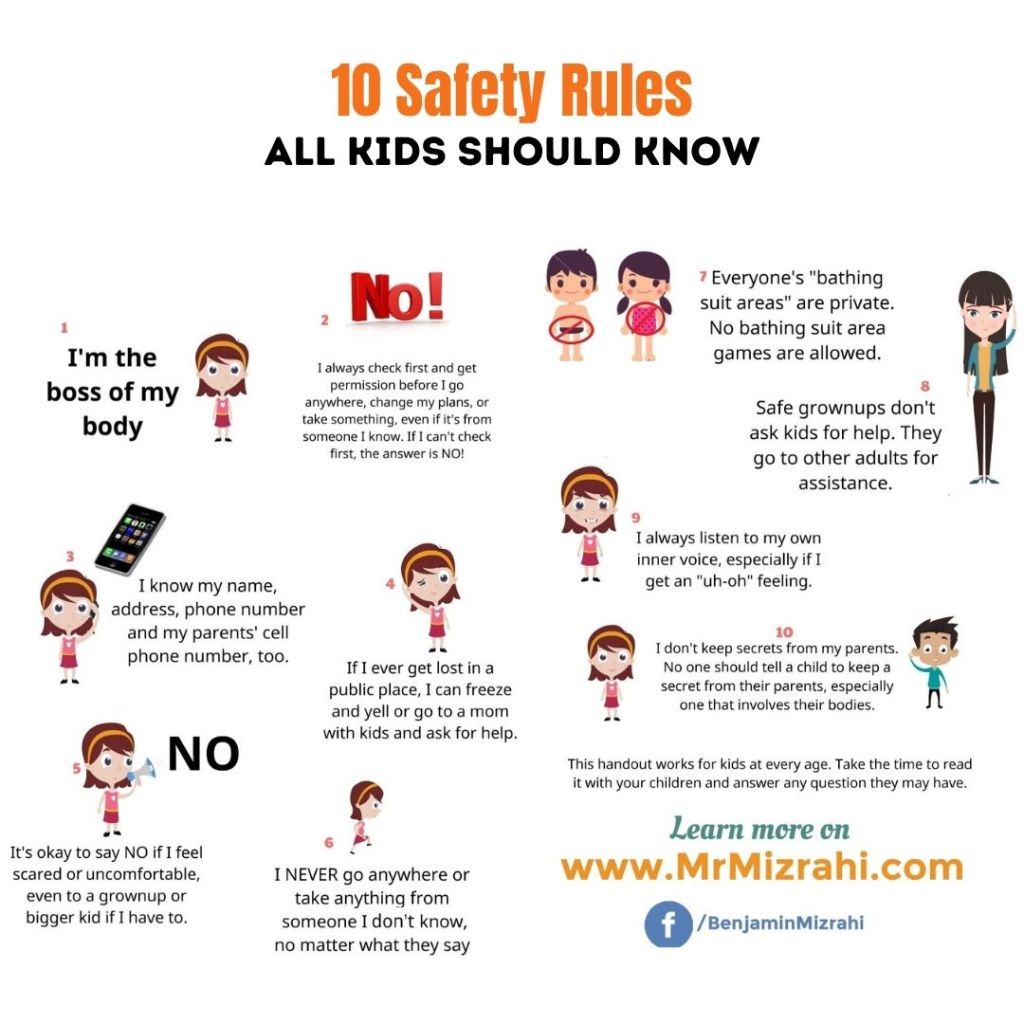
Children play intuitively and are constantly exploring different ways to play. Some do this with caution, while others continually seek out new challenges. Either way, a child’s right to explore, play and discover is something that as parents and caregivers we must protect. It enables them to develop, grow and learn, and become confident, capable characters.
A family is the first line of protection for children. Parents and caregivers are responsible for building a safe and loving home environment, and every safety skill you teach your child can be carried with them throughout their childhood discovery. Schools and communities have a responsibility to protect also, but it’s as part of their home life that basic safety skills should be taught.
As much as you would like to you can’t physically protect them 24 hours a day, so by teaching them to protect themselves, you put them in good stead for a healthy and happy future.
A collection of Alphabet mazes featuring ASL hand signs along with uppercase and lowercase letter practice. These mazes are great for children learning basic hand signs, and provide an opportunity to practice small motor control and dexterity. Handwriting practice for both uppercase and lowercase letters is provided below.
This is a collection of warm-up worksheets you can print for your young children. Warm-up sheets provide children with pre-writting practice as well as exercise of small motor control to build dexterity. These are great when used as warm-ups to daily work, or just as extra practice or laminate and use with a dry erase marker for repeated use in a classroom setting.
A simple pre-handwriting worksheet for children to trace. Starting with the lowercase letter children follow the line to the uppercase letter. Dyslexia friendly font used.
In this lesson on numbers 0 to 10, kids will be taught rote count sequence and numeral recognition. The lesson has been designed to introduce numbers in a scaffolded way, by first starting with a slow-paced numeral recognition exercise and progressing to a faster pace as the lesson continues. This technique helps build a stronger foundation of math skills.
Flexible Thinking is the ability to adapt to a new situation. It requires the ability to “unlearn” old ways of doing things and plays a key role in all types of learning.
One of the ways to introduce flexible thinking to your kid is to change some rules. Kids with flexible thinking can have trouble seeing that there’s more than one way to do things. Practice seeing alternatives by helping your kid make up new rules for games. Have players slide down ladders and walk up slides in Chutes and Ladders. Find another path to get back home, run the bases in reverse order while playing kickball…
Once your kid gets comfortable with switches like this, try combining the rules of two games to make a new game.
Playing to change the rules on small things will help your kid become more flexible when something unexpected arise.
Doctors have a term to describe the ability to think about things in a different way. They call it “cognitive flexibility.” It uses two skills—flexible thinking and set shifting. Flexible thinking is when kids are able to think about something in a new way. Set shifting is when they can let go of the old way of doing something in order to use a new way.
Here’s an example of how those skills work together. Kids often start out learning to tie shoes using the “Bunny Ears” method (making each lace into a loop). They then often progress to the “Squirrel and the Tree” method (making one loop and wrapping the other lace around it). Flexible thinking enables kids to consider this new squirrelly approach. Set shifting helps them “unlearn” the old bunny-ears way in order to use the new method.
Kids who are rigid in their thinking have difficulty moving beyond the more basic ways of doing things. If your child has weak flexible thinking skills, taking on new tasks and responsibilities as she gets older may be tough.
2. Flexible Thinking and Reading
Kids use flexible thinking both for learning to read and for reading to learn. When they’re starting out, flexible thinking enables them to understand how the same letter combination can make different sounds (such as the “ough” in words like enough and dough). It’s also the skill that helps kids understand how words can be used in more than one way (such as “Don’t slip on the banana peel” and “Sign the permission slip”).
As kids start reading books to get information, they use flexible thinking to understand what information is important and what details are just used to add to a description. Flexible thinking is also what helps them understand the perspectives of different characters in a story. Flexible thinkers have an easier time understanding idioms (such as “keep your ear to the ground”) and puns (such as “the joke about the duck quacked me up”).
If your child is rigid in her thinking, you may see that she has trouble identifying the correct pronunciation for words and interprets what she reads much too literally.
3. Flexible Thinking and Writing
Writing is a complicated process for kids. They have to organize their thoughts and choose the words for the sentences. They have to add supporting details while keeping track of the main idea. On top of that, they need to be able to check for grammar and spelling mistakes. All of that requires the use of flexible thinking. Kids who are more rigid thinkers can have a hard time shifting among all these things.
If your child has trouble thinking flexibly, her writing may not have enough supporting details. Or it might have lots of errors in it.
4. Flexible Thinking and Language Learning
Flexible thinking is the skill kids use to learn the rules of language. It helps them to know, for instance, that the way to put most words into the past tense is to add “-ed” to the end. Flexible thinkers also understand there are exceptions to those rules. It makes sense to them that the past tense of go is went. These kids can easily use both rules and exceptions of language.
Flexible thinking also plays a role in learning foreign languages. In other languages, letters can have different sounds. Sentences aren’t put together the way they are in English.
If your child is not a flexible thinker, it may be hard for her to learn the rules and the exceptions that make up languages. She may learn better by listening to how people speak the language than by sitting down and reading the rules in a textbook.
5. Flexible Thinking and Math
Flexible thinking is a key skill in math. Kids use it to find ways to solve word problems and to understand that a phrase like “how many in all” means that addition is being used. Flexible thinking also helps kids understand that there’s more than one way to solve a math problem. They can see how a new type of problem can be solved using a formula they already know.
Without strong flexible thinking skills, your child may struggle with math that requires her to do more than just solve the equation on the page. “Cheat sheets” that connect words or phrases to math operations can be helpful tools for your child. So can checklists of the different things she needs to look at to solve a problem.
6. Flexible Thinking and Studying
Doing homework and studying for a test require flexible thinking, too. Knowing how to switch between different subjects during homework time becomes increasingly important as kids get older and have more work to juggle. Doing math problems requires a very different strategy than doing a writing assignment. Kids need to be able to change their thinking to handle both.
When it comes to studying, kids use flexible thinking to figure out what kind of information they need to pay the most attention to. Do they need to memorize facts and information, such as for a multiple-choice quiz? Or do they need to learn the basic ideas so they can retell the story, such as for an essay test?
If your child has poor flexible thinking skills, switching strategies will not come naturally. This can make homework time a source of frustration. Teaching her note-taking strategies and providing homework planners can ease the stress on both of you.
The Good News: There Are Ways to Help
If your child has trouble with flexible thinking, she’s likely to have some problems learning. There are ways to help, though. Your child’s teacher can use strategies in the classroom to teach your child in ways that make more sense to her.
You and your child can also play games at home to build flexible thinking skills and come up with ways to make homework more manageable. One of the best things you can do is to help your child learn to make a list of pros and cons, first on paper and then in her head, to determine the best choice.
Key Takeaways
Kids who have weak flexible thinking skills have trouble knowing when not to use typical grammar and pronunciation rules.
Kids with weak flexible thinking skills have difficulty understanding abstract concepts in math and reading.
There are tools and strategies that can help your child think less rigidly.














 EXECUTIVE FUNCTIONS COACHING