How to Smooth Transitions and Avoid Meltdowns

Turning off the TV, leaving the playground, giving back the iPad, or ending a play date — any of these may provoke a tantrum. Why? Many children with autism and ADHD have difficulty moving from one task to another, especially when they must stop an enjoyable activity. Behavior intervention strategies can help smooth the transitions. 

  1. Define Expectations 

Clearly identifying your objectives and setting attainable short- and long-term goals are the first steps to any behavior change plan. 

Let’s take the LEGO example. The expectation may be: When the time comes to shift to another activity, my child will comply when he is asked, without resisting, crying, shouting, or throwing things. 

  1. Create a Schedule 

A written or a visual schedule can help your child follow the order of events for a specific time period. But posting a schedule does not automatically mean your child will follow it. Checking off the events in a schedule should be accompanied by positive reinforcement. 

  1. Reinforcement 

Once you have thought of possible reinforcers for your child (you can create a visual depicting the reinforcers for your child to see), try simultaneously presenting the reward as the transition time is occurring, before your child can resist. Besides offering tangible items, positive reinforcement should also include behavior-specific vocal praise. 

If your child already starts to fuss when the announcement is made to start a new activity, don’t promise the reinforcer. It is very important that the engagement in a challenging behavior never results in receiving a pleasurable item or activity. Reinforcers should only follow desired behaviors. As transitions are consistently paired with reinforcement, the new desired behavior can become more of the “norm.” 

  1. Plan 

Prepare in advance to reap the benefits from your intervention plans. Know how you will present the transition, what items or activities will be effective reinforcers to motivate a successful transition, and how you will respond if your child does not go along with the shift in activity. 

  1. Give Choices When Possible 

Offer options to help your child with transitions. You might say, “Do you want me to help you clean up, or do you want to do it by yourself? It is almost time to leave for baseball practice,” “We are ready to finish TV time and have lunch.” It also helps to see things from your child’s perspective. If a game is just about to end, or there are three minutes left on his TV show, be flexible when possible. 

When a parent’s emotion run high, the child’s emotion will, too. Demonstrate the behaviors you want your children to engage in. Urging a child to “Come on, hurry! We are going to be late,” can have a negative effect. Stay calm and steady. 

Coach Benjamin Mizrahi. Educator. Learning Specialist. Family Coach. Father. Husband.   

More articles on www.MrMizrahi.blog 
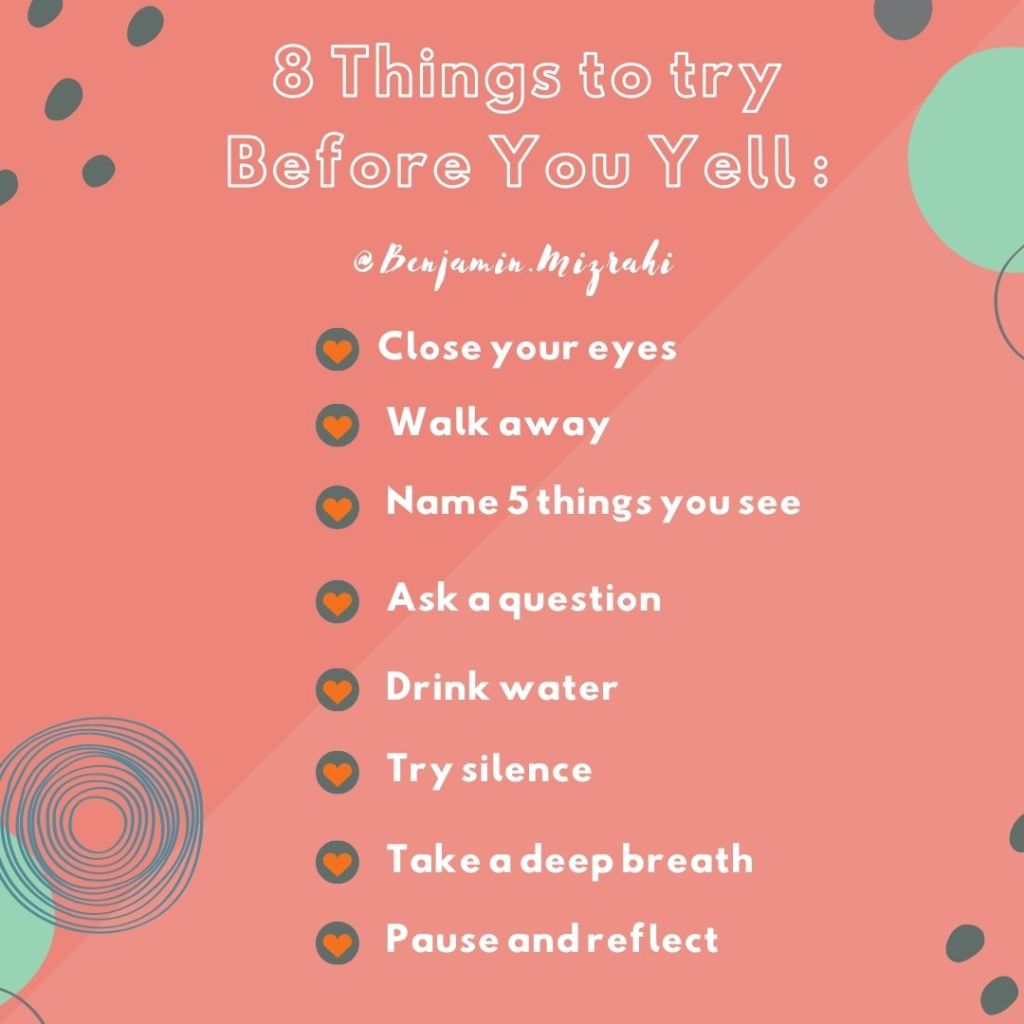
8 Things to Try Before You Yell

What else would you add?⁣⁣ 
⁣⁣ 
Yelling is something many parents struggle with and wish they did less of. Why do we yell? Here are a few possible reasons:⁣⁣ 
⁣⁣ 
👉Old patterns⁣⁣ 
⁣⁣ 
👉Last resort⁣⁣ 
⁣⁣ 
👉Exhaustion⁣⁣ 
⁣⁣ 
👉Overwhelmed⁣⁣ 
⁣⁣ 
👉Unprocessed emotions⁣⁣ 
⁣⁣ 
If we are prone to yelling and our child is not responding, it’s possible they’ve developed a defense against it in order to protect themselves. If there is no imminent danger, before you yell pause & notice what you’re experiencing.⁣⁣ 
⁣⁣ 
Pausing may look like closing your eyes, taking an exaggerated deep breath (exhalation being longer than the inhalation), or walking away.  
 
“I see the drawing on the wall and I’m experiencing some big feelings, I need a break. I will be right back.”⁣⁣ 
⁣⁣ 
Then notice what you’re experiencing. ⁣⁣ 
⁣⁣ 
If you’re overwhelmed because your child has destroyed the room – that makes sense.⁣⁣ 
⁣⁣ 
If you’re angry because your children keep fighting – that makes sense.⁣⁣ 
⁣⁣ 
As we make sense of our own experiences we can return to our child and ask a question rather than yell. Or we may reflect on how we would have liked to have been approached when we were little in a similar situation.⁣⁣ 
⁣⁣ 
Remember to care for yourselves, even if it means three minutes of deep breathing in the morning while you sit alone in the bathroom!⁣⁣ 

Coach Benjamin Mizrahi. Educator. Learning Specialist. Family Coach. Father. Husband.   

More articles on www.MrMizrahi.blog  

Build Your Child’s Confidence

Confidence is one of the greatest gifts a parent can give their child. As such, parenting has a clear impact on how children see themselves and build confidence.  
 
When a child encounters hardship, parents should point out how enduring these challenges will increase his resilience. It’s important to remind your child that every road to success is filled with setbacks.  

Praising your child is one of the ways by which his self-confidence is developed. However, overpraising him may not be good as it might lead either to an inflated view of one’s own capabilities or, equally possible, could lead to feelings of anxiety and inferiority. A child knows when the way he is being described does not reflect reality. It is a given fact that those with grandiose views of themselves, with high self-esteem that borders on narcissism, tend to be more aggressive when their egos are threatened.  
 
The most important way to boost your child’s confidence and self-esteem is to honor his feelings. If a child does not get accurate feedback and that he only gets positive feedback, then, he can never improve in an area of performance. Your child must get honest feedback which is straightforward and allows for improvement where necessary. 
 
Children need to live with people they love and who love them, people who have realistic expectations of them. This is what will boost a child’s self-esteem. 


Coach Benjamin Mizrahi. Educator. Learning Specialist. Family Coach. Father. Husband.   

More articles on www.MrMizrahi.blog  

Positive Things to Say to Kids

Words are a powerful thing. They can tear someone down. They can build someone up. And for children, hearing words of affirmation can literally affect their overall development and perception of who they are and who they will be. Whatever parenting style you follow, using positive words are much more likely to result in a positive outcome. Read on below for just a few things you can say to your little one today! And share this with a friend who might want to see it too! 
– 
I believe in you. 
You are important. 
What an amazing listener you are! 
You are such a kind person. 
I couldn’t have done this without you. 
I trust you. 
You are very brave. 
I love how you can make me laugh! 
I am impressed at how responsible you are. 
You are loved. 

Coach Benjamin Mizrahi. Educator. Learning Specialist. Family Coach. Father. Husband.   

More articles on www.MrMizrahi.blog  

Temper Tantrums VS Meltdowns

There are significant differences, neurologically, between a temper tantrum and a meltdown – those differences come down to which parts of the brain are in control during a meltdown or a temper tantrum. 

Tantrums 

As awful as tantrums can be, it is an indicator that your child’s executive functions are developing typically. So, in a strange way you can be proud of your kiddo for that fit they’re throwing. 

A child having a tantrum is acting out in order to get their way or push your buttons or get some attention. They’re likely operating with the forebrain and midbrain – the thinking and feeling brain. 

They may appear out of control but are able to stop the tantrum abruptly (for example, when they get what they want) and return to making logical decisions and behaving calmly. 

Parents are taught to ignore tantrum – because if your child’s tantrum doesn’t get them what they want or get a reaction out of you, they will learn that this strategy is ineffective and over time, will stop. 

You may notice a child who is throwing a tantrum will look over at you to see if you’re watching them. 

Young children use tantrums because they don’t have the communication skills yet to communicate their wants and needs. Learning about their feelings, and positive ways to communicate, will drastically reduce the frequency of tantrums. 

Meltdowns 

A meltdown is completely different. 

When a child is having a meltdown, thanks to their amygdala causing fight or flight to kick in, the prefrontal cortex responsible for executive functioning completely shuts down. 

Stress hormones flood their tiny body and, temporarily, they are literally incapable of controlling their actions and emotions, or using any executive functions like considering consequences, problem-solving, or listening to reason. 

When your child is having a meltdown, they do not need you to set firm boundaries or ignore their outbursts. Your child needs you to be nurturing and comforting until the meltdown is over.  

The best approach to take will vary depending on your child’s temperament and what the trigger of the meltdown was. Just remember that this is an emotional reaction and not a behavior choice. 

When your child is having a meltdown, trying to talk to them about consequences or appropriate vs inappropriate behavior will not help, and may in fact make things worse. 

The executive functions of the brain need to be up and running for any of this information to be processed. 

When their emotions are regulated again, and no longer rushing with emotions, you can talk about appropriate vs inappropriate behavior with them. 

It’s better to talk to your child using compassion and understanding than to be punitive. The best strategy for meltdowns is to be proactive. 

Coach Benjamin Mizrahi. Educator. Learning Specialist. Family Coach. Father. Husband.   

More articles on www.MrMizrahi.blog