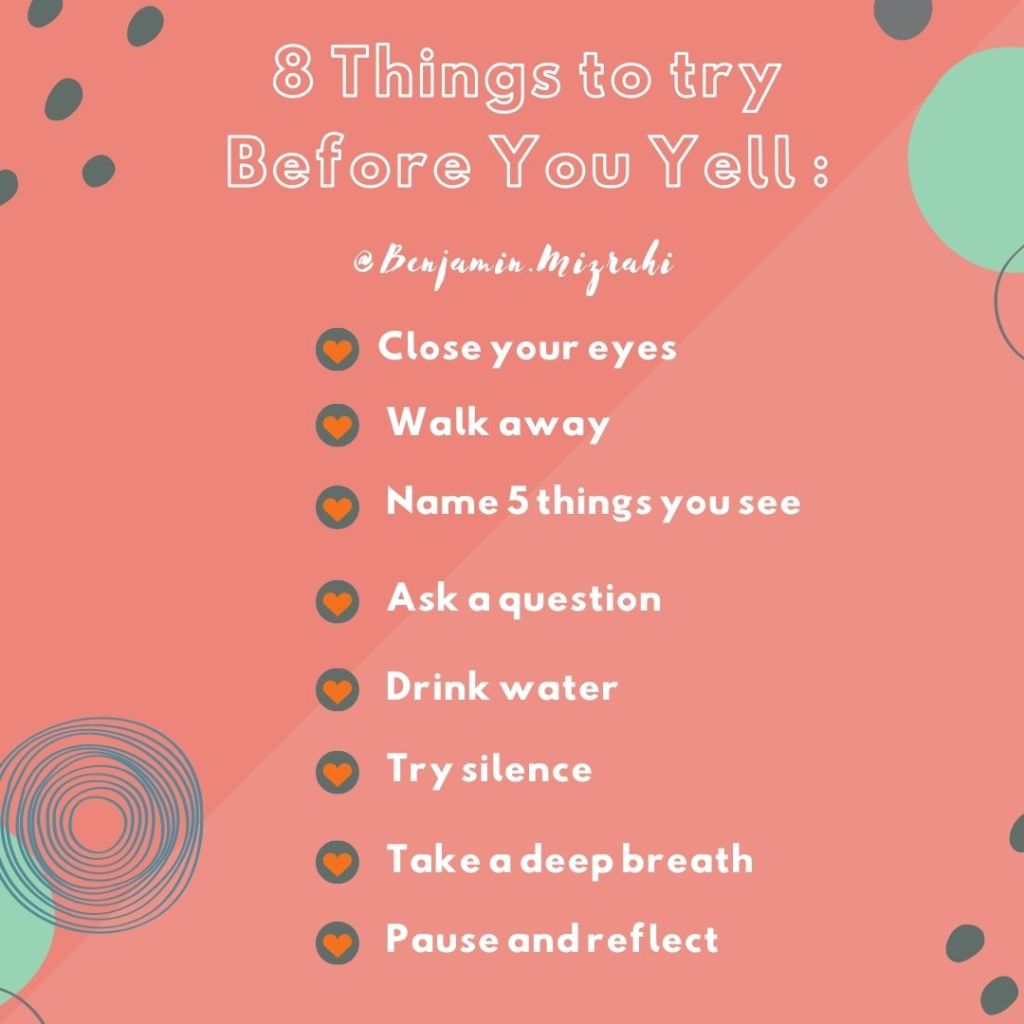
What else would you add? Yelling is something many parents struggle with and wish they did less of. Why do we yell? Here are a few possible reasons: 👉Old patterns 👉Last resort 👉Exhaustion 👉Overwhelmed 👉Unprocessed emotions If we are prone to yelling and our child is not responding, it’s possible they’ve developed a defense against it in order to protect themselves. If there is no imminent danger, before you yell pause & notice what you’re experiencing. Pausing may look like closing your eyes, taking an exaggerated deep breath (exhalation being longer than the inhalation), or walking away.
“I see the drawing on the wall and I’m experiencing some big feelings, I need a break. I will be right back.” Then notice what you’re experiencing. If you’re overwhelmed because your child has destroyed the room – that makes sense. If you’re angry because your children keep fighting – that makes sense. As we make sense of our own experiences we can return to our child and ask a question rather than yell. Or we may reflect on how we would have liked to have been approached when we were little in a similar situation. Remember to care for yourselves, even if it means three minutes of deep breathing in the morning while you sit alone in the bathroom!
Coach Benjamin Mizrahi. Educator. Learning Specialist. Family Coach. Father. Husband.
We admit, it’s hard to see past a child’s behavior, especially when it comes to hitting.
When we are physically hit, it can trigger wounds from our past that remind us of unmet needs we may have had as children. We may not have gotten hit, but the physical force can make our bodies travel back into time to unconsciously remember painful memories.
A FEW IMPORTANT THINGS TO REMEMBER -Hitting is a developmental expectation for kids 1-5. -When a child hits, it means they are requiring your attention. -Hitting is not a personal attack on you. -You’re still a great parent if your child hits.
THE KEY TO STOPPING HITTING -Be very consistent and predictable with how you respond.
VALIDATE THEIR EMOTIONS OR THE NEED WE SEE “I see your body has a lot of wiggles it wants to express.”
TEACH THEM WHAT TO DO INSTEAD “Our hands are not for hitting. We use gentle hands when we touch people’s faces. Here, show me gentle hands, please.”
PRAISE THE GOOD “You did it! You just showed me gentle hands!”
There are so many ways to support our children during their hitting moments. We hope these ideas help you.
Coach Benjamin Mizrahi. Educator. Learning Specialist. Family Coach. Father. Husband.
I hear from parents every day trying to break old patterns from their childhood and parent more consciously. If you are struggling to remove yourself from the ways you were parented and the negative cycles you’d prefer to leave behind, I want to encourage you. The only parent you are destined to become is the one that you decide to be.
Your past doesn’t get to choose your legacy.
Committing to breaking cycles from our childhood and parenting consciously can lead to imposter syndrome bringing self-doubt into the mix, “Am I doing this all wrong?” No one is fully conscious all the time. Making unconscious decisions and falling back into old habits is natural. Parenting is the best self-development course you will ever take.
Coach Benjamin Mizrahi. Educator. Learning Specialist. Family Coach. Father. Husband.
Praise nurtures your child’s confidence and sense of self. By using praise, you’re showing your child how to think and talk positively about themselves. You’re helping your child learn how to recognize when they do well and feel proud of themselves.
Giving your child words of praise is like offering him a ticket out of the fear and self-doubt that plague him.
The key to effective praise, the kind that is transformative rather than simply pleasant — is placement. If you applaud everything your child does, your praise sounds phony and loses its power. If, however, you withhold acclaim for only those occasional moments, you may lose the chance to draw out more from a child than he knew he had in him.
And what if your child does little to deserve praise? Help him to succeed, to go beyond himself. Praise is especially important for children who have ADHD because they typically get so little of it. They undergo testing and are expected to feel grateful for constructive criticism.
Children with ADHD carry buried treasures and hidden talents that must be excavated to be developed. Praise is one of the best pickaxes in this important mining expedition.
A reward is a consequence of good behavior. It’s a way of saying ‘Well done’ after your child has done something good or behaved well. It could be a treat, a surprise or an extra privilege. For example, as a reward for keeping their room tidy, you might let your child choose what’s for dinner. So, when you praise or encourage your child’s behavior and then reward it, the behavior is more likely to happen again.
Coach Benjamin Mizrahi. Educator. Learning Specialist. Family Coach. Father. Husband.
Self-esteem is how we each feel about ourselves at any given moment, but you must keep in mind that it’s very dynamic in nature. You can feel like a million bucks when you throw on that new outfit you put together for an interview but feel like a wreck if the interview doesn’t go your way.
It’s not uncommon for highly sensitive people to try and please everyone before considering pleasing themselves. If a highly sensitive child is always paying attention to what others are saying, the way people react can leave a relatively deeper impression on them. Seeing your child struggle with bouts of low self-esteem can be difficult, but with a little help, you can make a big improvement.
It’s important to show positive encouragement and support for what your child truly is while accepting them for what they are not. If your child is a great soccer player, it’s important to support them. However, if he/she is constantly struggling with science class, you shouldn’t hold it against them. This constant stream of support and encouragement can provide the building blocks for much-improved self-esteem and overall happiness.
Sensitive children need to express themselves and successfully master their favorite skill. Perhaps your sensitive child is particularly talented at playing guitar or skateboarding. Whatever the case is, it’s your job to encourage your child to succeed at what they want and find happiness in doing so.
Coach Benjamin Mizrahi. Educator. Learning Specialist. Family Coach. Father. Husband.
It might seem obvious but being able to name your feelings is the first step to controlling them.
Kids who have a hard time with Emotional Control could cry for half an hour or more without being able to stop or stay upset for a very long time no matter how many times you ask them to move on.
There are a few ways to help them manage their emotions. If you want to start early like I did with my toddler, start with simple games where they learn to:
Name the feeling and Recognize it when they see it. (which will also help them to read social cues)
Highly sensitive children are often in amidst of some strong emotional turbulence. Their eyes may seem sad, they could become vexed for little or no issue at all, and when they are ill it seems that the entire home is in commotion. Nevertheless, being sensitive can be a good thing as long as we guide our children according to their emotional capacities.
Highly sensitive children can be explained in five different categories:
The Anxious Highly Sensitive.
Not all anxious people are hypersensitive, but many highly sensitive people are anxious. At home, sensory perceptions are exacerbated. Thus, their hypersensitivity makes them fine observers of nuances of expressions and mimicry. What could be positive, like being able to read people, will be contaminated by anxiety. This is how neutral attitudes of concern or concentration will be interpreted as threatening. For example, an unusual facial expression by the father will signal his highly sensitive that something is wrong. This feeling may impact the child’s behavior through the rest of the evening.
In addition, their imagination is filled with anxiety, and they consider all the possible consequences of imaginary threatening events. They spend a lot of time trying to find solutions to problems that exist only in their head. This tires them enormously. Moreover, as they anticipate all kinds of difficulties, they often under-perform in school, even though they have all the required skills. Performance anxiety is an obstacle to academic success. Highly sensitive children are not easy to mobilize by teachers and are often not motivated by their difficulties.
Another characteristic of highly sensitive kids is their propensity to worry about everything all the time. As if they carried all the misery of the world on their shoulders, they spend a lot of time imagining the worst for their loved ones and for themselves and are very affected by it.
The Highly Sensitive Withdrawal
In this profile, we find children whose defense against excessive sensitivity is reflected in the inhibition, in different areas of life, emotional, social or intellectual. It is an unconscious attitude, which allows them to live better with their personality. As they are overwhelmed by their emotions, they prefer to avoid situations that expose them, such as group activities or strong, friendly relationships. They are often thought to be indifferent, whereas, on the contrary, they are too receptive! Some children prefer to give up a social and emotional life that overexposes their sensitivity.
Shyness is the corollary of this type of highly sensitive child, who is moreover often influenced. “Indeed, their hypersensitivity encourages them not to upset their friends, to avoid conflict they would live very badly.” This profile can lead them to take part in reprehensible actions, even cruel, only in order not to put in a situation of conflict vis-à-vis the group. And as they do not express their discomfort, they remain undermined for a long time without being able to evoke what disturbs them.
In addition, highly sensitive withdrawal, whose sensitivity is “mobilized to excess in all areas of life,” have a strong tendency to somatize. The stomach ache is then the privileged expression of their overflowing emotions, which they can not express (apart from any proven affection). Fleeing the reality too hard in daydreaming, they take refuge in an imaginary often rich. And in some cases, their inhibition leads to intellectual blockages that jeopardize their academic success. “This is particularly the case for these children who are psychologically frozen at the slightest remark of an adult, connoted negatively or deemed too dry.” Their motility can also be weakened by their hypersensitivity: they become clumsy, left.
The Expressive Highly Sensitivity
Unlike the previous examples, children whose high sensitivity is manifested by introversion, children in this category demonstrate with high intensity all the emotions: joy, sadness, fear, anger, love, disgust, frustration, astonishment … The physical enters then also in the dance, causing tears so intense that they can suffocate. They lose control of themselves. In case one of the parents is also hypersensitive, then it is the paroxysmal explosion on a daily basis!
Ultra-receptive to the moods and moods that emerge from their surroundings, they live according to the moods of others, especially when they are collective – as in a classroom. Their need to constantly please, their staggered attitudes, make them chameleons very difficult to follow and understand.
The Sensitive Highly Sensitivity
Sensitive children of this type think that we are angry at them or that they are not considered to their real value. They do not support the slightest criticism. Their ego is strong, they have a high opinion of themselves, even feel superior to others. However, their hypersensitivity makes their self-esteem vacillating, because it is based only on what is said about themselves, and not on their experience, the analysis of their strengths or weaknesses. Their imagination often makes them paranoid, and they make stories. “They are unfortunately rather difficult to meet, despite their keen desire to be loved and their ability to understand the emotions of others” because they react very strongly when their susceptibility is hit, quite often! They take everything to the first degree and easily distort what they say. They keep thinking that they are being mistreated, which makes their relationship exchanges very complicated.
How to help a highly sensitive child?
The first thing to do is to find out what is the dominant of your hypersensitive child. However, that it is rare for a child to belong exclusively to one of these: they often overlap with each other.
Then, we must bring them to relativize, because they have a lot of trouble to screen what happens to them, they take all full force. Parents can, little by little, help them distinguish between what is important and what is not. But for that, we must avoid the rational arguments: it is better to be reassuring, showing that one understands that the pain or anger is great for the child. Do not ridicule him.
Another action to take is to teach them to wait. Teach your child not to react immediately, to take time to distance themselves from the situations, to repel the primary reactions. For this, parents must lead by example, be patient, agree not to immediately get behavior from the child.
Soothing one’s susceptibility is also helpful. It’s about giving your child confidence so that the words of others do not reach them as much. To do this, you can discuss with your child afterward remarks that they perceived as offensive, and show them that there was no reason to react at all. Avoiding sensitive topics also pays off.
Surround them with love and security, more than other children, because the hypersensitive have greater needs in these areas. “It’s not about raising your highly sensitive child in a bubble, says the psychologist: a hyper-protective attitude will not help his business. But special attention is required, as well as evidence of love and esteem.
A highly sensitive child can have trouble with the demonstrations of tenderness and love (which overwhelm them with emotions): it is, therefore, necessary to observe and go at their own pace.
Developing autonomy is also fundamental to help your highly sensitive child live better with her/his hypersensitivity. This is true for all children, but even more so for highly sensitive kids. This autonomy will allow them not to model their emotions on those of others, to which they are particularly receptive. “To help him, he is offered a precise and stable framework, especially for unusual moments, by leading him to anticipate a little the events to come: how will he react? What are the alternatives? What questions to ask?”. The more situation your child is psychologically prepared, the less anxiety and unfounded interpretations s/he will experience.
Making them tame his emotions, helping your child identify and name her/his feelings, will be of great help to both of you. The best way is to help them do it as soon as the emotion begins to invade, or when it is still between two glasses of water. Getting your child used to hear words about how he feels will gradually allow her/him to distance himself from his invasive affectivity. It is crucial never to mock or criticize the emotional outbursts of a highly sensitive child, as it reinforces them. When it comes to anger, you can train her to restrain her by positive images, by breathing properly, while trying to speak.
Do not neglect the body dimensions. Taming their bodies is crucial for these children who do not have this skill innately. Clutching them, carrying them, cuddling them, making them do motor activities, is even more essential for a highly sensitive child.
Listen to them carefully. Even if they are often in excess, the little hypersensitive needs to feel that her/his word is valuable and is heard. To make them verbalize their suffering rather than somatize or shout, tap, etc., they should feel confident, and that their word is really heard, and not thwarted every time they try to tell you what open their heart. Then discuss with them to help relativize, delay, etc.
The importance of activities such as music, gardening, cooking, visual arts, but also relationships with animals and nature, as well as manual work, is beneficial for the all highly sensitive children.
Learning about emotions begins at a very young age, as the child discovers a wide range of emotions, and evolves over the years. This theme offers a better understanding of the essential stages of emotional development, its impacts, the interrelated abilities, and the factors that build emotional competence.
The foundations of children’s emotional development are based on their relationship with their parents. Through proper care and sufficient amount of attention, kids will learn to:
Use words to express their feelings, positive or negative.
Empathize with how others feel.
Manage strong emotions under challenging situations.
Cope with their fears in the face of the unknown.
Calm themselves when in distress.
Control their anger and learn from their mischief.
Having the capacity to deal with managing their emotions will help children to develop their confidence and be more able to communicate their needs and understand those of others. Indeed, self-confidence is one of the direct outgrowths of developed emotional control.
How important is it?
Emotional Competence (EC) is a developmental process that involves three interrelated competencies: 1) emotional expression, 2) emotional awareness, and 3) emotional regulation (e.g., being aware of his emotion and changing them if needed). In infancy, children already experience a wide range of emotions in social situations through non-verbal messages (e.g., hugging or making a face). Then, as cognitive development progresses, children can determine their feelings and those of others and the circumstances that led to their expression. This understanding of emotions, in turn, allows children to control and modify their emotions to cope with stressful situations.
Emotional development during infancy and early childhood are essential for many interrelated skills. Children with healthy EC are more likely to excel in at least three of the following. 1) persevere in learning, 2) engage in empathic and pro-social behaviors, 3) express appropriate emotions in various contexts, 4) use adaptive strategies to cope with conflicting and disturbing emotions (anger, disappointment), and 5) to reduce multiple risk factors related to psychopathology. Together, these skills predict academic success in the early years at school and positive interpersonal relationships with peers and family members.
What do we know?
Emotional control as a skill varies with age. It is also manifested in different ways from one culture to another. The culture in which children grow up tends to influence the intensity and type of emotion expressed. Notably, the expression and understanding of feelings are likely to vary among children depending on how children socialize, the presence of comforting objects, the proximity of parental figures and situational contexts.
Emotions do not all appear at the same time. Primary emotions (fear, anger, sadness, interest, and joy) appear in the first year of life, while secondary emotions (embarrassment, guilt, and shame) are usually expressed at the end of the second year. The mental representation that children have of “themselves” evolves at the age of two as well.
Emotions play an essential role in the appearance of psychopathologies during childhood. Children who have experienced adverse social experiences, such as abuse or insecurity, tend to be very vigilant in detecting signs of threat.
As a result, they engage in anxiety, aggression and fear behaviors as a means of self-protection. Their negative affectivity, inadequate regulation of emotions, and imbalances in the different emotional systems in their brains (anxiety, care, and research systems) predict internal and external disorders (depression, aggressiveness, respectively).
What can we do?
In order to enhance emotional competence in children, parents are encouraged to model various emotional expressions. Since emotions at home greatly affect the emotions that children express with their peers and at school, positive parent-child interactions is imperative. Particularly, parents will benefit from using positive parenting practices and support their children when faced with challenges. Interventions at an early age will help to improve the emotional control and emotional parent-child synchrony is greatly encouraged.





 EXECUTIVE FUNCTIONS COACHING