Reasons why Listening is Important for Your Child’s Growth


Young children are inquisitive and curious, we all know that. This is because they are blank slates. The world is still an amazing place for them, and they want to know more about it, about everything. 

In these formative years, children are limited in mobility and other sources of communication, as well as gaining information. So, they turn to the easiest way of gaining new information, listening. 

Let us gain in-depth understanding of how listening is essential in the growth ages, years 1-5, of every child. 

1. Listening Improves Concentration and Memory 

Listening is one of the prime senses of our body. Although visual memories are stronger, our body also retains auditory memories or echoic memories. It helps stabilize the mind and improves concentration. 

2. Improves Vocabulary 

As children grow older, their need to speak and communicate grows rapidly. However, this development is strongly rooted in the initial phase of their childhood. During this phase, listening plays an important role in developing their vocabulary and language processing. 

3. Adds Clarity to Communication and Thought 

This allows them to express themselves more clearly and understand what they want. The ability to communicate clearly and understand the reason strengthens the bond between children and parents. 

4.  Builds Confidence 

One aspect of listening is that it builds confidence. While listening seems like an ordinary thing, most of us listen to reply than to understand. 

Conscious listening decreases speech errors or response errors, thus improving confidence levels. Clarity of thought and concise, but perfect communication allows children to speak their mind. 

5. Improves Relationships 

Communication is the foundation for any relationship. Children with good vocabulary can speak openly with their adults. Their ability to understand reason helps parents to understand their children better as well. 

6. Optimal Method for Growth 

The most important factor of listening is that children between ages 2-4 have limited sources of gaining information and since they cannot read, they prefer listening. 

7. Enables Experiential Thinking 

One of the most important aspects of listening is that it triggers experiential learning. 

Audio plays a primary role in the beginning growth in children. Long before visuals start taking effect, audio plays a key role in developing the early experiences of children. 

Listening is a key-factor in children’s growth and empowers children in multiple ways to process information and interact with their surroundings better. 


Coach Benjamin Mizrahi. Educator. Learning Specialist. Family Coach. Father. Husband.   

More articles on www.MrMizrahi.blog 


How to Smooth Transitions and Avoid Meltdowns

Turning off the TV, leaving the playground, giving back the iPad, or ending a play date — any of these may provoke a tantrum. Why? Many children with autism and ADHD have difficulty moving from one task to another, especially when they must stop an enjoyable activity. Behavior intervention strategies can help smooth the transitions. 

  1. Define Expectations 

Clearly identifying your objectives and setting attainable short- and long-term goals are the first steps to any behavior change plan. 

Let’s take the LEGO example. The expectation may be: When the time comes to shift to another activity, my child will comply when he is asked, without resisting, crying, shouting, or throwing things. 

  1. Create a Schedule 

A written or a visual schedule can help your child follow the order of events for a specific time period. But posting a schedule does not automatically mean your child will follow it. Checking off the events in a schedule should be accompanied by positive reinforcement. 

  1. Reinforcement 

Once you have thought of possible reinforcers for your child (you can create a visual depicting the reinforcers for your child to see), try simultaneously presenting the reward as the transition time is occurring, before your child can resist. Besides offering tangible items, positive reinforcement should also include behavior-specific vocal praise. 

If your child already starts to fuss when the announcement is made to start a new activity, don’t promise the reinforcer. It is very important that the engagement in a challenging behavior never results in receiving a pleasurable item or activity. Reinforcers should only follow desired behaviors. As transitions are consistently paired with reinforcement, the new desired behavior can become more of the “norm.” 

  1. Plan 

Prepare in advance to reap the benefits from your intervention plans. Know how you will present the transition, what items or activities will be effective reinforcers to motivate a successful transition, and how you will respond if your child does not go along with the shift in activity. 

  1. Give Choices When Possible 

Offer options to help your child with transitions. You might say, “Do you want me to help you clean up, or do you want to do it by yourself? It is almost time to leave for baseball practice,” “We are ready to finish TV time and have lunch.” It also helps to see things from your child’s perspective. If a game is just about to end, or there are three minutes left on his TV show, be flexible when possible. 

When a parent’s emotion run high, the child’s emotion will, too. Demonstrate the behaviors you want your children to engage in. Urging a child to “Come on, hurry! We are going to be late,” can have a negative effect. Stay calm and steady. 

Coach Benjamin Mizrahi. Educator. Learning Specialist. Family Coach. Father. Husband.   

More articles on www.MrMizrahi.blog 
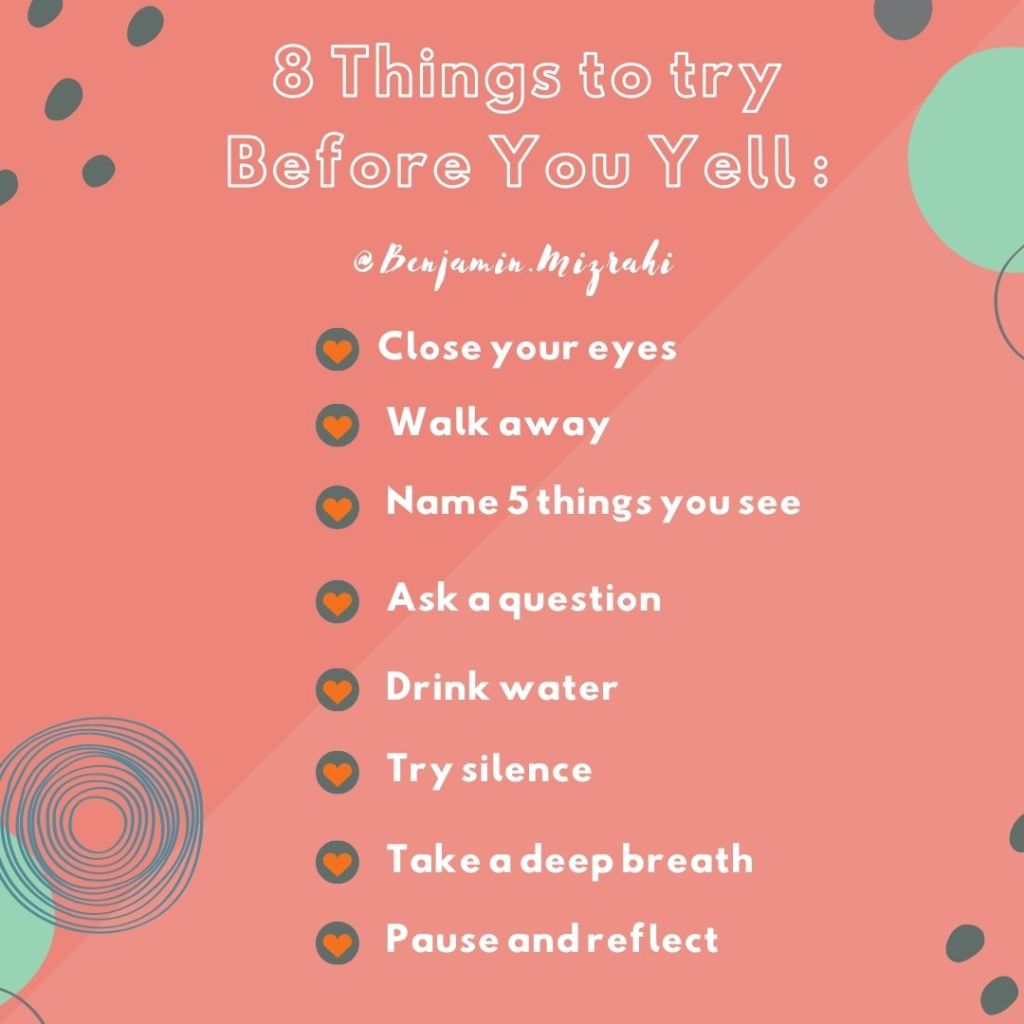
8 Things to Try Before You Yell

What else would you add?⁣⁣ 
⁣⁣ 
Yelling is something many parents struggle with and wish they did less of. Why do we yell? Here are a few possible reasons:⁣⁣ 
⁣⁣ 
👉Old patterns⁣⁣ 
⁣⁣ 
👉Last resort⁣⁣ 
⁣⁣ 
👉Exhaustion⁣⁣ 
⁣⁣ 
👉Overwhelmed⁣⁣ 
⁣⁣ 
👉Unprocessed emotions⁣⁣ 
⁣⁣ 
If we are prone to yelling and our child is not responding, it’s possible they’ve developed a defense against it in order to protect themselves. If there is no imminent danger, before you yell pause & notice what you’re experiencing.⁣⁣ 
⁣⁣ 
Pausing may look like closing your eyes, taking an exaggerated deep breath (exhalation being longer than the inhalation), or walking away.  
 
“I see the drawing on the wall and I’m experiencing some big feelings, I need a break. I will be right back.”⁣⁣ 
⁣⁣ 
Then notice what you’re experiencing. ⁣⁣ 
⁣⁣ 
If you’re overwhelmed because your child has destroyed the room – that makes sense.⁣⁣ 
⁣⁣ 
If you’re angry because your children keep fighting – that makes sense.⁣⁣ 
⁣⁣ 
As we make sense of our own experiences we can return to our child and ask a question rather than yell. Or we may reflect on how we would have liked to have been approached when we were little in a similar situation.⁣⁣ 
⁣⁣ 
Remember to care for yourselves, even if it means three minutes of deep breathing in the morning while you sit alone in the bathroom!⁣⁣ 

Coach Benjamin Mizrahi. Educator. Learning Specialist. Family Coach. Father. Husband.   

More articles on www.MrMizrahi.blog  

Positive Things to Say to Kids

Words are a powerful thing. They can tear someone down. They can build someone up. And for children, hearing words of affirmation can literally affect their overall development and perception of who they are and who they will be. Whatever parenting style you follow, using positive words are much more likely to result in a positive outcome. Read on below for just a few things you can say to your little one today! And share this with a friend who might want to see it too! 
– 
I believe in you. 
You are important. 
What an amazing listener you are! 
You are such a kind person. 
I couldn’t have done this without you. 
I trust you. 
You are very brave. 
I love how you can make me laugh! 
I am impressed at how responsible you are. 
You are loved. 

Coach Benjamin Mizrahi. Educator. Learning Specialist. Family Coach. Father. Husband.   

More articles on www.MrMizrahi.blog  

Not Every Emotion Needs an Explanation

A gentle reminder: ⁣⁣ 
⁣⁣ 
Not every emotion needs an explanation. ⁣⁣ 
⁣⁣ 
It seems fitting after two days of sharing scripts to share this reminder. ⁣⁣ 
⁣⁣ 
Words are helpful and if we are consciously engaging with our child and ourselves, scripts can help us understand the framework from which we want to parent and shift our mindset. ⁣⁣ 
⁣⁣ 
And yet, words can also be our crutches. ⁣⁣ 
⁣⁣ 
Words can be what we use to prevent us from engaging with what is happening in the present moment.⁣⁣ 
⁣⁣ 
Words can keep our anxiety at bay.⁣⁣ 
⁣⁣ 
If we are predominantly left-brained, words and logic are what feels comfortable and safe.⁣⁣ 
⁣⁣ 
We want to understand, rationalize, analyze, and get to the root of our child’s emotions.⁣⁣ 
⁣⁣ 
Naming the emotion.⁣⁣ 
⁣⁣ 
Validating the emotion.⁣⁣ 
⁣⁣ 
Trying to help our child uncover the root of the emotion. ⁣⁣ 
⁣⁣ 
All very valuable! ⁣⁣ 
⁣⁣ 
But we may miss the opportunity to teach our child another valuable lesson: emotions are not a part of us, we can experience them, notice them, and let them go.⁣⁣ 
⁣⁣ 
While this language is too sophisticated for a toddler, the goal is integration. ⁣⁣ 
⁣⁣ 
Integrate the left and the right brain. ⁣⁣ 
⁣⁣ 
As parents this means that our presence is more important than any words we share with our child.⁣⁣ 
⁣⁣ 
Empathy is communicated by our presence and body language, not only our words. ⁣⁣ 
⁣⁣ 
When your child is experiencing an emotion, pause and notice: ⁣⁣ 
⁣⁣ 
How is your breathing?⁣⁣ 
⁣⁣ 
What facial expressions are you communicating?⁣⁣ 
⁣⁣ 
What are your body movements communicating?⁣⁣ 
⁣⁣ 
Worth noting: if we are predominantly right brained and tend to get stuck in our emotions or our child’s emotions, integrating the left-brain or logic and reason is the goal. ⁣ 
⁣⁣ 
What about you, are you predominantly left ⬅ or right ➡ brained? 

Coach Benjamin Mizrahi. Educator. Learning Specialist. Family Coach. Father. Husband.   

More articles on www.MrMizrahi.blog