Talking and listening to your child holds a lot of importance, as it helps your child build a bond with you and develop his trust. It improves the bonding in a relationship and builds a child’s confidence.
Listening is not an easy task, as a parent you would be tempted to raise your voice and tell your child he is wrong. Your child may say something that challenges your views or beliefs, or you may hear something that will make you want to change, or it may disrupt what you think. And that is why, it is important to develop listening skills in yourself first, before getting your child to talk to you. And how do you do this?
Use your body language to show you’re listening. For example, face your child and make eye contact. If your child likes to talk while doing activities, you can show you’re listening by turning to look at your child and getting close to them.
Watch your child’s facial expressions and body language. Listening isn’t just about hearing words, but also about trying to understand what’s behind those words. ‘
Build on what your child is telling you and show your interest by saying things like ‘Tell me more about …’, ‘Really!’ and ‘Go on …’.
Repeat or rephrase what your child has said from time to time. This lets your child know you’re listening and helps you check what your child is saying.
Try not to jump in, cut your child off, or finish sentences – even when your child says something strange or is having trouble finding words.
Don’t rush into problem-solving. Your child might just want you to listen, and to feel that their feelings and point of view matter.
Prompt your child to tell you how they feel by describing what you think they’re feeling – for example, ‘It sounds like you felt left out when Felix wanted to play with those other kids at lunch’. Be prepared to get this wrong and ask your child to help you understand.
Coach Benjamin Mizrahi. Educator. Learning Specialist. Family Coach. Father. Husband.
Adults play an important role in the development of a child’s self-concept. It takes very young children a lot of growing up before they can picture themselves as separate persons capable of thinking and acting for themselves.
As children become aware of the adults around them, their parents and teachers serve as models to them. Adults who feel negatively about themselves and express these negative feelings may find children modeling, or imitating, these attitudes and behavior.
What can parents do to nurture a positive self-concept?
1. Be mindful of the language you use to describe your children. Do not label them with words such as ‘lazy’, ‘naughty’, ‘aggressive’ or ‘mean’. Instead, look for and point out your child’s strengths.
2. Provide them with opportunities for success. Give your child age-appropriate tasks she can complete on her own. Having done so will give her a sense of pride and help build a “can do” mentality.
3. Show your children that you have faith in their goodness and in their abilities. This is a matter of language choice.
4. Spend time together. A vital part of having a healthy self-concept is feeling loved and valued.
5. Support your child’s interests. Learn what your child is interested in and support him in mastering that skill or accomplishing his desired level of achievement. Feeling competent and good at something grows a positive self-concept.
6. Set reasonable rules and enforce them with loving kindness. Your rules should be age-appropriate and clear. It’s important to make sure your child knows that mistakes are a part of life and doesn’t mean she’s a bad person. When giving consequences, keep your child’s dignity in mind.
7. Help your child to manage his emotions and work out problems. When children learn to solve their own problems, they build confidence and, therefore, a positive self-concept. Learning to manage emotions is key to having the ability to step back from a situation and view it objectively.
8. Maintain a connected relationship. Knowing that she has you to talk to, that you will listen without casting out immediate judgment and take her feelings seriously, will help her to feel supported, safe, and important.
9. Give her the opportunity to explore her environment, ask questions without feeling like a nuisance, and engage in make-believe play activities. To nurture curiosity and imagination, allow ample time for free play and exploration.
10. Acknowledge effort and offer encouragement. As she grows, her own self-evaluation will become important to her self-concept, and she needs to learn how to emphasize her strengths and accomplishments, even if there is no trophy in the end.
A healthy self-concept is the foundation for the positive development and the over-all well-being of a child. When a child has a healthy self-concept, he sees himself as being loved, loving, and valuable, and that’s what we all want for our children.
Coach Benjamin Mizrahi. Educator. Learning Specialist. Family Coach. Father. Husband.
Parenting style matters in ADHD. Parenting does not cause ADHD, but different methods tend to be more effective and more likely to minimize symptoms.
What improves behavior for kids with ADHD? Emotionally supportive but consistently firm parenting. Behavioral improvement happens when parents:
take the lead,
stick by new systems, and
remain patient with their children.
Change Begins with You
You didn’t cause the ADHD, but you do impact the outcome. Studies show that support aimed at parents helps ADHD symptoms more than when therapists work only with children. You’ve always done the best you can, and there’s always something new to learn and try. The balancing act is being open to change, while also accepting that you (like all of us) haven’t been perfect before.
Stick to the Basics of Positive Parenting
Where other children may respond well to a wide range of parenting styles, children with ADHD require parents to more consistently stick to the basics. All children need supports until they have the capacity to monitor their own behavior, create their own routines, and manage their own responsibilities. Children with ADHD require this framework for several years more than their peers.
As a parent of a child with ADHD, you’re being held to a high standard. You are expected to stay positive in the face of slow progress when a child does not consistently do what you think is best. And yet, ADHD-related behaviors require near-constant correction for some kids, creating a background hum of “don’t touch that, don’t run into the street, get back over here and finish your dinner.” What follows is a tough-to-break cycle of negativity.
Yet parenting that leans too far in the punitive direction may exacerbate ADHD-related behaviors in the long haul. Instead, a balance can be found where a parent firmly upholds limits while creating an overall home environment that seeks out and emphasizes the child’s successes.
Set Fair & Reasonable Expectations for Yourself
Skillful parenting often comes from recognizing when you need outside support. Working with someone to address your own concerns or improve your marriage can make a huge difference for your children. Getting training and working with a coach or therapist provides skills and strategies. Practical tools support behavioral change and can help you build your own confidence and resilience.
Setting realistic expectations for you and your children is also vital. You cannot do everything “right” as a parent, or depend on a uniform, cookie-cutter approach to “fixing” life, since there is no one perfect solution. Instead, you can cultivate your own balance and wisdom, which allow you to manage family life to the best of your ability. Practicing mindfulness is one way to do this; Impact ADHD’s regular “Self-Care Tips” for parents is another.
Pay attention to your parenting style and find a match that works for you and your children. The fact that parenting influences ADHD may seem like a burden, but it can be an opportunity to take life in a new direction.
Coach Benjamin Mizrahi. Educator. Learning Specialist. Family Coach. Father. Husband.
Guess what? The nagging and yelling aren’t working. Learn how to keep words to a minimum, nix harsh punishments, and develop a more positive approach to navigating ADHD with your child.
Like all kids, children with attention deficit hyperactivity disorder (ADHD) sometimes make bad choices regarding their own behavior. No surprise there. But to make matters worse, parents could often use a few parenting tips themselves, and err in the way they discipline misbehavior. Instead of using firm, compassionate discipline, they move into what I call the ignore –nag-yell-punish cycle.
First, the parent pretends not to notice the child’s bad behavior, hoping that it will go away on its own. Of course, this seldom works, so next the parent tries to urge the child not to do such and such. Next, the parent starts yelling and scolding. When this doesn’t produce the desired result, the parent becomes extremely angry and imposes harsh punishments. I think of this fourth stage as the parent’s temper tantrum.
This four-part strategy (if you could call it that) isn’t just ineffective. It makes life needlessly unpleasant for every member of the family.
How can you avoid it? As with any other pitfall, simply being aware of it will help you steer clear of it. At the first sign of starting on the wrong path, you can stop what you’re doing and make a conscious decision to try something else. Take an honest look at how you respond when your children misbehave. What specific situations are likely to cause you to go down this path? How far down the path do you typically proceed? How often?
Let’s examine the ignore-nag-yell-punish strategy more closely to see why it doesn’t work – and come up with some strategies that do.
Why Ignoring Doesn’t Work
By ignoring your child’s misbehavior, you send the message that you neither condone nor support his misbehavior. At least that’s the message you hope to send.
In fact, your child may read your silence as “I won’t give you my attention or concern” or even “I reject you.” That can wound a child. On the other hand, your child may assume that your silence means that you approve of his behavior or will at least tolerate it. “Mom hasn’t said I can’t do this,” he thinks, “so it must be OK.”
Even if your child correctly interprets the message that you’re trying to send by ignoring him, he has no idea what you want him to do instead. In other words, ignoring your child doesn’t define better behavior or provide guidance about how your child should behave next time.
Instead of ignoring him when he does something you disapprove of, I recommend another “i-word”: interrupting. That is, quickly move people or objects so that your child is unable to misbehave.
For example, if your children start quarreling over a toy, you might say, “Alex, sit over there. Maria, stand here. I’ll take this and put it up here.” Similarly, if your teen comes for supper with dirty hands, immediately take his plate off the table and silently point to his hands if you feel the need to tell your child what you expect of him, tell him once, very clearly. Then stop talking.
Don’t Be a Nag
Why is it important to keep words to a minimum when disciplining your child? Because, as I often remind parents, words are like tires. Each time they rotate against the pavement, they lose tread and become less efficient at starting, stopping, and steering. If you spin words out endlessly, they’ll become less efficient at starting, stopping, and steering your child. Eventually, your words will have no “traction” at all – as tires will eventually become bald.
If the chatterbox parent is ineffective, so is the parent who barks orders like a drill sergeant. To break the yelling habit, tell yourself that you won’t open your mouth until you’re calm enough to speak at a normal volume and in a cordial tone. Often, all it takes to calm down is to spend a few minutes alone – something as simple as excusing yourself to get a glass of water may do the trick.
Taking time to cool off will also help you avoid the last and most counterproductive element of ignore-nag-yell-punish.
Punishment vs. Undoing and Redoing
Parents often assume that by punishing a misbehaving child, they’re helping to build the child’s conscience. Not so. In most cases, harsh punishments, like spanking, simply encourage a child to become sneaky to not get caught next time.
A better approach is to impose consequences that are appropriate to the offense and respectful of your child. Ideally, the consequence you impose for a particular misbehavior will involve undoing or redoing the situation. The consequence for carelessly spilling milk for example, might be that your child cleans up the mess (undoing), and, then pours another glass and sets it in a safer place (redoing). No need to blame or yell. No need to impose harsh punishments (for example, withholding food).
If you’re careful to recognize your first steps down the ignore-nag-yell-punish path – and to substitute the strategies I’ve described – you’ll find yourself on a different path, one that leads to a better relationship with your child. It’s a trip I highly recommend.
Kids with ADHD tend to have outbursts more often than other kids their age. Most of the time, these flare-ups aren’t threatening. Kids might yell or slam doors. But sometimes, they lose control and become aggressive.
Here are five tips on how to curb the aggression of a child with ADHD and ODD.
1. Cut down on electronics. For kids with ADHD, too much screen time can make symptoms worse. Set a timer or limit the number of hours of electronic use per day (the suggested amount of time is no more than two hours for the entire day). During the periods of the day when you child would have been streaming a TV program, offer alternatives – go out for a walk, cook together or try out a new activity once a week.
2. Teach your child compromise and negotiation skills. Kids with ADHD have difficulty being flexible and compromising. Adapting to new situations and rules they’re not accustomed to isn’t a pleasant activity for them. Establish a set of “rules.”
3. Help your child express his or her emotions positively. Kids who learn how to express their emotions in a healthy way grow up to be supportive of others, perform better in school, have better relationships with partners and peers, have better coping skills, and have an overall healthier sense of self.
4. Show your child stability and structure. Children with ADHD need structure and routine. Daily routines and a predictable, organized schedule help make your child feel safe. Maintain consistent house rules. Remind your child of your expectations and the consequences of not meeting those expectations.
5. Exercise. Exercise is a fantastic activity for anyone, even for kids without an attention disorder. But for kids with ADHD, it’s particularly helpful. Science has proven that exercise is a great way for kids to unleash and unwind; it’s also a way to work out any feelings of anger and frustration.
Experts say that even 30 minutes of vigorous exercise per day can help kids with ADHD manage their moods. It can even decrease or eliminate the need for medications that are prescribed to aid in symptom management. It’s also an excellent way of reducing aggression.
Coach Benjamin Mizrahi. Educator. Learning Specialist. Family Coach. Father. Husband.
The COVID-19 pandemic and its associated social and economic stressors can undermine children’s development and well-being. Not only must they cope with major changes to everyday life, such as physical distancing and home confinement, but their families may struggle to meet their basic physical and emotional needs. You can follow these suggestions to promote well-being in your family:
Validate your child’s experiences.
Instead of offering falsely positive reassurances or irritated dismissals about your son’s or daughter’s emotions and questions, acknowledge what you’re observing and hearing from them. Ask open-ended questions that begin with “What…” or “How…” and reflect their answers back to them with “Did I get that right? Is there anything else?” You can’t make things better, but you’ll offer comfort to ease their pain and fear.
Stick with the facts
Real information is key. Kids need clear guidelines about the purpose of the quarantine and what actions they can and can’t take. Limit your family’s exposure to the news and be aware of what you are saying on the phone or Zoom when your kids are around. They really hear more than you think they do.
Remember that we are suffering apart and together.
There’s a universal feeling of unease right now, which is combined with the loss of usual routines and decreased social, in-person contact. Staying connected to your social network is essential, so help your kids, especially younger ones, connect with friends and extended family. Social media and group Zoom chats help people check-in with each other and decrease loneliness.
Coach Benjamin Mizrahi. Educator. Learning Specialist. Family Coach. Father. Husband.
Children with ADHD have more than the ordinary amount of trouble paying attention and controlling impulsive behavior.
Students who have ADHD have above average IQs, but experience difficulty in the classroom which may lead to lower grades or other problems.
Here are the tips and teaching methods for teachers and parents to assist students with ADHD.
1. Break instructions down into smaller parts.
Giving one piece of directions at a time is helpful for kids with ADHD. This helps students stay focused on one task at a time and helps maintain focus through the class period.
2. Give written directions.
Students with ADHD may not remember lengthy oral directions. Provide written directions that allow students to refer to them when needed. Having directions accessible while completing an assignment ensures students stay on track.
3. Check student work early and often.
It is very frustrating for students to have to redo assignments! It can contribute to the common problem of taking hours each day to do homework. Checking classwork and homework a few minutes after beginning a task provides the opportunity to redirect efforts – whether it be because the student misunderstood directions or needs a little more math help!
4. Use patterns and mnemonics.
Learning patterns in math makes it easier to understand and remember concepts. Mnemonics are memory devices, like “don’t miss Susie’s boat” to remember how to do long division (divide, multiply, subtract, bring down). Anything that seems to make math easier and faster helps kids with ADHD focus better.
5. Provide real-life examples.
Real-life examples can make math concepts come alive for all students including those with ADHD.
Telling time and making change with money are examples of ways for younger students to understand basic concepts with real-life context.
6. Use technology and visuals for math help.
Charts and graphs are a great way to assist kids with ADHD to remember the steps needed for complex calculations. Computers and smartboards also help students interact with the material in different ways. This can affect transfer from short-term to long-term memory.
Coach Benjamin Mizrahi. Educator. Learning Specialist. Family Coach. Father. Husband.
For some children, being assertive comes naturally. They easily express their thoughts and feelings and have no problem standing up for what they believe in. Meanwhile, other kids struggle to express themselves, especially about things that bother them.
These skills are especially important when it comes to dealing with bullying and other offensive behaviors. If your child needs to beef up her assertiveness skills, here are seven ways you can get her started on the right path.
🟣 Highlight the difference between assertiveness and aggressiveness. Explain that aggressive people attempt to force other people to do what they want. Meanwhile, assertive people are comfortable sharing their feelings. They also will defend themselves or others against unfairness and ask for what they need. Assertive people also respect the needs and wishes of other people.
🟣 Allow them to make choices. Empower your children by letting them make their own choices about things they are asked to do. Assure your child that she can say no to any request that makes her uncomfortable.
🟣 Stress that they have rights. Be sure your children know they have the right to say “no.” Your child also has the right to be treated with respect, to express her feelings, to state her needs and to be proud of who she is.
🟣 Foster self-esteem. To build self-esteem in your child, listen to what she has to say. Encourage her to think for herself. Doing so will demonstrate that her thoughts, feelings and opinions matter.
🟣 Practice being assertive at home. Roleplay everyday situations that your child faces at school. Practicing assertiveness will help your child get used to expressing her needs in a safe environment. It also gives her experience in being assertive so that when the time comes to assert herself, it does not feel awkward or foreign to her.
🟣 Be aware of how you respond to their requests. As a parent, it is very easy to say no without even thinking. But when you are teaching your child assertiveness skills, you want to avoid shutting her down. Try to offer a brief explanation for your answer, especially if you are saying “no.” Sometimes kids need to be reminded that it is acceptable to ask, even if the answer is sometimes “no.”
🟣 Communicate that assertive people still ask for help. Finally, let your kids know that being assertive does not mean they cannot ask others for help, especially if they are in a situation that is unfamiliar or scary. Also, assure your child that asking for help is nothing to be ashamed of. Instead, it shows she is being wise in addressing a difficult issue.
Coach Benjamin Mizrahi. Educator. Learning Specialist. Family Coach. Father. Husband.
Children thrive if parents can have clear expectations for behavior and enforce those standards consistently. Determine what your expectations for your kids are on everything from how they perform at school to curfews, household chores and even things like using profanity and what their bedtime is during the school year. Be specific and then make the consequences equally as clear.
Tip #2: Model Appropriate Behavior
Remember that you always have an audience when your kids are in your presence. We’re human so we’re going to get irritated and speak harshly or display a temper now and then, but just as soon as it happens and you catch yourself, stop and apologize in front of your kids. By explaining why you’re sorry to your kids, you demonstrate that we need to be held accountable for our action.
Tip #3: Be Affectionate Often
When a child hears phrases like “I love you,” or “How’s it going?” or notices that you stopped what you’re doing when she enters the room and is greeted with a loving smile, it means the world to a child. When you display affection to your kids and other family members, you’re validating to them how important they are to you, which sends the best positive message you could ever deliver.
Tip #4: Teach Problem Solving
When kids are exposed to problems that allow them to be part of the solution, it builds important skills that will carry over into their adult life including how to manage their behaviors.
Although kids crave structure and boundaries, they also love and need to exert their independence. As they grow, obviously they’ll have more opportunities to make more involved decisions, which in turn will aid in their problem-solving abilities.
Tip #5: Teach Behavior During Play Time
Forbid name calling. Compassion starts with what’s acceptable and what’s not. Let him know that being kind to others is the rule and hurtful words are not allowed. If you get involved right away, you are sending an important message that kindness trumps everything and that name calling is not going to happen.
Tip #6: Request Respect
If your kids are taught how to respect themselves and others, they will learn good coping skills for dealing with anger and frustration in appropriate ways that are not verbally or physically abusive to others.
Coach Benjamin Mizrahi. Educator. Learning Specialist. Family Coach. Father. Husband.
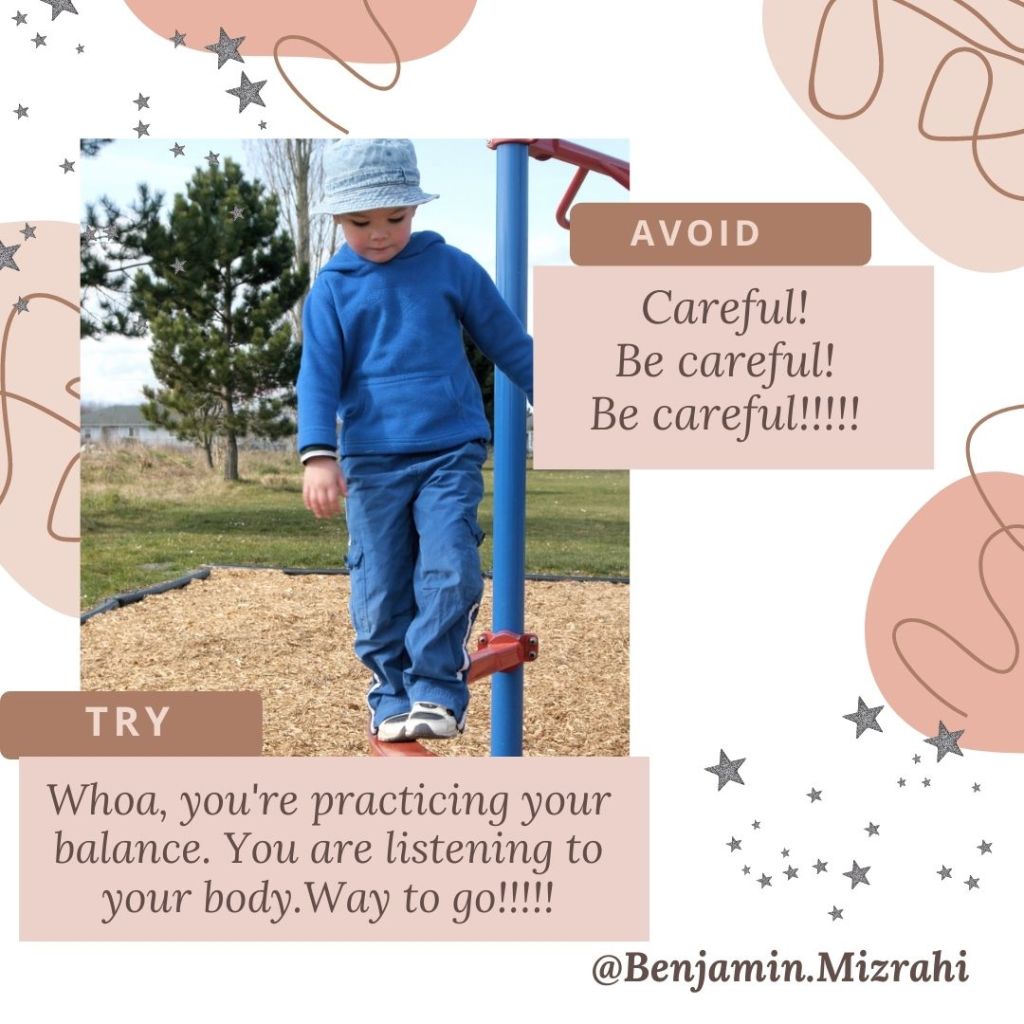
Toddlers love to take the most mundane things and turn them into the most anxiety provoking things ever for us parents. Real talk? How many times a day do you find yourself saying, “BE CAREFUL!!”🚨
Here’s the deal, when it’s a nonstop barrage of “be careful!”, your kid either a) paralyzes in fear b) completely ignores you c) gives you a puzzled look and doesn’t ACTUALLY learn what is dangerous. 🙈
When we verbalize OUR worry and anxiety to them, they internalize it. What does this mean? Their little fight-or-flight response gets triggered. 😧
This is GREAT if in real danger. But, if they’re actually safe in that moment, hovering and constantly telling them to 🚨”be careful!” can signal “the world isn’t safe” and “don’t take risks!” “be hyper vigilant and on guard at all moments!” Basically, our anxieties become their anxiety.
Risky play is crucial for healthy growth and development. Research shows that “parents who… encourage[d] their kids to push their limits to a greater extent had children who were less at risk of exhibiting anxiety disorder symptoms…”
So, how can we break the “Be Careful” cycle? ✨Pause, take a deep breath ✨Does this situation present serious harm? ✨Why does this make me uncomfortable? ✨Is my child learning skills right now?
Some situations require you to do nothing and other situations require you to help your child foster awareness or problem solve. So, we’ve now reserved the 🚨”BE CAREFUL!”🚨 for when they truly SHOULD completely stop in their tracks with fear – dangerous things like running into the road, about to burn themselves, etc. So, instead TRY THIS. Guide their awareness + problem solving skills: ✨Bring awareness to their bodies “Woah! You’re practicing your balance! You’re really listening to your body! Way to go!” ✨Notice how? “Notice how the water under your feet makes the rocks slippery.” ✨Do you see? “Do you see that big branch up ahead?” ✨Do you feel? “Do you feel how wobbly that branch is when you climb over it?” ✨Problem solving “That branch up ahead is in the way, what should we do?”
It’s important that we let our kids engage in risky or challenging play because it’s a great way for them to practice problem solving skills. Let the children know to proceed with caution, but don’t make them be afraid to fall. They need to learn how to get back up, dust themselves off, and move forward.
Coach Benjamin Mizrahi. Educator. Learning Specialist. Family Coach. Father. Husband.
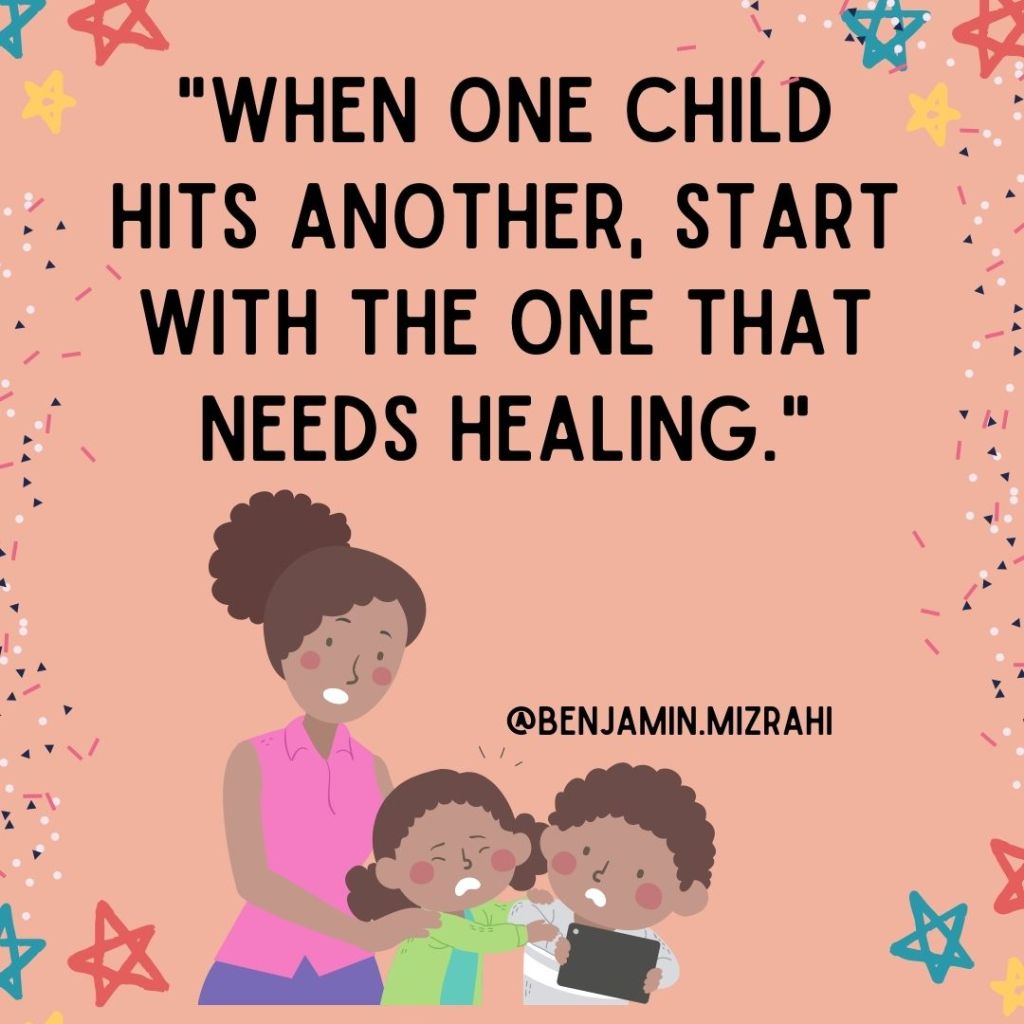
“What should I do when one child hits my other child?” ⠀⠀ ⠀⠀ 👉🏻When you have a child who hits/bites/kicks and another child who has been hurt and you approach the situation after it has already happened, it is important to start with the child who has been hurt. ⠀⠀ ⠀⠀ 💕Tell the child who did the hurting that you see them and that you will talk with them in a minute. ⠀⠀ ❤️This shows the child who is hurt, the outcome of their actions (causing pain to someone else). ⠀⠀
❤️Second, it shows the child who is hurt that their pain matters to you and that you see them. ⠀ ⠀⠀ ❤️Third, it slows you down enough so that, in the moment, you don’t make choices, which don’t align with your values of how you are going to discipline. ⠀⠀ ⠀⠀ 👉🏻As you slow down to respond to your hurting child, you are allowing your brain time to calm down so that you can access your own logical thinking again and approach the child who was hitting from a place of curiosity and calm. ⠀⠀ ⠀⠀ ❤️Once you have spent a few moments with your hurting child, you can then go to the child who hit and with curiosity try and understand what happened and what your child may need to learn so that they can get their needs met in a way that doesn’t involve hitting! ⠀
You could narrate what happened, focus on repairing the relationship, and stay curious about what skills your child may need to learn or work on for the future.
This is a simplification of what happens in these moments, but we hope you find this helpful. ⠀⠀ ⠀ Do you have sibling fights in your home?
Coach Benjamin Mizrahi. Educator. Learning Specialist. Family Coach. Father. Husband.








 EXECUTIVE FUNCTIONS COACHING