Reflective listening is a skill I utilize during Play Therapy!
This skill involves focusing intently on the child and working to convey that you hear, understand, and care about what the child is communicating!
The concept is straight-forward and includes three easy steps. ‼️
1. Remove all distractions (i.e. phone, work, television, etc.).
2. As your child talks, look at them and listen closely.
3. “Reflect” back what your child shared with you.
Yes – it really is that simple! ⭐️
When we make the time to remove distractions and really listen to understand – instead of listening to respond – we help our children know that their experiences and emotions are valuable and important to us.
This creates strong parent-child bond and models healthy communication skills for the child!
Coach Benjamin Mizrahi. Educator. Learning Specialist. Family Coach. Father. Husband.
Something to remember is you should never force an apology from your child. By telling your child “Say you’re sorry,” there is no explanation for your child as to why their actions could have hurt someone. Or what they can do to change the way they acted.
This type of “sorry,” in particular when, it’s said with no feeling or a lack of sincerity, will stay with kids into their adult life.
Parents often urge children to immediately apologize. And although that is not out of bad intentions, it can be counterproductive. Other children see a lack of authenticity, and a child forced to apologize is learning to feign remorse.
What to do instead?
1) Modeling. If you are one to say “sorry” when you err, they will mimic you. Trust me on this one.
2) Pause. That’s right. Give kids a moment to volunteer a genuine response to a situation before you jump in two guns ablazin’. You may well discover that your children do say they are sorry, if given a moment to compose themselves.
3) Focus on the future: Instead of forcing them to say sorry about the past, which they can’t change, put the focus on their commitment to do something differently in the future. “Can you let your friend know that you won’t take his bike without asking again.”
4) Ask your child “what should happen now?” If they broke a neighbor’s window playing ball, letting the child think for themselves of how to right the situation helps build empathy, internalizes the lesson, and generates positive feelings about rectifying the situation. Replacing the window with their allowance and writing a letter stating it was an accident and promising to play in the park in the future feels restorative when they come up with the idea.
Coach Benjamin Mizrahi. Educator. Learning Specialist. Family Coach. Father. Husband.
When it comes to ADHD, you shouldn’t automatically assume that your child does not listen. They, in fact, might, though, it might appear that they don’t. Alternatively, they could hear and understand and decide to act defiantly instead of obeying. Ultimately, there could be several things going on. Let’s look at some of the most common possibilities.
🟣You don’t have their full attention
For a child with ADHD, their mind often jumps from one focus point to another. If nothing specifically grabs or demands their attention, their mind quickly moves to the next thing. To make your ADHD child listen, do everything you can to request and maintain their full attention.
🟣They don’t understand what you are saying and can’t process the information
Many children with ADHD might struggle with verbal commands because they do not learn best in an auditory setting. If processing is an issue, change your approach and possibly try to explain what you want through demonstration. You could also try to write out instructions or use pictures or drawings.
🟣They are being willfully defiant
In response to defiance, if you want to make your ADHD child listen better, you can try a few things. First, you may want to explain the consequences of their actions again. If they still choose not to obey, you should carry out the consequences. You can’t back down, though, or change the results from what you had said. By doing that, your child might believe they have won the encounter and choose to continue to be defiant in the future. Instead, you should do what you said and carry through on the consequences. Hopefully, they eventually will learn to obey to receive positive results instead of negative ones.
Secondly, if you find that negative consequences have little effect, you might consider seeking out professional help. Many individuals with ADHD also have Oppositional Defiant Disorder, or ODD. ODD is a separate disorder in which a child willfully and persistently opposes the authority of others. If you continually have concerns about your child’s defiance, this might be the underlying cause.
Making your ADHD child listen can be a difficult task. You don’t have to be alone in figuring it out, though. While it might take time, you can learn to communicate in ways to make your ADHD child listen.
Coach Benjamin Mizrahi. Educator. Learning Specialist. Family Coach. Father. Husband.
As a parent, do you feel strongly about the importance of chores for your kids, or do you think kids should be kids and not worry about responsibilities?
Well, I would say that most of us feel like kids need opportunities to be kids, but they also need to learn about age-appropriate responsibilities. Here are the 5 Essential Skills Learned Through Chores.
🔷 Independence
As parents, it’s our job to teach our children these skills to create independent, autonomous adults. But the key is that we must model correct completion of the chore.
🔷Confidence
Getting a chore done and doing it well can give your child a major sense of accomplishment.
🔷Initiative
Initiative almost always follows confidence. By teaching our kids how to do new things, we are giving them confidence in themselves. That confidence will translate into a willingness to try new things and a whole lot of initiative.
🔷Perseverance
If you want your children to acquire knowledge in life skills, like sweeping, washing dishes, mowing the yard, and laundry, they need to be shown, step by step, the correct technique for completing each task. Then they need to be given ample opportunities to do it repeatedly! The repeated act of proper task completion teaches our kids persistence.
🔷Responsibility
The only way we can effectively teach our kids how to become responsible is by giving them a task (chore) to complete on their own. If you have taught your kids how to complete specific tasks, but they consistently perform the task incorrectly, show them again.
After showing them several times, they are responsible for completing the chore correctly.
Ultimately, this is the only way they will understand the importance of chores, learn to take responsibility for their chores, and grow as a person.
Coach Benjamin Mizrahi. Educator. Learning Specialist. Family Coach. Father. Husband.
There isn’t a single piece of research that shows that rejecting, ignoring, dismissing, invalidating, resisting, ridiculing, punishing or attempting to shut down children’s emotions is good for them or for the parent-child relationship. There is, however, decades of research showing just the opposite: that when we accept our children’s feelings and help them organize their emotions by offering our presence, connection, nurturance, understanding, and guidance, they develop into more secure, confident, and socially and academically competent adults who tend to be able to better regulate their emotions and respond with sensitivity to others’ emotions.
For both kids and adults, having our emotions rejected or dismissed usually leads to the amplification of the intensity of emotion. In kids, “meltdowns” and “tantrums” (emotional dysregulation, stress, and overwhelm) are likely to be more intense and occur for longer when their emotions are rejected rather than accepted. Accepting your child’s emotion and responding with sensitivity, with presence, empathy, and nurturance, can help to soothe and contain your child’s emotion, and help them organize their emotional experience; this process is called ‘coregulation’ and is the foundation required for children to gradually learn to regulate their own emotions.
‘Oh, but what about when they are engaging in undesirable behavior?’, I hear you say. ‘Should I set limits when they are expressing their emotion in bad behaviors?’ Children can’t effectively or consistently regulate their behavior before they have learnt to effectively regulate their emotion…and let’s be real here, many adults haven’t mastered this skill. Your child is much more likely to be able to regulate their behavior (engage in healthy, adaptive behavior) when they can effectively regulate their emotions, and, for them to be able to regulate their emotions, they need to have their emotions accepted and supported by their caregivers— on this the research is clear.
Young children are inquisitive and curious, we all know that. This is because they are blank slates. The world is still an amazing place for them, and they want to know more about it, about everything.
In these formative years, children are limited in mobility and other sources of communication, as well as gaining information. So, they turn to the easiest way of gaining new information, listening.
Let us gain in-depth understanding of how listening is essential in the growth ages, years 1-5, of every child.
1. Listening Improves Concentration and Memory
Listening is one of the prime senses of our body. Although visual memories are stronger, our body also retains auditory memories or echoic memories. It helps stabilize the mind and improves concentration.
2. Improves Vocabulary
As children grow older, their need to speak and communicate grows rapidly. However, this development is strongly rooted in the initial phase of their childhood. During this phase, listening plays an important role in developing their vocabulary and language processing.
3. Adds Clarity to Communication and Thought
This allows them to express themselves more clearly and understand what they want. The ability to communicate clearly and understand the reason strengthens the bond between children and parents.
4. BuildsConfidence
One aspect of listening is that it builds confidence. While listening seems like an ordinary thing, most of us listen to reply than to understand.
Conscious listening decreases speech errors or response errors, thus improving confidence levels. Clarity of thought and concise, but perfect communication allows children to speak their mind.
5. Improves Relationships
Communication is the foundation for any relationship. Children with good vocabulary can speak openly with their adults. Their ability to understand reason helps parents to understand their children better as well.
6. Optimal Method for Growth
The most important factor of listening is that children between ages 2-4 have limited sources of gaining information and since they cannot read, they prefer listening.
7. Enables Experiential Thinking
One of the most important aspects of listening is that it triggers experiential learning.
Audio plays a primary role in the beginning growth in children. Long before visuals start taking effect, audio plays a key role in developing the early experiences of children.
Listening is a key-factor in children’s growth and empowers children in multiple ways to process information and interact with their surroundings better.
Coach Benjamin Mizrahi. Educator. Learning Specialist. Family Coach. Father. Husband.
Others who study the appeal of sad music say listening to it may be therapeutic for people dealing with grief or loss. “We have built-in psychological, hormonal, and physiological systems that facilitate dealing with [these emotions],” says Tuomas Eerola, a professor of music cognition.
Eerola says. “The fact that music or art is non-interactive is actually an advantage in situations of loss and sadness since there is no judgement, no probing. An artwork or a song that a person can relate to can provide comfort without the baggage of social interaction with another human being.”
Rather than prolonging sorrow, sad songs and books and films seem to give people relief and pleasure — and maybe even a greater sense of emotional connection to other human beings.
In short, music has the proven ability to affect emotions, mood, memory, and attention. The emotional power of music is one of the main motivations of people who devote so much time, energy and money to it.
The ability of music to express emotions is also the reason for its application in music therapy. The knowledge about ways in which sad music becomes enjoyable can inform existing music therapy practices for mood disorders.
What’s your favorite sad song? 🌧💙👇
Please make sure to hit SAVE on this post to show us your support ⭐️
Turning off the TV, leaving the playground, giving back the iPad, or ending a play date — any of these may provoke a tantrum. Why? Many children with autism and ADHD have difficulty moving from one task to another, especially when they must stop an enjoyable activity. Behavior intervention strategies can help smooth the transitions.
Define Expectations
Clearly identifying your objectives and setting attainable short- and long-term goals are the first steps to any behavior change plan.
Let’s take the LEGO example. The expectation may be: When the time comes to shift to another activity, my child will comply when he is asked, without resisting, crying, shouting, or throwing things.
Create a Schedule
A written or a visual schedule can help your child follow the order of events for a specific time period. But posting a schedule does not automatically mean your child will follow it. Checking off the events in a schedule should be accompanied by positive reinforcement.
Reinforcement
Once you have thought of possible reinforcers for your child (you can create a visual depicting the reinforcers for your child to see), try simultaneously presenting the reward as the transition time is occurring, before your child can resist. Besides offering tangible items, positive reinforcement should also include behavior-specific vocal praise.
If your child already starts to fuss when the announcement is made to start a new activity, don’t promise the reinforcer. It is very important that the engagement in a challenging behavior never results in receiving a pleasurable item or activity. Reinforcers should only follow desired behaviors. As transitions are consistently paired with reinforcement, the new desired behavior can become more of the “norm.”
Plan
Prepare in advance to reap the benefits from your intervention plans. Know how you will present the transition, what items or activities will be effective reinforcers to motivate a successful transition, and how you will respond if your child does not go along with the shift in activity.
Give Choices When Possible
Offer options to help your child with transitions. You might say, “Do you want me to help you clean up, or do you want to do it by yourself? It is almost time to leave for baseball practice,” “We are ready to finish TV time and have lunch.” It also helps to see things from your child’s perspective. If a game is just about to end, or there are three minutes left on his TV show, be flexible when possible.
When a parent’s emotion run high, the child’s emotion will, too. Demonstrate the behaviors you want your children to engage in. Urging a child to “Come on, hurry! We are going to be late,” can have a negative effect. Stay calm and steady.
Coach Benjamin Mizrahi. Educator. Learning Specialist. Family Coach. Father. Husband.
What else would you add? Yelling is something many parents struggle with and wish they did less of. Why do we yell? Here are a few possible reasons: 👉Old patterns 👉Last resort 👉Exhaustion 👉Overwhelmed 👉Unprocessed emotions If we are prone to yelling and our child is not responding, it’s possible they’ve developed a defense against it in order to protect themselves. If there is no imminent danger, before you yell pause & notice what you’re experiencing. Pausing may look like closing your eyes, taking an exaggerated deep breath (exhalation being longer than the inhalation), or walking away.
“I see the drawing on the wall and I’m experiencing some big feelings, I need a break. I will be right back.” Then notice what you’re experiencing. If you’re overwhelmed because your child has destroyed the room – that makes sense. If you’re angry because your children keep fighting – that makes sense. As we make sense of our own experiences we can return to our child and ask a question rather than yell. Or we may reflect on how we would have liked to have been approached when we were little in a similar situation. Remember to care for yourselves, even if it means three minutes of deep breathing in the morning while you sit alone in the bathroom!
Coach Benjamin Mizrahi. Educator. Learning Specialist. Family Coach. Father. Husband.
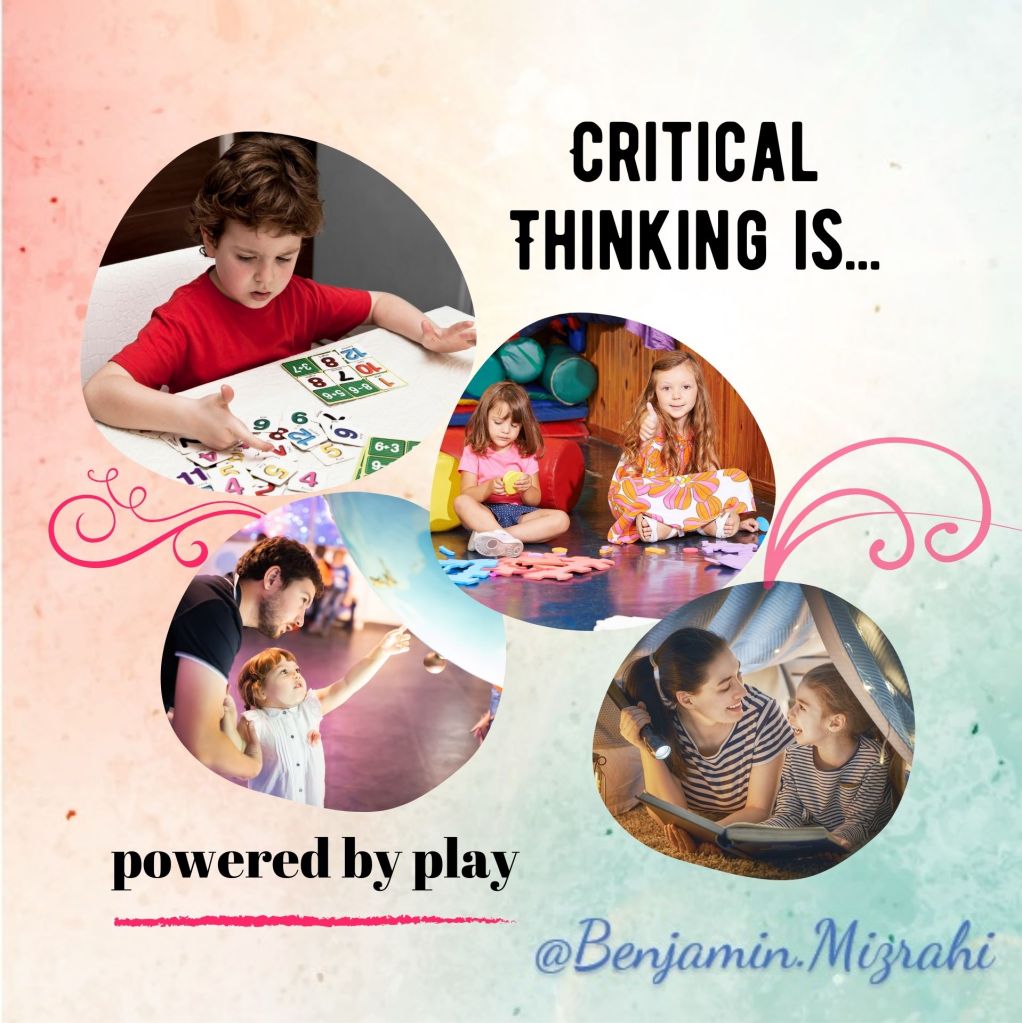
We use critical skills every single day to make good decisions, understand consequences of our actions, and solve problems. Now that technology has infiltrated our children’s lives, critical thinking skills are harder to achieve. However, our children still need to be able to think critically even with all the gadgets that they can rely on. If our children can’t think for themselves, how will they function in this complex world? We are all in big trouble if our children lose the ability to think critically.
It’s up to us to help them develop a critical mindset throughout their childhood. By instilling critical thinking skills from an early age, we will teach our kids how to effectively analyze the world around them. Here are some ways that you can enhance your children’s critical thinking skills at home.
🔹 Read books for fun
You can shift this pattern by reading with your children daily and discussing the material with them in ways that will challenge them to think critically. See if they can make connections between the story and their own life. Ask them to use what they have read so far to predict what will happen next. All this practice with fun stories will help them analyze more challenging pieces of literature, both fiction and non-fiction, as they get older.
🔹 Explore science
Science experiments and other related activities are fantastic ways to teach children how to think critically because they need to make predictions, evaluate data, and then interpret the scientific facts and findings to relate them to the world around them.
🔹 Show them how to answer their own questions and evaluate information
Take advantage of their curiosity to teach them how to look for answers to their questions in a critical way. Provide opportunities for them to speak to people who can provide them direct answers. For example, if they want to know what a fireman does, schedule a trip to the local fire station so your child can learn firsthand how everything works. When your children are doing research online, sit with them and help them find reliable sources.
Show them the difference between evidence-based information and opinions. Our goal is to give our children the critical thinking skills so that they can spot unreliable sources on their own. It is very important that they know how to question what they read and to evaluate its validity.
🔹 Build problem-solving skills
When dealing with conflicts, our children need to use critical thinking skills to understand the problem at hand and to come up with possible solutions. Use games, puzzles, riddles, mystery novels, physical challenges, and other activities to teach them problem solving skills.
🔹 Force them to memorize basic information
In order to exercise your kid’s memory muscle, you can go a bit retro on them. Make sure they know some basic facts by heart like their address and important phone numbers. As they get older, continue to add more facts to this list like relatives’ birthdays, math equations, and state capitals. Also, see if they can give directions from home to school and other places you frequent.
Coach Benjamin Mizrahi. Educator. Learning Specialist. Family Coach. Father. Husband.
Confidence is one of the greatest gifts a parent can give their child. As such, parenting has a clear impact on how children see themselves and build confidence.
When a child encounters hardship, parents should point out how enduring these challenges will increase his resilience. It’s important to remind your child that every road to success is filled with setbacks.
Praising your child is one of the ways by which his self-confidence is developed. However, overpraising him may not be good as it might lead either to an inflated view of one’s own capabilities or, equally possible, could lead to feelings of anxiety and inferiority. A child knows when the way he is being described does not reflect reality. It is a given fact that those with grandiose views of themselves, with high self-esteem that borders on narcissism, tend to be more aggressive when their egos are threatened.
The most important way to boost your child’s confidence and self-esteem is to honor his feelings. If a child does not get accurate feedback and that he only gets positive feedback, then, he can never improve in an area of performance. Your child must get honest feedback which is straightforward and allows for improvement where necessary.
Children need to live with people they love and who love them, people who have realistic expectations of them. This is what will boost a child’s self-esteem.
Coach Benjamin Mizrahi. Educator. Learning Specialist. Family Coach. Father. Husband.
We admit, it’s hard to see past a child’s behavior, especially when it comes to hitting.
When we are physically hit, it can trigger wounds from our past that remind us of unmet needs we may have had as children. We may not have gotten hit, but the physical force can make our bodies travel back into time to unconsciously remember painful memories.
A FEW IMPORTANT THINGS TO REMEMBER -Hitting is a developmental expectation for kids 1-5. -When a child hits, it means they are requiring your attention. -Hitting is not a personal attack on you. -You’re still a great parent if your child hits.
THE KEY TO STOPPING HITTING -Be very consistent and predictable with how you respond.
VALIDATE THEIR EMOTIONS OR THE NEED WE SEE “I see your body has a lot of wiggles it wants to express.”
TEACH THEM WHAT TO DO INSTEAD “Our hands are not for hitting. We use gentle hands when we touch people’s faces. Here, show me gentle hands, please.”
PRAISE THE GOOD “You did it! You just showed me gentle hands!”
There are so many ways to support our children during their hitting moments. We hope these ideas help you.
Coach Benjamin Mizrahi. Educator. Learning Specialist. Family Coach. Father. Husband.





 EXECUTIVE FUNCTIONS COACHING