Positive parenting is a journey that takes not only practice and patience but the ability to shift from a fixed mindset to a growth mindset.
A fixed mindset is about seeing the qualities of yourself, your child, and all the circumstances around us as unable to change. Whereas a growth mindset is believing that things can change with time, effort, and persistence.
And once you make that shift to a growth mindset, you’re able to expand your capacity to embrace challenges, to continue through obstacles, to learn from mistakes, to seek out inspiration and other successes instead of criticizing yourself for not measuring up. That’s what’s possible when we have a growth mindset inside of parenting.
So, when you’re in the heat of the moment and react in a negative way to your toddler’s behavior (like yelling or punishing), I invite you to be easy on yourself and understand that reacting that way doesn’t make you a bad parent. That it isn’t a permanent response to everything your child does in the future. That if you want to make a change, you CAN.
You always have the opportunity to repair a relationship by making amends.
Here’s how:
1. Take Ownership by saying, “I felt frustrated and yelled at you.” 2. Acknowledge the impact and say, “How was it for you? Got it. You felt sad when mommy yelled.” 3. Apologize then say, “I’m sorry that wasn’t my intention.” 4. Move forward by saying, “Next time, I’m going to step back and take 5 deep breaths.”
Avoid beating yourself up by remembering that you are human and allowed to make mistakes. Having a growth mindset can change your whole outlook and feelings about parenting a toddler.
Coach Benjamin Mizrahi. Educator. Learning Specialist. Family Coach. Father. Husband.
Play encourages creativity, increased dexterity, and physical, cognitive, and emotional strength!
Play can lead to feelings of confidence, competence, and resilience in children!
Play is POWERFUL.
For most people, learning involves acquiring a specific new skill, such as memorizing alphabets, counting, writing, etc. They often believe that playing is only for fun and involves no actual learning.
However, according to studies, playing is learning. Children learn through playing.
The importance of play in early childhood cannot be underestimated because playing is essential to a child’s growth.
Another added benefit of play is strengthened child-parent bonds! As a parent, consider joining your child in play. Allow your child to set the scene and take the lead – this gives you an opportunity to experience your child’s world and connect on a deeper level!
Coach Benjamin Mizrahi. Educator. Learning Specialist. Family Coach. Father. Husband.
Finding your kids in the thick of a physical altercation–punching, biting, slapping, or even worse was scary stuff for everyone involved–children and parents alike. But the truth is, this behavior is common, especially in younger children who don’t have more appropriate conflict resolution skills.
What can you do to reduce sibling fights? Model empathy, personal boundaries and healthy conflict resolution. Coach children during conflicts (when needed). Stepping out of a judge role and taking on a more neutral, facilitator role. Below are the five essential guidelines to stop sibling fights.
1. Step in and limit all behaviors that are hurtful. (You might need to physically stand in their way) Use calm and confident words.
It might sound like “I’m standing here, and I will not let you hurt each other.”
2. Take time to listen and validate feelings. Taking turns as needed to speak to each child and remembering that coaching role explained above. Think along the lines of “You two are having a hard time—I wonder what we can do,” instead of “He or she is the problem.”
3. Focus on understanding needs and boundaries. Avoid criticizing the behavior that was out of line. Children are quite aware that hitting and hurting a sibling is wrong.
4. Use respectful communication and discipline with the intent to teach. Focusing on solutions and agreements instead of punishments. This actively strengthens connection, a sense of cooperation, capability and well-being.
5. Don’t be afraid to suggest that everyone take some time to calm down. Stay by your children but don’t get into problem solving mode until tears have passed and everyone seems ready to listen.
Coach Benjamin Mizrahi. Educator. Learning Specialist. Family Coach. Father. Husband.
“Be mindful of the language you use to describe your children. They will come to see themselves through the filter you design.” – Lori Petro, TEACH Through Love
Words are powerful. Words are especially powerful when said by parents to their children. The words we use to describe our children become a part of their self-concept and their behavior is based on their self-concept. Our actions have deep roots on what we think and how we perceive self. Self-concept has a big influence on our behavior. Behavior pattern decides actions. Stable or unstable self-concept, it is a motivating force in a person’s behavior…It is important at this moment to connect the influence of the words we use to call little ones as ‘dumb’, ‘stupid’, etc. We just casually call and forget, but those words have big impact on little minds. Some school children study below their capacities because they have learned at home and from other members of friend circle to think themselves as dumb.
Children will have a much easier time valuing themselves if they are valued by their parents. Dorothy Briggs, the author of Your Child’s Self-Esteem, says that parents are like a mirror, creating the child’s self-image. We reflect to them who we think they are, and they take it in as the absolute truth. They are not critical of our evaluation of them until they get much older, when the damage is largely done.
The way we ‘frame’ a situation, or a person, heavily influences our interactions. If we consistently see our children as frustrating impediments in that would otherwise be a well-ordered life, then every interaction with our children will be marred by that default view. Such a view promotes a deficit-orientation towards a family. It reduces motivation on the part of parents to help their ‘good-for-nothing’, ‘bratty’, ‘ungrateful’ children. And unsurprisingly, such approach is hardly inspiring for children. They feed off the negativity of parental perception and typically live up to precisely what is expected of them…which is not much.
I understand we aren’t perfect parents, and sometimes something may slip off our tongues that we regret saying. In those instances, apologize and reaffirm to your child your love and belief in him. Positive parenting does not require us to be perfect, but it does require us to be mindful. Be mindful not only of the words you say, but of the thoughts you think. Reframe negative thoughts and purposefully look for and appreciate the positives in your children. Tell them how kind, capable, and wonderful you think they are. One of the greatest gifts you can give your child will never be found under the Christmas tree: A healthy self-concept.
Reflective listening is a skill I utilize during Play Therapy!
This skill involves focusing intently on the child and working to convey that you hear, understand, and care about what the child is communicating!
The concept is straight-forward and includes three easy steps. ‼️
1. Remove all distractions (i.e. phone, work, television, etc.).
2. As your child talks, look at them and listen closely.
3. “Reflect” back what your child shared with you.
Yes – it really is that simple! ⭐️
When we make the time to remove distractions and really listen to understand – instead of listening to respond – we help our children know that their experiences and emotions are valuable and important to us.
This creates strong parent-child bond and models healthy communication skills for the child!
Coach Benjamin Mizrahi. Educator. Learning Specialist. Family Coach. Father. Husband.
Something to remember is you should never force an apology from your child. By telling your child “Say you’re sorry,” there is no explanation for your child as to why their actions could have hurt someone. Or what they can do to change the way they acted.
This type of “sorry,” in particular when, it’s said with no feeling or a lack of sincerity, will stay with kids into their adult life.
Parents often urge children to immediately apologize. And although that is not out of bad intentions, it can be counterproductive. Other children see a lack of authenticity, and a child forced to apologize is learning to feign remorse.
What to do instead?
1) Modeling. If you are one to say “sorry” when you err, they will mimic you. Trust me on this one.
2) Pause. That’s right. Give kids a moment to volunteer a genuine response to a situation before you jump in two guns ablazin’. You may well discover that your children do say they are sorry, if given a moment to compose themselves.
3) Focus on the future: Instead of forcing them to say sorry about the past, which they can’t change, put the focus on their commitment to do something differently in the future. “Can you let your friend know that you won’t take his bike without asking again.”
4) Ask your child “what should happen now?” If they broke a neighbor’s window playing ball, letting the child think for themselves of how to right the situation helps build empathy, internalizes the lesson, and generates positive feelings about rectifying the situation. Replacing the window with their allowance and writing a letter stating it was an accident and promising to play in the park in the future feels restorative when they come up with the idea.
Coach Benjamin Mizrahi. Educator. Learning Specialist. Family Coach. Father. Husband.
When it comes to ADHD, you shouldn’t automatically assume that your child does not listen. They, in fact, might, though, it might appear that they don’t. Alternatively, they could hear and understand and decide to act defiantly instead of obeying. Ultimately, there could be several things going on. Let’s look at some of the most common possibilities.
🟣You don’t have their full attention
For a child with ADHD, their mind often jumps from one focus point to another. If nothing specifically grabs or demands their attention, their mind quickly moves to the next thing. To make your ADHD child listen, do everything you can to request and maintain their full attention.
🟣They don’t understand what you are saying and can’t process the information
Many children with ADHD might struggle with verbal commands because they do not learn best in an auditory setting. If processing is an issue, change your approach and possibly try to explain what you want through demonstration. You could also try to write out instructions or use pictures or drawings.
🟣They are being willfully defiant
In response to defiance, if you want to make your ADHD child listen better, you can try a few things. First, you may want to explain the consequences of their actions again. If they still choose not to obey, you should carry out the consequences. You can’t back down, though, or change the results from what you had said. By doing that, your child might believe they have won the encounter and choose to continue to be defiant in the future. Instead, you should do what you said and carry through on the consequences. Hopefully, they eventually will learn to obey to receive positive results instead of negative ones.
Secondly, if you find that negative consequences have little effect, you might consider seeking out professional help. Many individuals with ADHD also have Oppositional Defiant Disorder, or ODD. ODD is a separate disorder in which a child willfully and persistently opposes the authority of others. If you continually have concerns about your child’s defiance, this might be the underlying cause.
Making your ADHD child listen can be a difficult task. You don’t have to be alone in figuring it out, though. While it might take time, you can learn to communicate in ways to make your ADHD child listen.
Coach Benjamin Mizrahi. Educator. Learning Specialist. Family Coach. Father. Husband.
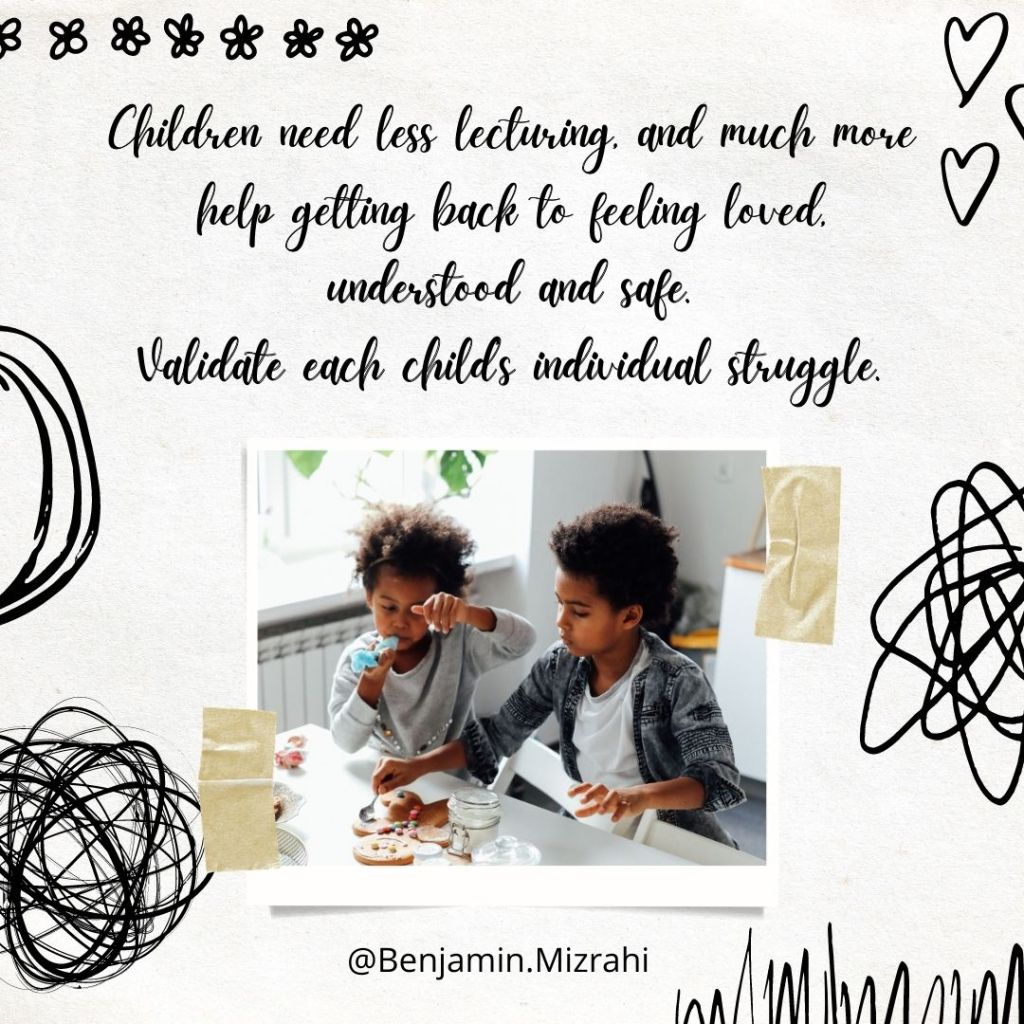
There isn’t a single piece of research that shows that rejecting, ignoring, dismissing, invalidating, resisting, ridiculing, punishing or attempting to shut down children’s emotions is good for them or for the parent-child relationship. There is, however, decades of research showing just the opposite: that when we accept our children’s feelings and help them organize their emotions by offering our presence, connection, nurturance, understanding, and guidance, they develop into more secure, confident, and socially and academically competent adults who tend to be able to better regulate their emotions and respond with sensitivity to others’ emotions.
For both kids and adults, having our emotions rejected or dismissed usually leads to the amplification of the intensity of emotion. In kids, “meltdowns” and “tantrums” (emotional dysregulation, stress, and overwhelm) are likely to be more intense and occur for longer when their emotions are rejected rather than accepted. Accepting your child’s emotion and responding with sensitivity, with presence, empathy, and nurturance, can help to soothe and contain your child’s emotion, and help them organize their emotional experience; this process is called ‘coregulation’ and is the foundation required for children to gradually learn to regulate their own emotions.
‘Oh, but what about when they are engaging in undesirable behavior?’, I hear you say. ‘Should I set limits when they are expressing their emotion in bad behaviors?’ Children can’t effectively or consistently regulate their behavior before they have learnt to effectively regulate their emotion…and let’s be real here, many adults haven’t mastered this skill. Your child is much more likely to be able to regulate their behavior (engage in healthy, adaptive behavior) when they can effectively regulate their emotions, and, for them to be able to regulate their emotions, they need to have their emotions accepted and supported by their caregivers— on this the research is clear.
Young children are inquisitive and curious, we all know that. This is because they are blank slates. The world is still an amazing place for them, and they want to know more about it, about everything.
In these formative years, children are limited in mobility and other sources of communication, as well as gaining information. So, they turn to the easiest way of gaining new information, listening.
Let us gain in-depth understanding of how listening is essential in the growth ages, years 1-5, of every child.
1. Listening Improves Concentration and Memory
Listening is one of the prime senses of our body. Although visual memories are stronger, our body also retains auditory memories or echoic memories. It helps stabilize the mind and improves concentration.
2. Improves Vocabulary
As children grow older, their need to speak and communicate grows rapidly. However, this development is strongly rooted in the initial phase of their childhood. During this phase, listening plays an important role in developing their vocabulary and language processing.
3. Adds Clarity to Communication and Thought
This allows them to express themselves more clearly and understand what they want. The ability to communicate clearly and understand the reason strengthens the bond between children and parents.
4. BuildsConfidence
One aspect of listening is that it builds confidence. While listening seems like an ordinary thing, most of us listen to reply than to understand.
Conscious listening decreases speech errors or response errors, thus improving confidence levels. Clarity of thought and concise, but perfect communication allows children to speak their mind.
5. Improves Relationships
Communication is the foundation for any relationship. Children with good vocabulary can speak openly with their adults. Their ability to understand reason helps parents to understand their children better as well.
6. Optimal Method for Growth
The most important factor of listening is that children between ages 2-4 have limited sources of gaining information and since they cannot read, they prefer listening.
7. Enables Experiential Thinking
One of the most important aspects of listening is that it triggers experiential learning.
Audio plays a primary role in the beginning growth in children. Long before visuals start taking effect, audio plays a key role in developing the early experiences of children.
Listening is a key-factor in children’s growth and empowers children in multiple ways to process information and interact with their surroundings better.
Coach Benjamin Mizrahi. Educator. Learning Specialist. Family Coach. Father. Husband.
Turning off the TV, leaving the playground, giving back the iPad, or ending a play date — any of these may provoke a tantrum. Why? Many children with autism and ADHD have difficulty moving from one task to another, especially when they must stop an enjoyable activity. Behavior intervention strategies can help smooth the transitions.
Define Expectations
Clearly identifying your objectives and setting attainable short- and long-term goals are the first steps to any behavior change plan.
Let’s take the LEGO example. The expectation may be: When the time comes to shift to another activity, my child will comply when he is asked, without resisting, crying, shouting, or throwing things.
Create a Schedule
A written or a visual schedule can help your child follow the order of events for a specific time period. But posting a schedule does not automatically mean your child will follow it. Checking off the events in a schedule should be accompanied by positive reinforcement.
Reinforcement
Once you have thought of possible reinforcers for your child (you can create a visual depicting the reinforcers for your child to see), try simultaneously presenting the reward as the transition time is occurring, before your child can resist. Besides offering tangible items, positive reinforcement should also include behavior-specific vocal praise.
If your child already starts to fuss when the announcement is made to start a new activity, don’t promise the reinforcer. It is very important that the engagement in a challenging behavior never results in receiving a pleasurable item or activity. Reinforcers should only follow desired behaviors. As transitions are consistently paired with reinforcement, the new desired behavior can become more of the “norm.”
Plan
Prepare in advance to reap the benefits from your intervention plans. Know how you will present the transition, what items or activities will be effective reinforcers to motivate a successful transition, and how you will respond if your child does not go along with the shift in activity.
Give Choices When Possible
Offer options to help your child with transitions. You might say, “Do you want me to help you clean up, or do you want to do it by yourself? It is almost time to leave for baseball practice,” “We are ready to finish TV time and have lunch.” It also helps to see things from your child’s perspective. If a game is just about to end, or there are three minutes left on his TV show, be flexible when possible.
When a parent’s emotion run high, the child’s emotion will, too. Demonstrate the behaviors you want your children to engage in. Urging a child to “Come on, hurry! We are going to be late,” can have a negative effect. Stay calm and steady.
Coach Benjamin Mizrahi. Educator. Learning Specialist. Family Coach. Father. Husband.
Words are a powerful thing. They can tear someone down. They can build someone up. And for children, hearing words of affirmation can literally affect their overall development and perception of who they are and who they will be. Whatever parenting style you follow, using positive words are much more likely to result in a positive outcome. Read on below for just a few things you can say to your little one today! And share this with a friend who might want to see it too! – I believe in you. You are important. What an amazing listener you are! You are such a kind person. I couldn’t have done this without you. I trust you. You are very brave. I love how you can make me laugh! I am impressed at how responsible you are. You are loved.
Coach Benjamin Mizrahi. Educator. Learning Specialist. Family Coach. Father. Husband.




 EXECUTIVE FUNCTIONS COACHING